The following information is from Alex K6VHF, DSES Senior Space Scientist and edited by Richard Hambly K0GD.
Before proceeding, thanks to the following people who contributed to this project:
- Larry Stewart N7LWS – for supplying all connectors
- Don Latham – for supplying Raspberry Pi 5 with SSD and case
- Floyd Glick WD0CUJ – for supplying aluminum box/enclosure
Data Collection and Processing Module (DCPM)
Deep Space Exploration Society (DSES)
Overview
The Data Collection and Processing Module (DCPM) is a specialized, high-performance computing system designed to collect, process, store, and analyze data directly at the antenna feed.
By moving computation to the source, the DCPM eliminates the limitations of traditional control-room PCs and enables powerful real-time scientific workflows.
Built for flexibility and field operation, the DCPM acts as a self-contained computer, data-storage platform, and signal-processing engine, supporting multiple receivers and complex mission-critical tasks.
Why the DCPM Is Needed
Traditional RF data collection requires long coaxial runs from the feed to indoor receivers and PCs. This approach introduces several issues:
- RF loss across long coax cables
- Single-device limitations — typically only one receiver can be used at a time
- High latency, since processing happens far from the antenna
- Complex wiring and control-room dependence
The DCPM solves these challenges by moving the entire processing chain right to the antenna feed, where the receivers are located.
How the DCPM Works
The DCPM integrates directly with SDRs and other receivers at the feed using high-speed USB 3.0 connections. This eliminates RF losses and allows high-bandwidth digital data to flow directly into the processing system.
Key Capabilities
- Simultaneous support for up to 3 receivers
- Direct data acquisition at the feed — no long coax runs
- Real-time processing and analysis
- Local storage for high-volume datasets
- Automated operations using custom scripts (Python, C++, C#, Java, etc.)
- Remote access via Ethernet or fiber optic
- Expandable — multiple DCPM units can be interconnected for additional SDRs or custom sensor modules
- Designed for harsh or remote environments
With processing occurring at the source, the DCPM significantly improves data fidelity, bandwidth, and system reliability.
Multi-OS Integration
A major strength of the DCPM is its ability to operate with both Linux and Windows environments simultaneously.
This allows:
- Running diverse scientific software and drivers
- Combining Linux-based signal-processing pipelines with Windows-only tools
- Greater flexibility for research workflows
- Rapid development of custom automation scripts
The result is a versatile platform that adapts to your project — not the other way around.
Practical Applications
The DCPM is suitable for a wide range of radio astronomy and deep-space research tasks, including:
- ARTEMIS-II mission support
- Detection and tracking of Deep Space Network (DSN) probes
- Hydrogen line data collection and processing
- Interferometry experiments
- Pulsar detection and timing
- EVE and EAE research programs
- Future DSES missions requiring high-bandwidth data capture
Because it is fundamentally a modular computing system, the DCPM can be adapted to virtually any RF or scientific data-collection need.
System Architecture
Below is a simplified diagram of the DCPM unit:

The total internal storage memory for DCPM is 640GB. You can use an external USB3.0 SSD up to 4TB of memory. The built-in DC-DC 5V capable to deliver up to 10A including external devices.
Since both PCs use a remote connections, there is no need to have screen or typing devices. The DCPM controls remotely via TCP/IP protocol with Remote Desktop. Both Linux OS and Windows OS accessed simultaneously.
RASPBERRY PI 5 Specifications:
Broadcom BCM2712 2.4GHz quad-core 64-bit Arm Cortex-A76 CPU, with cryptography extensions, 512KB per-core L2 caches and a 2MB shared L3 cache
VideoCore VII GPU, supporting OpenGL ES 3.1, Vulkan 1.2
Dual 4Kp60 HDMI® display output with HDR support
LPDDR4X-4267 SDRAM 16GB
2 × USB 3.0 ports, supporting simultaneous 5Gbps operation
2 × USB 2.0 ports
Gigabit Ethernet, with PoE+ support (requires separate PoE+ HAT)
2 × 4-lane MIPI camera/display transceivers
PCIe 2.0 x1 interface for fast peripherals (requires separate M.2 HAT or other adapter)
Raspberry Pi standard 40-pin header
Real-time clock (RTC), powered from an external battery
NUC BOX G5 specifications:
| CPU | Intel Alder Lake N97 (4C/4T, 6M Cache, 2.0GHz to 3.6GHz) |
| GPU | Intel UHD Graphics 1.2GHz |
| RAM | 12GB LPDDR5 4800 MT/s |
| ROM | 256GB M.2 2242 SATA (Max. 2TB) |
| Wireless LAN | WiFi 5(8821CE), Bluetooth 5.0, Ethernet 2.5G Giga LAN RJ45 |
| Video output | Dual Display Output, 2*HDMI 2.0 (4K@60Hz) |
| Power Adapter | 12V-3A Certification Input: 100-240V AC, 50/60Hz , Output: 12V/3A |
| lnterface | 3 x USB 3.2 Ports, 2 x HDMI Ports, 1 x RJ45 Ethernet LAN Port, 1 x 3.5mm Audio Port, 1 x DC Port |
DCPM Hardware
The DCPM size is 7″ x 4.5″ x 3.5″ and weight is 3lbs
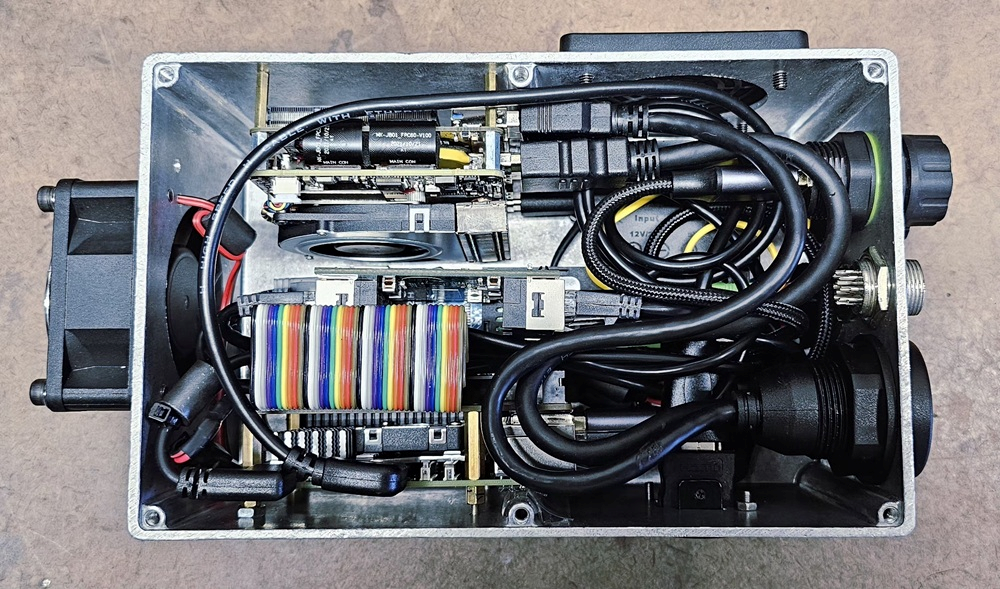
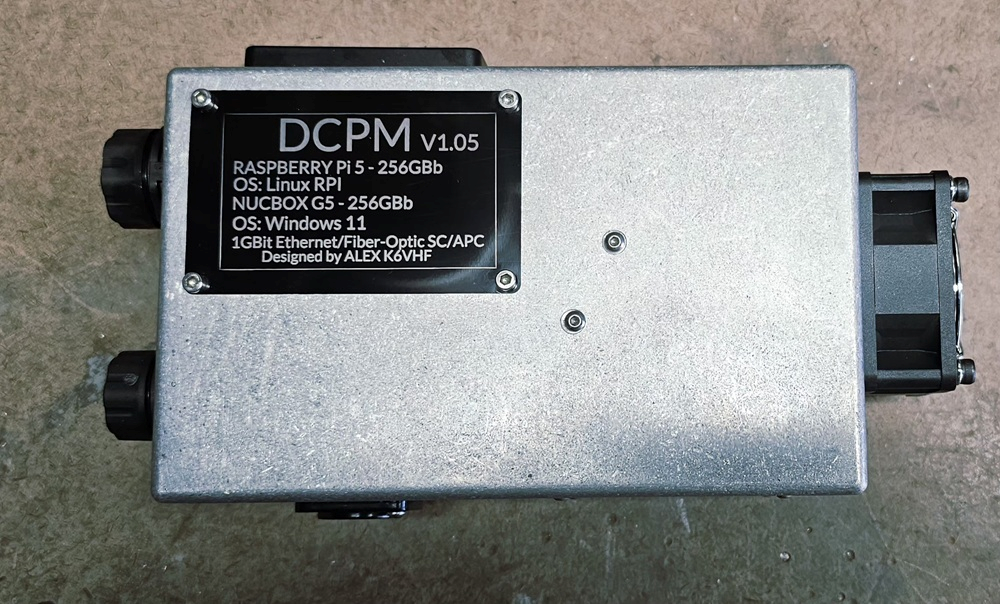
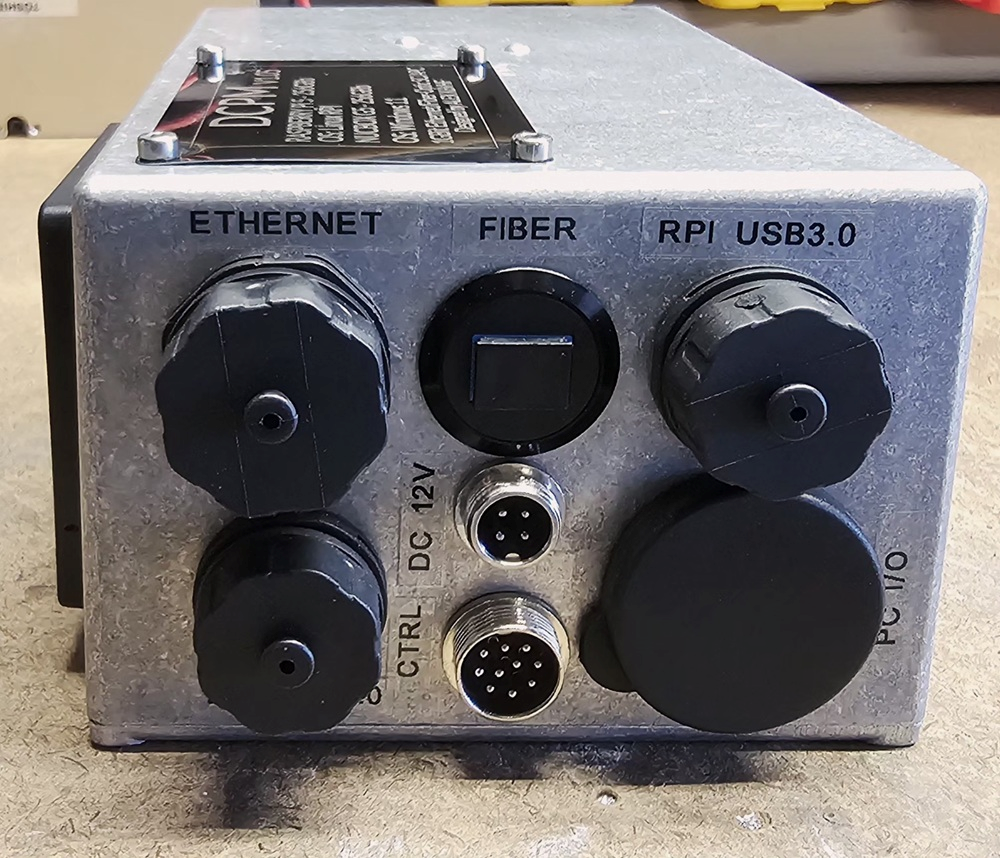
Examples of DCPM Use
1) Interferometer/Hydrogen/DSN/Pulsars reception/data collection and processing
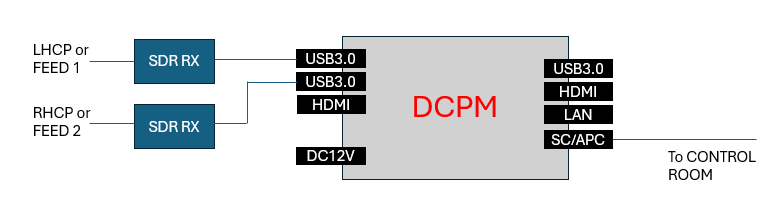
2) B210 applications/Pulsars reception/data collection and processing
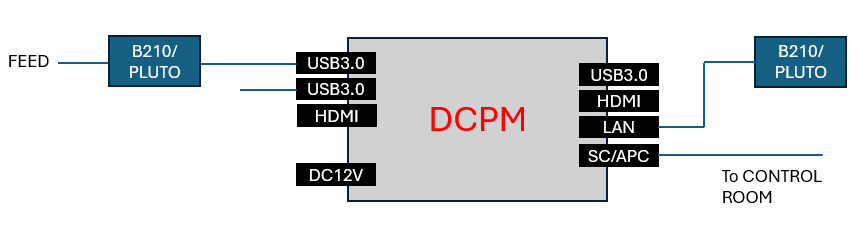
3) Example of expansion

4) if you need 4 RX SDR at same time using just one DCPM

Conclusion
The DCPM provides a powerful, flexible, and scalable approach to RF data acquisition and analysis. By processing signals directly at the feed and supporting multiple receivers and operating systems, it enables scientific capabilities that traditional PC-based setups cannot match.
For questions, collaboration ideas, or suggestions for improvements, please reach out.
Alex K6VHF
DSES Senior Space Scientist