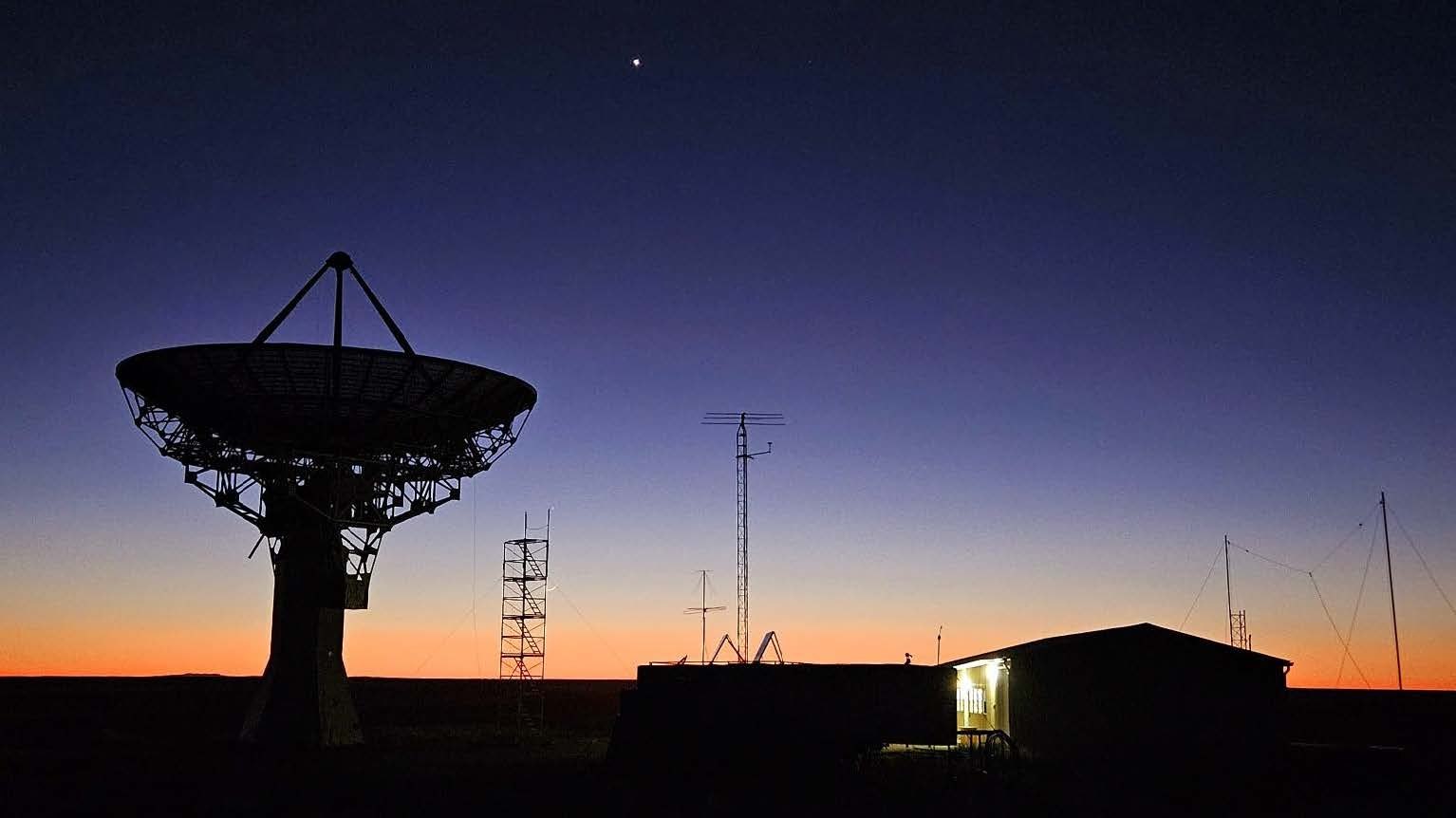
Through most of August 2026, our 60-foot dish at Haswell, Colorado sat motionless, pointed near the zenith, while the Earth’s rotation swept the sky through its beam. A small computer at the dish recorded a spectrum of the 21 cm hydrogen line around the clock, unattended — first a six-day wide-band survey, then, after a receiver upgrade, a deeper survey at twice the spectral resolution.
What came back was the structure of our own galaxy — and a telescope measured, from the sky itself, to a hundredth of a degree.

The run, by the numbers
- 26,000 spectra across the month — not one missing
- Hydrogen at 0.10 km/s velocity resolution, with the receiver’s own artifacts moved entirely out of the band
- The radio galaxy Cygnus A detected on all seventeen observing days, its transit time agreeing to ±2 seconds across three receiver setups
- Telescope beam measured at 0.69°, sensitivity about 4,000 Jy — using the sky itself as the ruler
- Dish pointing pinned to a hundredth of a degree: one fixed 0.15° offset remains, and the next campaign is designed to remove it
Watching the spiral arms
Hydrogen atoms throughout the galaxy broadcast at exactly 1420.4058 MHz. Because the gas orbits the galactic centre, the line reaches us Doppler-shifted — and the shift tells us how fast each cloud moves and, through the geometry of galactic rotation, roughly where it is. When the beam crossed the plane in Cygnus, the spectrum resolved into separate components: local gas near zero velocity, and gas in the outer spiral arms rushing toward us at 45 and 70 km/s.

A radio galaxy, every day at the same second
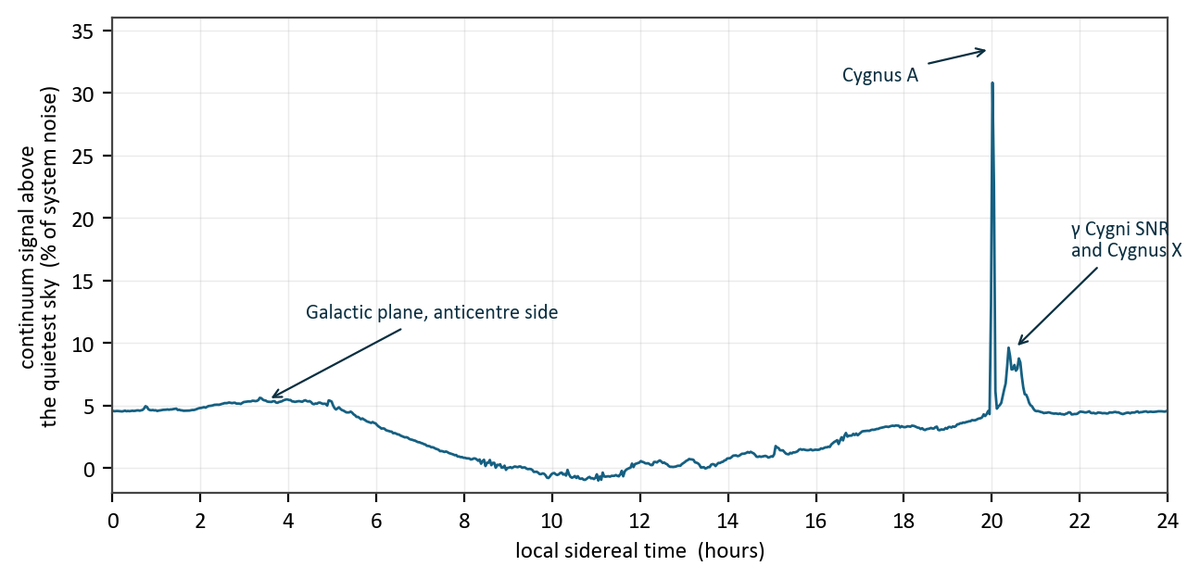
Averaging each spectrum away from the hydrogen line turns the same data into a continuum survey — a map of total radio power around the sky. One object dominates: Cygnus A, one of the strongest radio sources in the sky, powered by a supermassive black hole 600 million light-years away. It swept through our beam every sidereal day, at the same second, at the same strength.

The sky calibrates the telescope
Cygnus A is effectively a point source, so its transit measures the telescope itself: the width of the curve gives our beam (0.69°), its strength gives our sensitivity (about 4,000 Jy system equivalent flux density, measured directly by the September calibration move), and its timing checks the whole chain — clocks, software, mount — to the second. In August that chain closed: a maintenance team read the dish’s position encoders on-site, and the encoders and the sky now agree. The mount repositions to twenty arcseconds, and the one remaining unknown — a fixed 0.15° east-west boresight offset — is measured so precisely that the next campaign can be designed around removing it: stepping the dish across Cygnus A night by night to map the beam and pin the pointing for good.
September update: the mount, measured
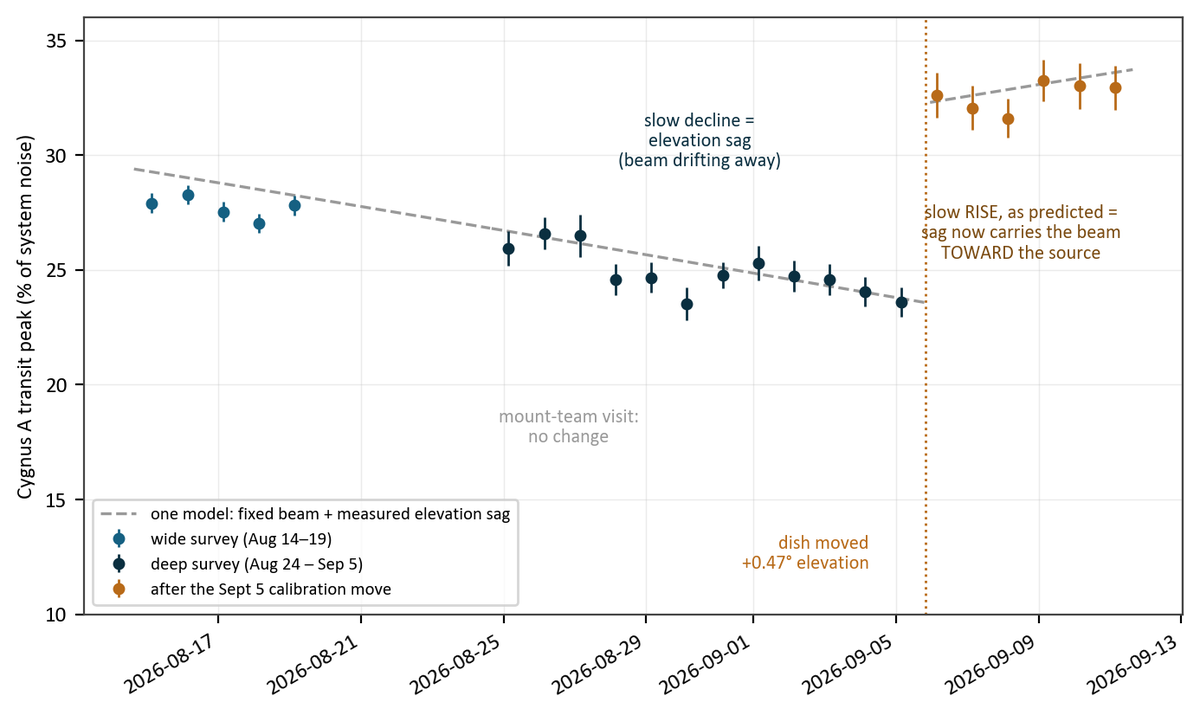
In early September the dish was deliberately moved half a degree in elevation to put Cygnus A at the center of the beam — the first step of the calibration campaign. That one move measured the telescope’s true sensitivity (about 4,000 Jy), revealed that the mount sags slowly in elevation — about 13 arcseconds per day, confirmed three independent ways, including a rise in the daily Cygnus A signal that was predicted before it was observed — and traced an apparent encoder offset to a stale mount calibration: the control system’s site coordinates proved correct — confirmed against a GPS receiver at the site — and a single +0.123° offset in the encoder-to-elevation conversion, the signature of a mount calibration not run in over a year, explains the sky, the encoder, and the control display at once. Every one of the campaign’s twenty-nine daily measurements fits a single model.
October update: the sensitivity, confirmed
The September revision ended with a prediction: parked at the corrected position, the Cygnus A transit should peak near 40% of system noise. Through late September and early October the dish delivered twenty-three consecutive daily transits without a single lost row — and walked straight up to that number. The beam started a tenth of a degree north of the source; the mount’s slow sag carried it onto Cygnus A at the encoder-measured 13 arcseconds per day, and fitting the whole series with just two free numbers lands the on-axis peak at 0.391 ± 0.004 of system noise — a directly measured sensitivity of about 4,000 Jy, closing the question the August report opened as a degeneracy.
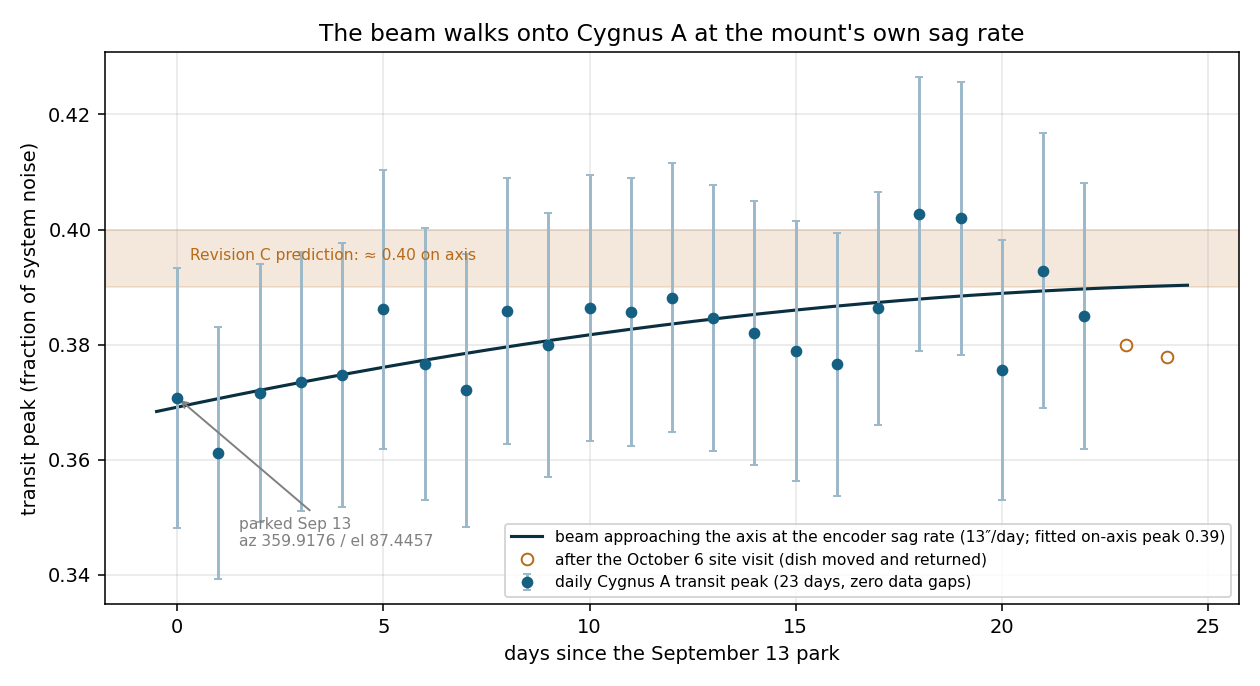
The same daily transits turn out to be a pointing monitor of remarkable sensitivity: when the October 6 site visit returned the dish with an azimuth error of about one arcminute on the sky, the next two transits arrived four seconds late and two percent low — exactly the signature that shift predicts. The quicklook analysis behind this monitoring now ships with the DSES Radio Astronomy Workbench as the Drift-Scan Review tool (since version 1.6.0), and it reads both Workbench and ezRA recordings.
A receiver that got better mid-campaign
Halfway through the month we upgraded the receiver configuration so that its self-generated artifacts land outside the science band entirely. The payoff is right at the heart of the measurement: the hydrogen line’s rest velocity, which previously had to be patched around an artifact, is now a clean measurement at 0.10 km/s per channel.

What’s next
The drift scan is paused through late October while the dish supports the Earth–Venus–Earth campaign; it resumes at the calibrated park. The first step of the pointing-calibration campaign is complete — Cygnus A dead on-axis, sensitivity confirmed — and the next steps are planned: stepping the beam across the sky’s calibrator sources to map it and remove the last fraction of a degree of pointing error, and a joint mount calibration on Cassiopeia A with the control-system team, for which this campaign’s numbers are the prediction. After that: longer hydrogen surveys, and — the same dish, the same receiver — pulsar observations.
How drift scanning works
A drift scan is radio astronomy at its simplest and most robust: park the telescope, let the Earth’s rotation do the scanning, and record continuously. Every object at the beam’s declination passes through once per sidereal day, so a fixed dish surveys a full ring of sky every 23 h 56 m — with perfectly repeatable geometry and no tracking errors. It is the oldest survey technique in radio astronomy, and it remains one of the best ways to characterize a telescope and its site.
Reports
- August 2026 Hydrogen Drift-Scan Campaign (Report 2, Revision D, October 2026) — the definitive analysis behind this page: both surveys, seventeen days of Cygnus A, the telescope’s true pointing, the calibration-campaign plan, the September addendum with the calibration-move results, and the October addendum confirming the sensitivity on-axis. Supersedes the Six-Day report.
- Lowering the Barrier to Radio Astronomy — DSES Science Meeting, September 28, 2026 (slides, PDF; video on YouTube): the Workbench 1.6.0 story built with its users — the Haswell drift scans, Ray’s and Rich’s home stations — and the EVE-26 modem.
- Status Report (6 December 2025)
- DSES-60 1420 MHz Early Study (21 November 2025)
Observations and analysis by DSES members using the DSES Radio Astronomy Workbench (formerly the DSES Spectrum Analyzer), our in-house open-source software — source on GitHub, releases at gpstime.com — running on a Raspberry Pi at the Haswell site. Page updated September 2026.