“Our second confirmed pulsar!”

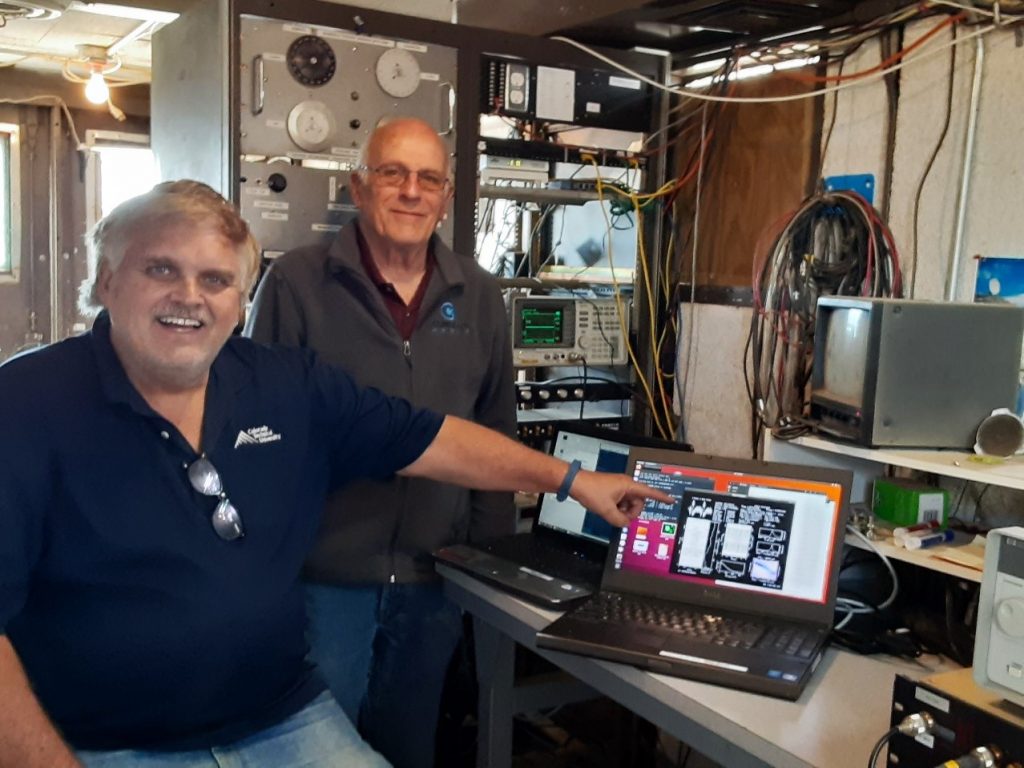
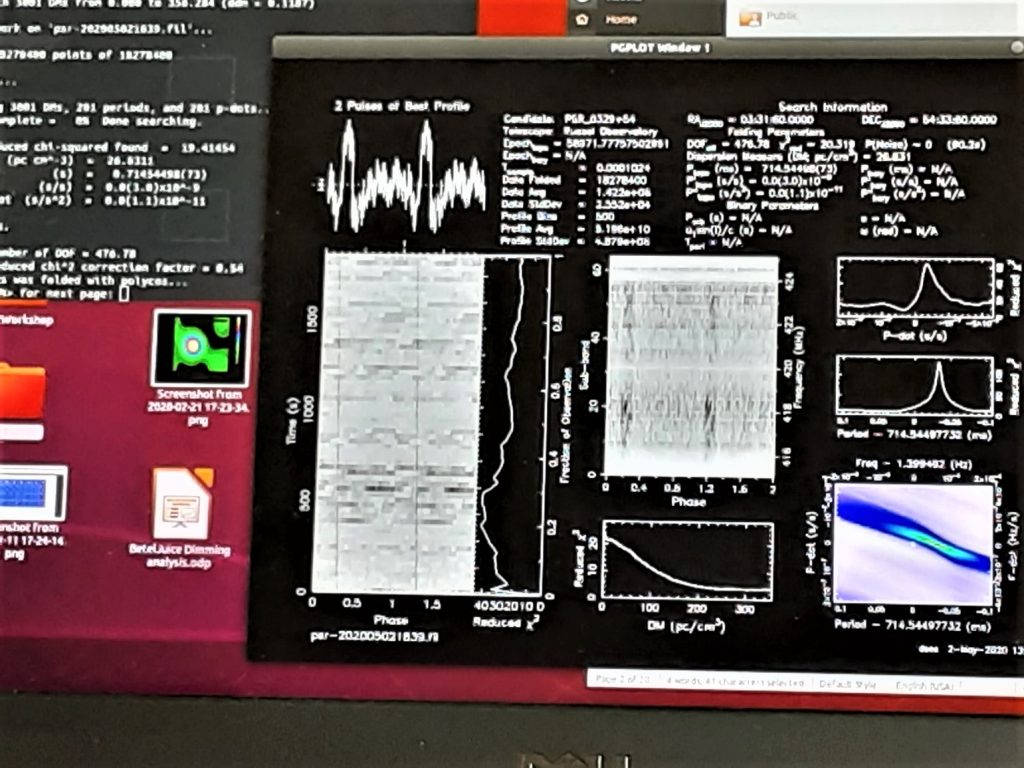
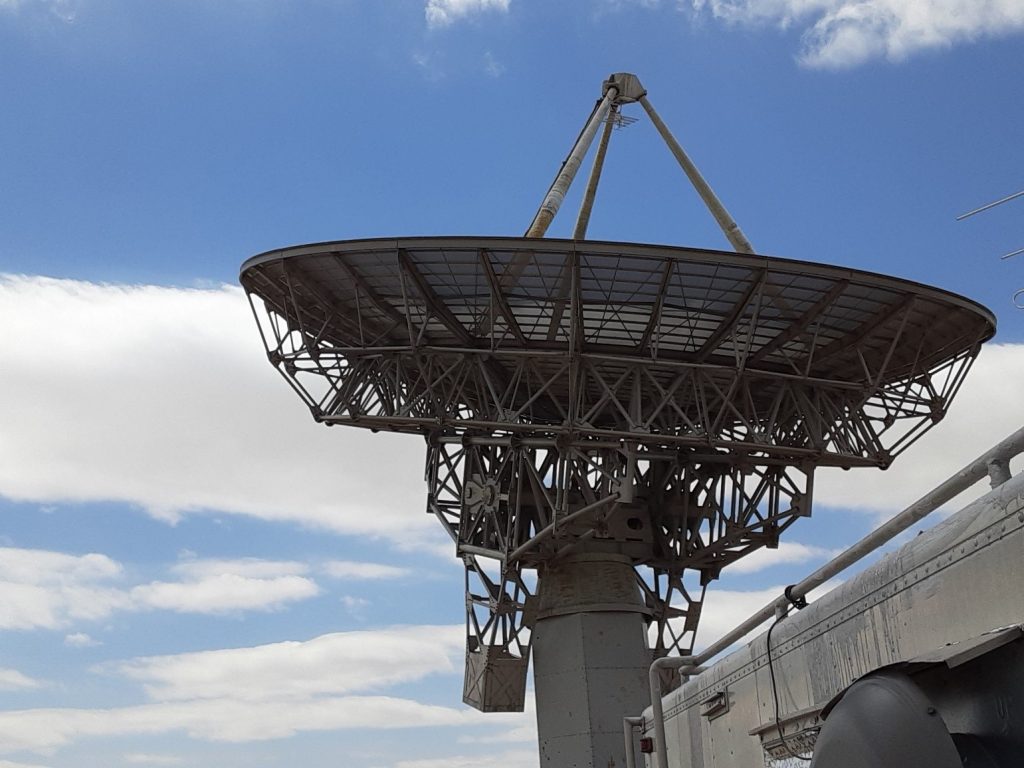
Rich Russel reports we observed our second confirmed pulsar, “We got B0950+08 today!!!!!!” The observing team was Rich Russel, Ray Uberecken, and Bob Haggart. The team did the observing and made the measurement at the Plishner radio telescope site with the 60-foot antenna yesterday on July 4, 2020. Congratulations to the team! And congratulations are due also to all of the DSES members who have been working hard to restore the 60-foot dish antenna and develop is capability as a working scientific tool! This is a long time coming.

A brief information entry about PSR B0950+08 in Wikipedia: https://en.wikipedia.org/wiki/PSR_B0950+08

Meanwhile, the report of our first pulsar observation on May 2nd, of pulsar, B0329+54 (J0332+5434), was just published in the May-June journal of the Society of Amateur Radio Astronomers: First Deep Space Exploration Society (DSES) Pulsar Captured on the 60-ft Dish

DSES Science Meeting June 22, 2020

2020-06-22 DSES Science Meeting
Notes by Bill Miller.
Science Presentation by Dr. Rich Russel.

Participants:

We had 19 participants in the virtual science meeting, a new record.

Dr. Rich Russel, Ray Uberecken, Myron Babcock, Don Latham, Bascombe Wilson, Ted Cline, Jon Richardson KU4PEH, Ed Corn, Storm Quant (Kevin Shoemaker), Jay Wilson, Glenn Davis, Gary Agranat, Dave Molter, Dave Schick, Bob Haggart, Jim Madsen K3ILC, Bob Sayers, Tony Bigbee, Bill Miller

Preliminaries: 

Plishner site trip summary of 6-20-20:

Ray Uberecken , Bob Haggart and Bill Miller went to the Plishner site on Sat. June 20.  See notes in Site trip report.

Covid-19 Policy:

Once again, we want to remind everyone to read our policy on Covid-19 on the webpage concerning meeting and going to the site.  In summary; If you have had the virus or have had symptoms or been closely exposed to a positive person you should let us know and self-isolate from the group and others for 14 days and not meet of go to the site.

SARA east conference

Rich is the SARA east conference coordinator. The August conference is virtual and is $20 to participate on Sat-Sun Aug 1st and 2nd.

Rich’s science presentation on Pulsar detection:

http://dses.science/wp-content/uploads/2020/06/DSES-Science-Meeting-6-22-20.pdf

Much of the discussion was focused on understanding our pulsar observation and on what we can do improve our ability.

Zoom Meeting Recording
Date: Jun 22, 2020 05:08 PM Mountain Time (US and Canada)
https://us02web.zoom.us/rec/share/5MlUEJfO0F5LXbPd2WvWeP4fRb-_eaa80SgYq6JYnhmJ9zhQ6vhRNDmHd4LZkX0- 

Password: 9x@t3pt*

Deep Space Exploration Society Science Meeting – May 25, 2020

Hosted online by Dr. Richard Russel.

The slides for the meeting are available here on PDF: http://dses.science/wp-content/uploads/2020/05/DSES-Science-Meeting-5-25-2020-r2.pdf

The link to the video of the meeting is at the end of this page.

*

Notes of the May 25, 2020 Science Meeting are by Bill Miller:

We had 12 participants in the virtual science meeting:

Dr. Rich Russel, Ray Uberecken, Myron Babcock, Ted Cline, Jon Richardson KU4PEH, Ed Corn, Gary Agranat, Bob Haggart, Jim Madsen K3ILC, Dave Molter, Bill Miller

Preliminaries: 

Rich thinks we need Internet service at the site for some of the experiments.

When Rich and Ray went down this last weekend the transformer at the gate had blown and they had to call in the power company to come fix it so didn’t get anything else done.   The power company came down, worked on it, and got it fixed.

Bill, we need to mention that everyone should read our policy on meeting and going to the site on the webpage.  If you have had the virus or have had symptoms or been exposed to a positive person you should self-isolate from the group and others for 14 days and not meet of go to the site.

Rich is the SARA east conference coordinator. The August conference is virtual and is $20 to participate. http://www.radio-astronomy.org/node/279

We were placed on the Neutron star group for the pulsar observation that Rich, Ray and Bob made several weeks ago. Rich thanks the rest of the group for all the hard work that got us to this point.

http://neutronstar.joataman.net/sites/dses/index.html

Rich’s presentation:

Rich gave his presentation on Pulsar B0329+54 observation, software setup and capture.

  • We had a lot of help from Steve Plock and Dr. Joe Martin (K5SO) to set up the SDR.
  • All the team members have put in a great deal of time and travel into the observatory to set up the feeds, cabling, power and control system to do this.
  • Ray, Bob and Rich were there for the first pulsar capture but everyone contributed.
  • Used the Ettus Research USRP N210 receiver.
  • Used a specially configured Laptop with a 1TB drive, Linux and Presto SW.
  • Used the GNU SW by Dr. Joe Martin (K5SO).

The Presto SW  builds a .FIL file with the data and time stamp.

Initial trial runs in Feb and May had the gain set too high and was saturating the receiver.

The first thing to check is the signal level of the feed and amps on a spectrum analyzer.

The site has a lot of RFI at 408 MHz right where we would like to observe so have to move up from this.

Ray added a 20dB preamp at the trailer end of the feed line.

Will move this preamp to the antenna end to compensate for the coax loss and reduce noise.

Single frequency RFI signals are filtered out by the SW.

The manual tracking works really well.

The tracking is run on the control Laptop and the Presto SW is run on the Linux Laptop.

The Initial  .FIL file gave a 2 pulse display after folding the signal from several hours of data.

The Presto SW is at    www.cv.nrao.edu/~sransom/presto

The SW needs input of a very accurate pulsar period.  The doppler error in the period due to the rotation of the earth and its orbital velocity  and position in orbit, also modifies the perceived pulsar period. Need to have the pulsar period set out to 4 or 5 decimals for the SW to fold/stack the signals to a usable observation.

The new SW takes the data, time tags it with the GPS data and creates the .FIL file.

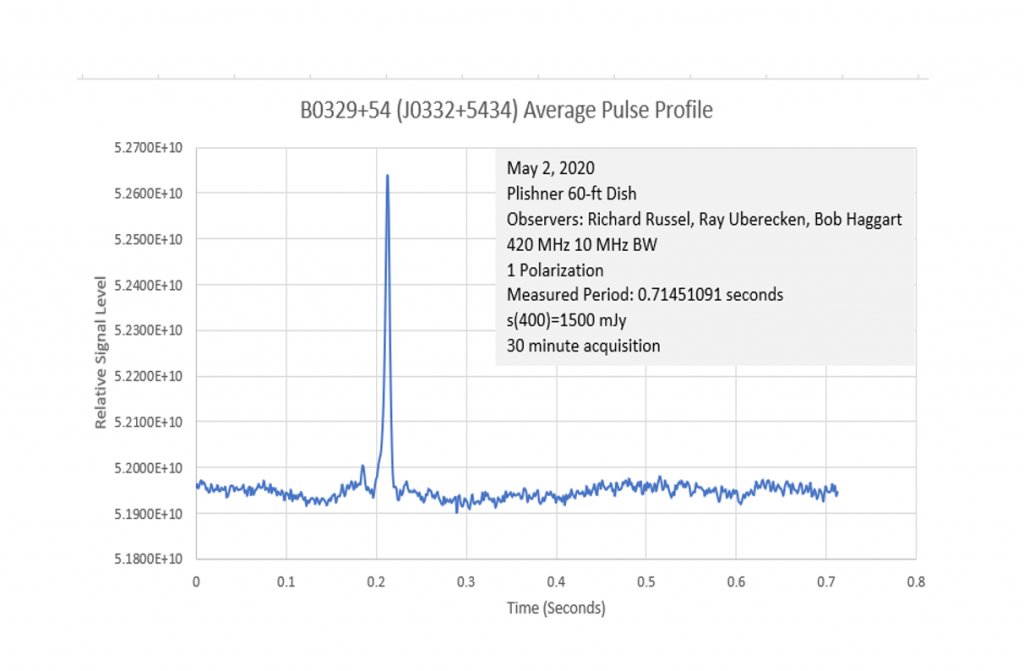
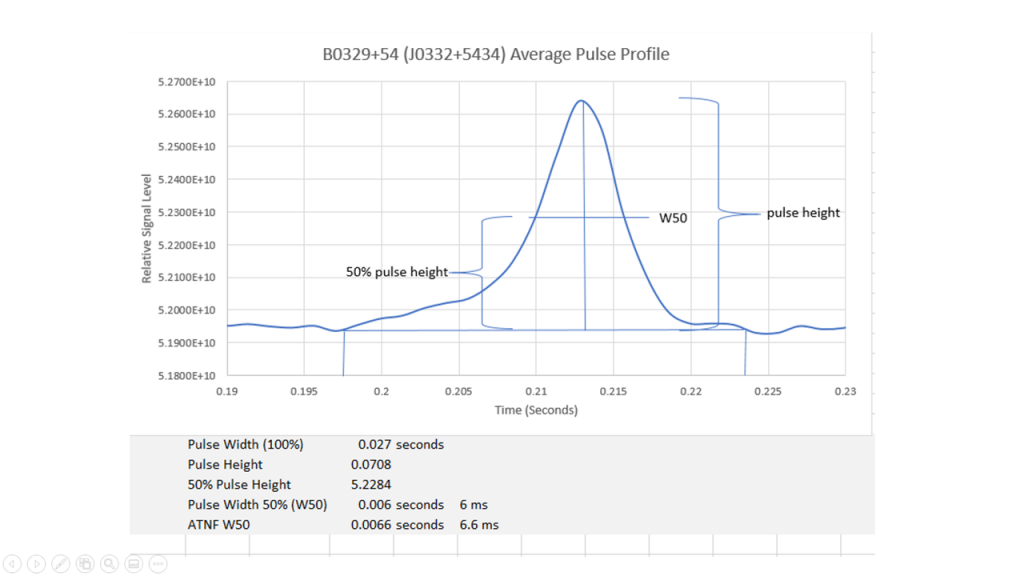
The data from the Presto program will give a signal strength vs time for a single pulse that can be plotted using excel.  This Pulsar has a W50, 50% of pulse height with width of 6.6 mSec

This pulsar is circumpolar so it can be acquired at any time of day.  We need to change the mount limits to better enable this tracking without having to stop and unwrap 360 degrees if near the stop.

Most of the other available pulsars are in the Milky Way and only visible at night at this time of year.

The Murmur SW http://i0naa.Altervista.org  is a good tool to find the pulsars

For low horizon pulsars with little access time, perhaps you could add the sample files from several days together to get more data and stacking strength to acquire the signal.

Scintillation is a problem that distorts the signal through the atmosphere so we need observations that are high in elevation and at the best times of day and night for atmospheric stability.

The next observing session is planned for coming Friday night or through Saturday.

We need to get at least 5 pulsars to get on the top of the neutron star list.

Jon asked,  “Where is the pulsar capability going?”

                Badge of honor and accomplishment.

                One of the difficult things we have the facility to do.

Finding a glitch in the pulsar.

There are guys that process pulsars daily and look for anomalies.

Ray has his new quick change feed on the dish.

We can do pulsars for several months and then do EME or can receive the beacon from the moon.

https://www.google.com/search?q=OE5JFL+beacon

With Rays quick change feed, we can switch back and forth.

We can do Skips SETI observations in between other work with simple change out of the feeds.

We need a group calendar or way to communicate on the web site to schedule site trips and who is going.  Need to find a way to do this.

The Zoom Meeting Recording can be found on my Drop Box link at:         

https://www.dropbox.com/sh/l949mj9o2084nhs/AACnrJNys-jzNa-mwzSfG4eka?dl=0&preview=2020-05-25+Science+Meeting.mp4

Please forgive the first 5 minutes of setting up Zoom.

May 11, 2020 DSES Engineering and Operations Meeting Notes

by Bill Miller 5/11/2020

We had 17 participants in the virtual engineering meeting today:  Most ever! Thanks everyone for joining.

Participants: Dr. Rich Russel, Ray Uberecken, Myron Babcock, Ted Cline, Bob Sayers, Jonathan Ayers, Xander Duvall, Tony Bigbee, Ed Corn, Gary Agranat, Skip Crilly Don Latham, Glenn Davis, Floyd Glick, Matt Mathews, Bob Haggart, Bill Miller

Agenda and notes:

  1. Check in. How is everyone doing with the stay at home/safer at home situation.  Is anyone experienced or known someone experiencing the virus? Anything we can do for them?
    • We have had one core member contract and recover from the virus that we know of.
    • We cancelled in person meetings in March and went to virtual meetings to protect members.
  2. Myron’s Treasure’s update:
    • Checking $2440.40 
    • Savings $5741.85
    • Upcoming Insurance $290 to $310 
    • Board to approve reimburse to Steve for New Mexico mileage to set up the Ettus pulsar receiver with Joe Martin.
    • Membership
      1. 30 Voting members including 5 lifers  and 12 nonvoting. Myron checking with others as yet unpaid.
  3. Pulsar detection congratulations to Team and further work from Rich Russel
    • On the attempt on Feb 15th,  the gains were set too high and saturating the Ettus Research SDR receiver. Need to tune this front end gain into proper range for the input of the SDR.
    • Last Week on May 2, B0329 +54 pulsar got it on the fourth try for a ½ hour run with manual tracking.
    • This week on May 9 , got the B0329 +54 pulsar on 420Mhz+/-5 Mhz. which is the  second brightest pulsar and tried three others and didn’t see them.  All the others were low in the horizon. Joe Martin took 12 hours to get one of them at his site but the DSES team didn’t get any of the others yet.
    • Would like to be able to do the Crab Nebula Pulsar.
  4. Additional engineering needed for pulsar work.
    • Automatic tracking
    • Intermittent a/b switches on the encoders is causing a problem. Rich wants to take them out. Bill says they are not inherently intermittent but dirty.  Ray said that exercising them solved the immediate problem but if taking them out will improve the process, Bill’s OKAY with that.
    • Pulsar software used is Presto. Scott Ransom in Charlottesville is author and Skip can connect you if having issues or feedback.
    • Tony sites “Murmur SW is a predictive program to help set up for Pulsar observation.
    • Ray added 20dB amp in the comm trailer.  Steve has a preamp with better noise figure that can be added at the feed.
    • Each pulsar will take a minimum of about an hour of collection time.
    • Steve and Paul Berge need to reset the electric azimuth drive stops so that the system will track the circumpolar pulsars continuously without wrapping back around. Currently can only go 15 degrees past north and need to be set up for 90 degrees from north.
    • Tropospheric observations need a different stop.
    • Ray says the pulsars observed lately are circumpolar, near the north star so need to be able to go to the 90 degree mark on either side.  Paul Berge could do the adjustment on the limit switches.
    • Manual tracking  is boring and automatic tracking would be better. 
  5. Ray: Feed work and change out capability
    • Ray has another 1420 MHz feed that we would like to try
    • Steve located his electronics box in the same spot where Ray was planning for his box so need to reconcile this positioning with Steve.
    • Ray has a 1296 MHz feed available to do moon bounce and tropospheric scatter work.
    • Ray has installed rotating swivel joints in the coax.
    • The coaxes pull up through the center when moving the elevation to the horizon.  Currently the coax swivels are only a few feet below the tube and one broke when moving the elevation to 90 degrees so Ray will mitigate that with some extra flexible coax.
    • Skip asks about the bandwidth of the 1420 MHz feed.  Skip used 1390 – 1460 Mhz and this is the same specification  of the preamp that Ray used.
  6. SETI project with Skip. 
    • Skip will not be able to go to Greenbank with travel restrictions but will be able to do observation from his New Hampshire observatory. 
    • Skip’s dish is running 24/7 with 6 computers. Doing a lot of post processing of the data he is collecting.
    • Skip says there is no real urgency for simultaneous observations because of this and not to risk anything for his sake at this time.
  7. Tracking System 1 update;
    • System 1. Lewis Putman completed the HW design and will connect with Jones plug in the back of the rack. 
    • The control SW is updated, and Glenn will do some testing and give it to Lewis.
    • Glenn will set up a design review with Lewis, Dave, Bill and Ray to discuss the electrical interface plans.
  8. Summer site work?
    • Bunker bunk room.
    • AC up to feed point needs conduit
    • Water heater in the
    • Two 30 Amp 240 volt outlets in generator shed.
    • Top door for the doghouse. Need steel 32 inch door.
  9. Ham radio
    • Looks good
    • Need some cross bolts in the Yagi beam.
    • Addition antennas?
  10. Eastern SARA August Conference, August 2-5, 2020 Green Bank Observatory WV.
  11. Open House? 
    • Need to wait till late June for a decision on announcement due to uncertainty of the virus situation.
    • Gary and Bill will check for best calendar dates considering the Moon, other events and Ham activities.

Open Floor

  1. Bob Haggart, 
    • The back door of the trailer opened up a little crack and allowed the dirt to blow in.
    • Sealed up the AC units and other openings but must clean out the dirt.
    • The back air conditioner needs replacing. Bill has one he will donate.
    • The Heater was removed to make room for the back workbench
    • Bob working on the battery room as a storage room.  The tower inverter power is running off the railroad batteries in the comm. trailer so Bill doesn’t see any reason to replace the old wet cell batteries in the battery shack and we should recycle them.
  2. Gary Agranat
    • Gary has an upcoming MIT class reunion that has been moved to a virtual reunion. 
    • He has been asked by the class committee to make a class presentation on the Plishner Observatory and what we are doing in a Ted talk format.
    • This will be a great networking and familiarization opportunity with the 1985 MIT class.

Bill recorded the meeting on Zoom. It is in two parts, due to a gap in Internet coverage:

  1. https://www.dropbox.com/sh/1ms0ngdjrrsehhk/AABn9w_NLjV8hEoB9VRas37_a/2020-05-11%20DSES%20Eng%20Meeting%20Zoom%20Part%201.mp4?dl=0
  2. https://www.dropbox.com/sh/1ms0ngdjrrsehhk/AADRvLawoJnZl4RlvW90N6Ora/2020-05-11%20DSES%20Eng%20Meeting%20Zoom%20Part%202.mp4?dl=0

New work area in the science trailer, built by Bob Haggart

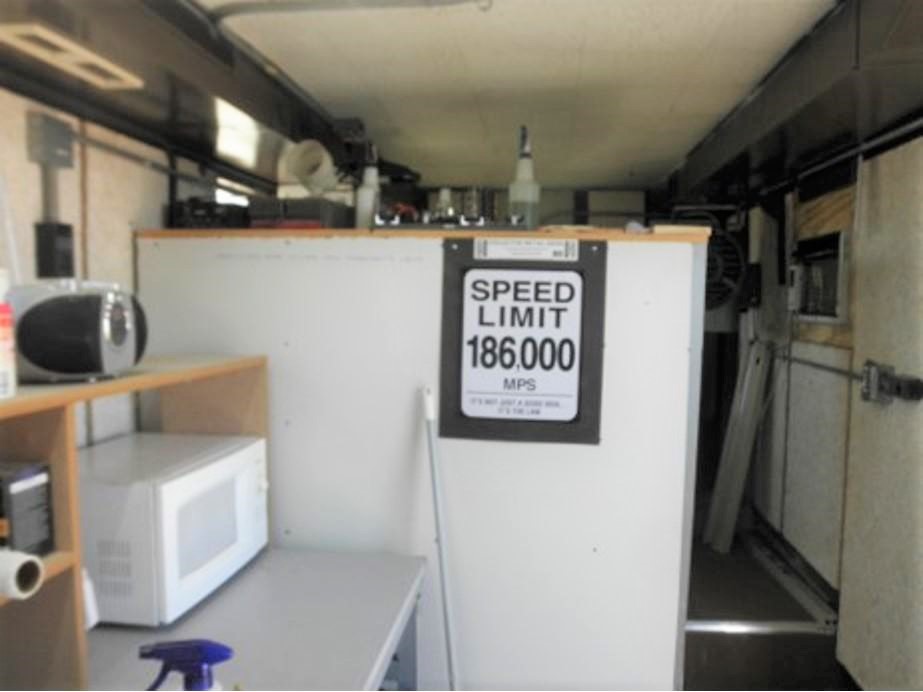
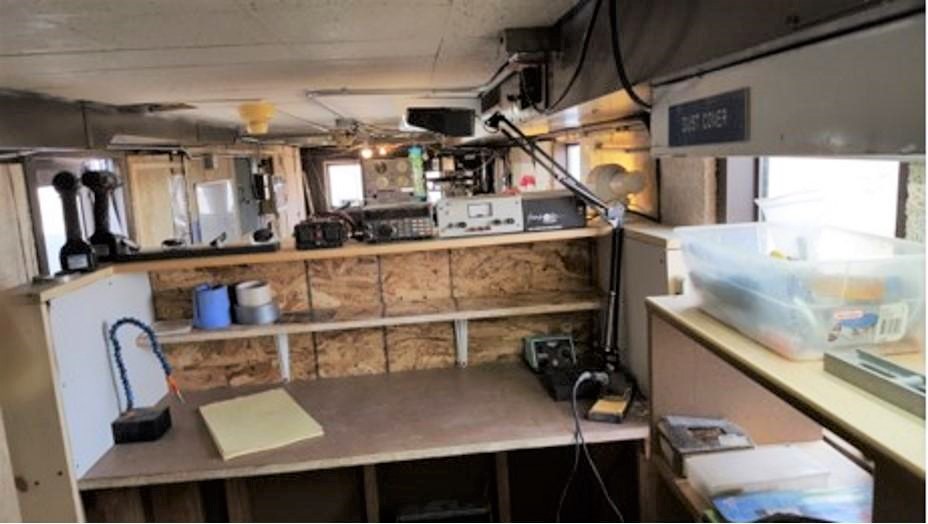
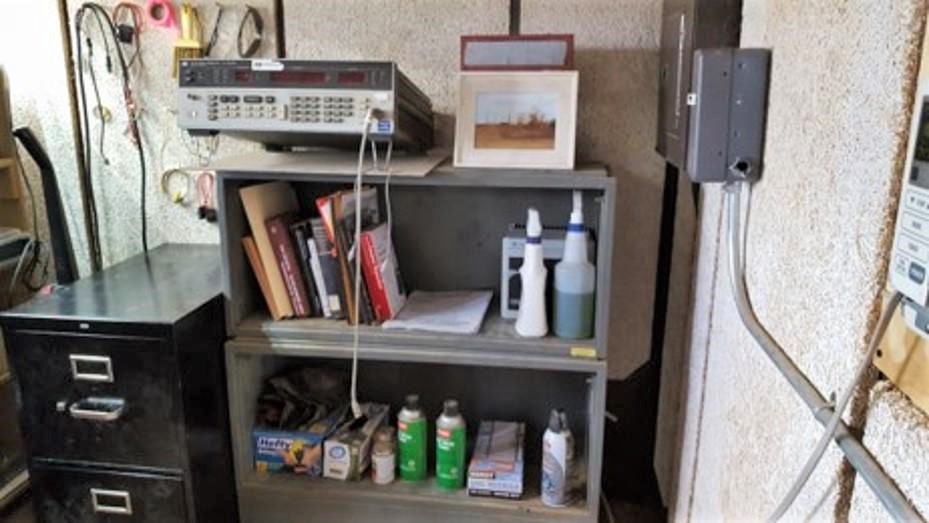
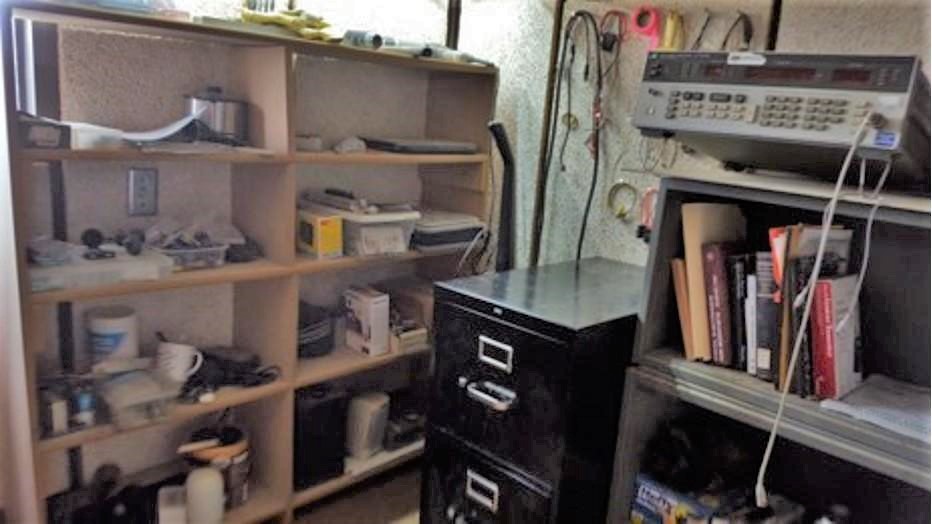
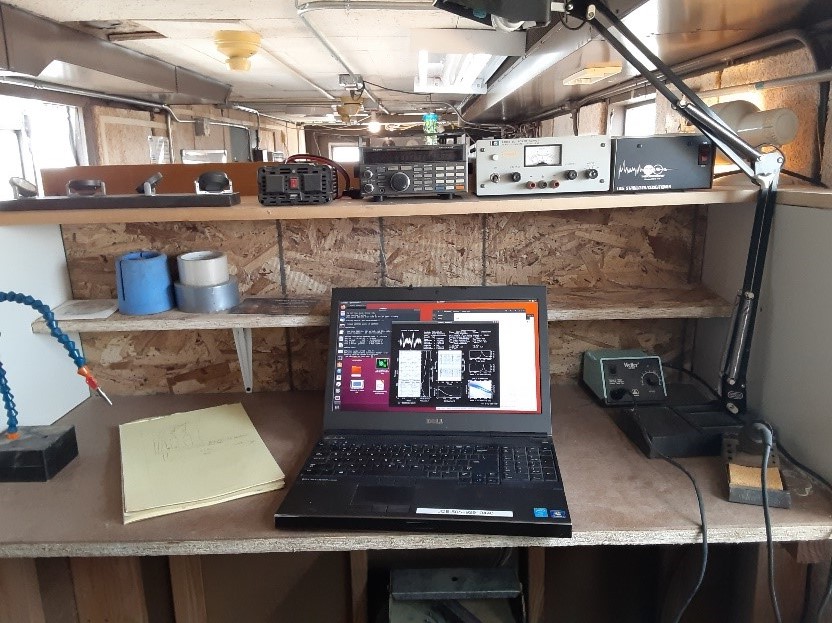
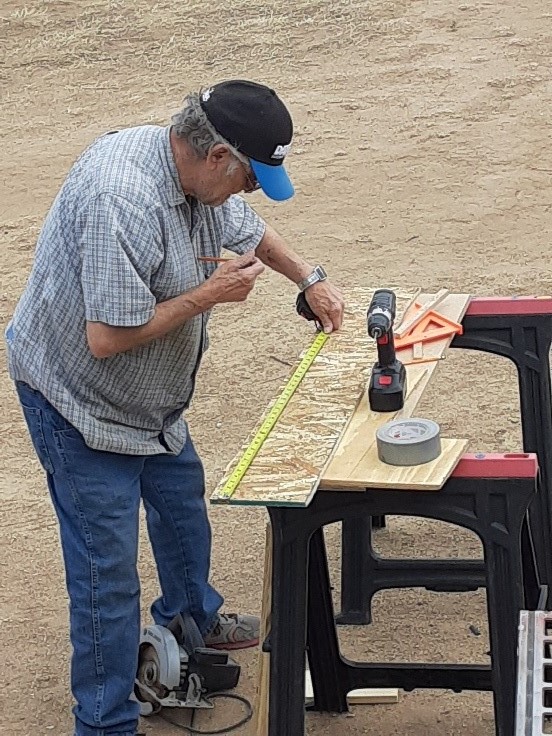
Bob Haggart (N0CTV) has been steadily improving the workspace of the science trailer at the Plishner radio telescope site. During the pulsar observation work on May 2, 2020, he completed building his latest enhancement: a partitioned work space at the east side of the science trailer. There is desktop space, which can be used for electronics building and testing. And there is additional shelf space, for better organization and storage.

Thank you Bob!

The new partitioned work area, seen from the middle of the science trailer.
New desktop workspace, with room for building and testing. There is also close access to test equipment, references, and technical documentation.
The work space in use during the pulsar observations on May 2, 2020.

First DSES Pulsar captured on the 60-ft dish by the observing team of Richard A. Russel, Ray Uberecken, Bob Haggart On May 2, 2020

By Dr. Richard Russel, DSES Science Lead.

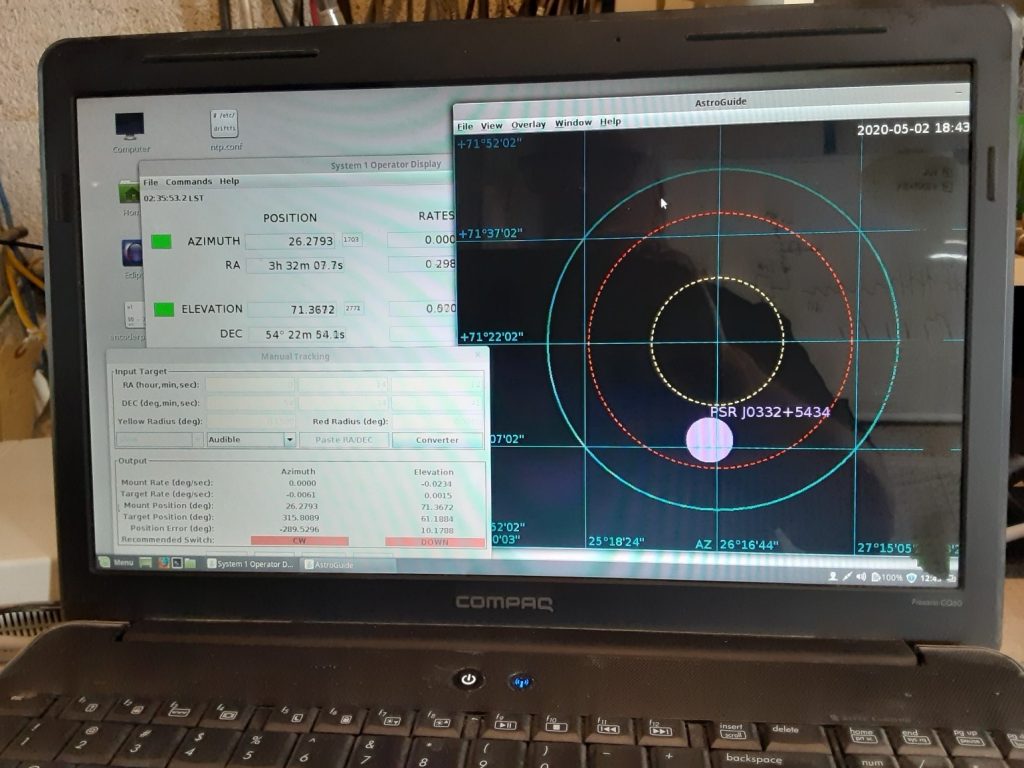
The pulsar, B0329+54 (J0332+5434)1, was observed on the third try just before the team was ready to pack up for the day on Saturday, May 2, 2020. A final modification of the software defined radio settings was tried (all the gains were set to a minimum) did the trick.

The 60-ft dish was setup to manually track the pulsar using the System 1 tracking program software developed by Glenn Davis and Phil Gage. This program allowed us to track the pulsar’s position by keeping it in the bullseye.

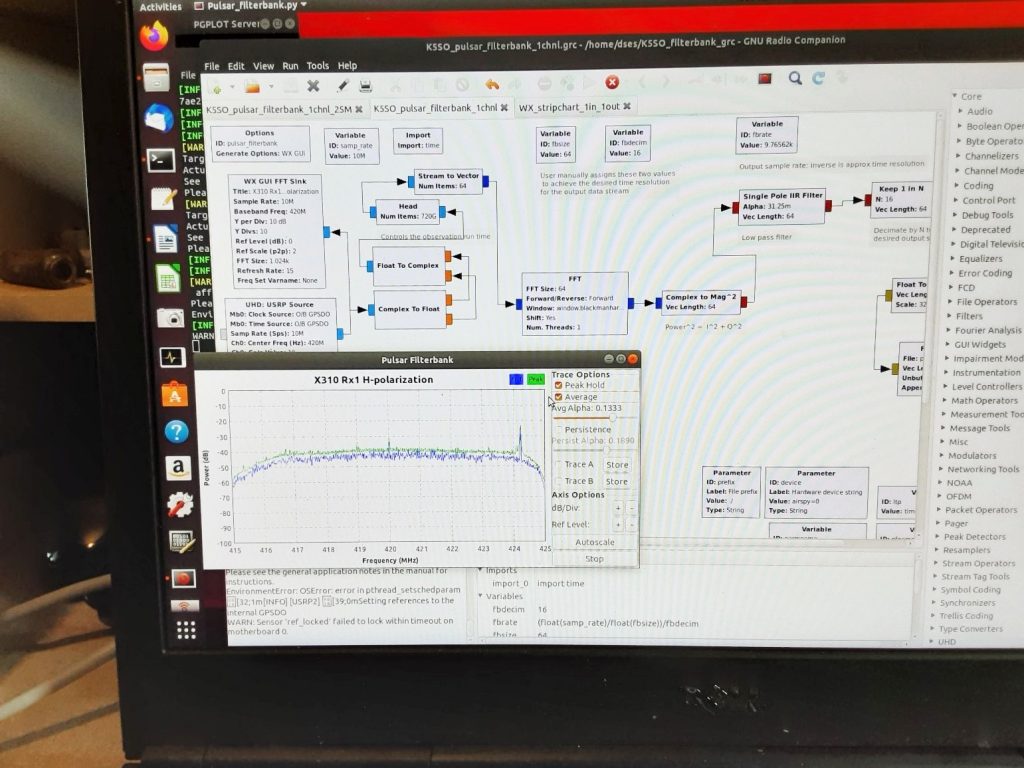
We observed at a frequency of 420 MHz, with a bandwidth of 10 MHz.

The pulsar system was initiated last year by Steve Plock. Our mentor throughout the effort has been Dr. Joe Martin (K5SO) in New Mexico. Joe validated that we made a successful pulsar capture.

A screen shot of a computer

Description automatically generated

The GNU radio software was turned on to start the acquisition.

A screen shot of a computer

Description automatically generated

It should be noted that you cannot tell if you have the pulsar real-time because it is pulsing way below the noise level. After about 30 minutes, we stopped the acquisition and we moved the post-processing over to Bob’s new workbench.

A picture containing person, outdoor, man, sitting

Description automatically generated
Bob Haggart constructing the new workbench.
A picture containing indoor, table, kitchen, counter

Description automatically generated
The new workbench in the science trailer, built by Bob Haggart.

Rich and Ray celebrate our first pulsar! (Bob’s taking the picture)

Two people standing in a kitchen

Description automatically generated

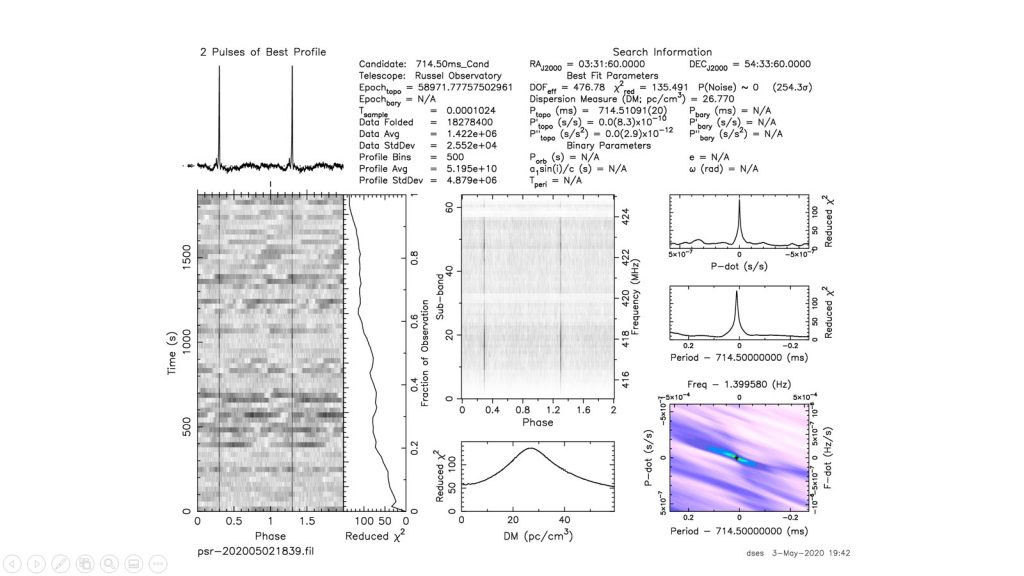
The first iteration of post -processing requires that the pulsar period be estimated with a program called TEMPO. The first iteration is shown below. It clearly shows a pulsar because of the prominent peaks and the lines tracing down the plots, however it is not quite set to the optimum period.

After some more iterations the final picture looked cleaner.

More analysis using the resultant data files allowed us to verify the pulsar as B0329+54 (J0332+5434).

Even the pulse width at the 50% height (W50) was estimated. The preliminary analysis below shows a measured W50 of 6 ms. The current value in the ATNF database is 6.6 ms. This is real close and confirms our observation.

More observation runs are planned and DSES can can consider itself one of the few amateur organizations to accomplish pulsar observations2.

A picture containing outdoor, clock, tower, water

Description automatically generated

Reference:

  1. PSR B0329+54 is a pulsar approximately 3,460 light-years away in the constellation of Camelopardalis. It completes one rotation every 0.71452 seconds and is approximately 5 million years old.[Ref: wikipedia]
  2. Our successful observation is reported in Neutron Star Group http://neutronstar.joataman.net/

DSES Science Meeting, April 27, 2020

Meeting notes by Bill Miller, April 29, 2020.

We had 13 participants in the virtual science meeting:

Dr. Rich Russel, Ray Uberecken, Myron Babcock, Ted Cline, Bob Sayers, Jon Richardson, Jonathan Ayers, John R Kucypeh (sp), Xander Duvall, Tony Bigbee, Ed Corn, Gary Agranat, Bill Miller.

Ray gave a discussion of feed system modifications and plans fix the feed to enable Pulsar work.

Bill said we have to hold a virtual board meeting and elect officers from the board.  We also need to call the annual all members meeting.

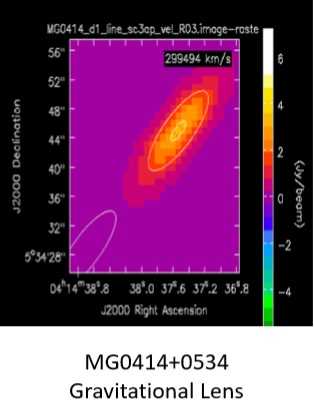
Rich gave a presentation with slides (see below) on reduction and graphing of data sets from the  national observatories and Pulsar observations. He also discussed the data from his 9 foot dish and about how to understand the Hubble Galaxy and object classification nomenclature, such as MG0424+0435  where 0424 in the right ascension and +0435 is the declination.  He also discussed the gravitational lensing effect given by the gravity well of a foreground object bending the light  and radio emissions of a background object around it.  Prime examples of this are;  https://www.eso.org/public/images/eso9856f/ and https://en.wikipedia.org/wiki/Einstein_Cross  the Einstein Cross.  Rich gave data and discussion of the Betelgeuse dimming phenomenon and whether this may be preamble to the star going supernova.  While a supernova may be preceded by a few hours by an early warning detector of Neutrinos as Gary has outlined, it is unlikely that this is the cause of the dimming and Rich gave a discussion of his theory and simulation of a passing object shading Betelgeuse.

Xander Duval was in attendance and said that he had been invited to go to the state science fair when others dropped out.  At the Fair he won an award from Nasa on earth science systems and submitted his research paper to the Junior Humanities and Science symposium and scored another award in physical sciences there. We are happy that this worked out well and hope to help him with future work.

Bob Sayers has a 4 ft PVC Mag Loop antenna that he would like to give away.  This can be configured for use with a SuperSID setup.

Rich said that it can be used as part of the Astronomy League’s Silver/Gold certification for radio astronomy.  You need 5 projects, 2 of which you need to build yourself. Available projects are:

  1. SuperSID Monitor
  2. Radio Jupiter or Radio Jove
  3. Neutral Hydrogen (Hi) Measurement
  4. Meteor Scatter
  5. Itty-bitty Telescope

Jonathan Ayers has a paper up on the SARA Western Conference Proceedings.  Gary Agranat says check it out at http://dses.science/wp-content/uploads/2020/04/MitigateRFIinSCDriftScanDataPython.pdf [Python Program for Mitigating Radio Frequency Interference Observed in SpectraCyber Receiver Drift Scan Data Files, by J. Ayres]

Here is a drop box link to the meeting recording missing the first 10 minutes before I logged in.

https://www.dropbox.com/sh/2pqscwj7txr7d5p/AADq0yNlG2KI3ZZDE8lqfxEta?dl=0

These are the slides from our DSES Science Meeting, Monday evening April 27, 2020. Presented by Dr. Rich Russel. In PDF format.

DSES Science Meeting, April 27, 2020

System 1 antenna control system update April 13, 2020

By Glenn Davis

I thought I would put out a System 1 status, so you can see what we’ve been working on the past couple of months.  To quickly summarize:  Lewis Putnam has been concentrating on the System 1 hardware design (Please see the hardware diagram below) to support automatic tracking of the Haswell Mount.  Additionally he has been looking at the individual mount axis characteristics to see how well they can support sidereal tracking (See detail text below). 

Phil Gage has supported myself looking at an Elevation axis movement issue we had seen at the site.  We found a loose cable on our March 1 trip which appeared to be causing the elevation axis issues.  Additionally, Phil has been working on the hardware/software interface for the Labjack hardware (Please see the hardware diagram below).  The Labjack hardware, the U3 and JTick-DAC components, will be used to control the mount axis rates.

I have been updating the System 1 Hardware Simulator to support the Numato Relay Board and Labjack U3/JTick-DAC hardware devices.  Additionally, I’ve been working on the hardware/software interface to the Numato Relay board.  This device will be used to enable the drive controllers and control the direction of the Elevation Axis.  Using the work completed by Phil and the Simulator modifications, I’ve been able to test and debug most of the automatic tracking software modifications and simulate the System 1 tracking celestial objects over large periods of time (hours).    

Here is a more detail summary of the past work and future work on the System 1 team (Before site modifications are performed, we will present our design work to the DSES Engineering Team):

March 12 2020 Trip

  • Purpose: Determine relationship between Az / El drive command voltages and rate resulting from command voltages
  • Approach:
    • Made measurements to calibrate mount Az and El drives (Rate as function of applied voltage)
    • Took measurements separately for Azimuth and Elevation
    • Measured both CW and CCW rates for Az and Up/Down rates for Elevation 
    • Varied voltage via Trailer Control Panel Az and El rate potentiometers from 0 to 5 volts (.2-volt increments for voltages below a volt and 1-volt increments from 1 volt to 5 volts.)
    • Logged axis position data in System 1 software
    • Captured measurements in Excel spreadsheet and plotted
  • Findings:
    • Plotted results indicate linear relationship between voltage and rate for both positive and negative rates for both axes.
    • Performed linear fit to determine slope and intercept values that can be used to convert an axis rate into a command voltage.
    • Unique Slope and intercept parameters will be used in System 1 software
    • Slowest drive rates are .02 deg/sec for Az and .06 deg/sec for Elevation; lowest rates were consistent between positive and negative rates
      • Rates needed for sidereal track are about an order of magnitude lower
      • Will have to cycle axis drives on / off to achieve sidereal track rates
    • Elevation Potentiometer voltage will not go to zero
      • Lowest voltage is somewhat less than .2 volts
      • Cause is unknown but potentiometer is most likely candidate
    • Measurements for Elevation similar to results from August 2019 but measurements for Az significantly different from August results, unknown cause
    • Measurements in March were more extensive and disciplined. Will use calibration from these measurements in the implementation of the software.

System 1 Mount Drive Interface Hardware Design/Implementation

  • Progress:
    • Completed hardware circuit design
      • Interfaces to the tower drive electronics via the Jones Plug
      • Uses a Labjack U3 device / TickDAC that provides two +-10-volt Digital Analog Convertors to enable setting Az / El axes control voltages
        • Labjack has necessary digital I/O to interface to the axes encoders so downstream can be used to replace the now obsolete Integrity Systems digital I/O board
      • Uses Numato 8 Relay Board to enable the drive controllers and control direction in the Elevation Axis
    • Developed an approach to integrating circuit into the trailer rack
      • Mount components on a small rack shelf about 6” deep
      • Mount shelf on back rails of the Trailer Rack
      • Move Jones cable from Manual control panel to System 1 Drive Control when using System 1 for drive control
    • Acquired major components and some minor components – Numato 8 Relay Board, Labjack interface device, Jones plug and wire
  • Next Steps:
    • Colorado Springs
      • Acquire remaining additional components – Switch, LEDs, resistors, rack shelf/panel
      • Mount components on rack shelf and wire components together
      • Integrate / test software with drive control assembly
    • Site
      • Install rack shelf / panel
      • Install updated software
      • Test / debug automated drive control

Please pass this on to other individuals who may be interested.

Thank you.
Glenn Davis

Synchronized Multiple Radio Telescope Microwave SETI

This paper is an updated presentation by Skip Crilly K7ETI about the continuing SETI observation results we’re doing together. The DSES 60-foot dish antenna in Haswell and the 40-foot dish antenna at the Greenbank Observatory in West Virginia have been making simultaneous observations for SETI (Search for Extraterrestrial Intelligence) since November 2017. A third antenna in New Hampshire was added for taking data in December 2019. Simultaneous observing by sites distant from each other helps filter out local radio frequency interference (RFI). Signals observed at each site can then more confidently be identified as non-Earth in origin. This presentation summarizes the results, with additional data from February and March 2020.

The paper is available as a PDF file. Please click to read. Synchronized Multiple Radio Telescope Microwave SETI, by Skip Crilly [HamSCI 2020, March 2020]

This updates the previous presentation of February 2, 2020.