Dan Layne presented a list of science projects planned for 2024.
The presentation slides: January 2024 Science Meeting
Video of the presentation: January 2024 Science Presentation
Deep Space Exploration Society
Colorado — Radio Astronomy at the Speed of Light
Dan Layne presented a list of science projects planned for 2024.
The presentation slides: January 2024 Science Meeting
Video of the presentation: January 2024 Science Presentation
Bill Miller has provided the following report on Plishner site visits from Dec 2023 to Feb 2024. In this report he covers recent work on the new building as well as work performed on other site visits.
Read the report here: Dec, Jan, Feb trips to the Plishner Radio Site
By Bill Miller and Paul Sobon
Every year the DSES holds an open house public event, where we provide tours of the facility and demonstrate what radio astronomy and Amateur radio are all about. This year, on September 16 we demonstrated EME (Earth Moon Earth) or moon bounce communication allowing folks to bounce their voice or radio signal off the moon using our 60 Ft radio dish antenna. This is a rare opportunity and thrill for children and adults alike, to hear their voice echo off the moon, traveling about 240,000 miles to the moon and back at the speed of light,186,000 miles per second. The echo returns in about two and a half seconds. Only a few private stations in the world can accomplish this because it takes a very large antenna and powerful transmitter for voice transmission to echo off the moon. In addition to hearing our own echoes, the EME station was able to contact other stations in Canada, Italy, England, and Germany as well as many other ham operators in the USA. We also gave tours of the new building and underground facilities and did solar and nighttime observations with optical telescopes. An astronomy presentation on Pulsars was held during the event. Throughout the day, we got a lot of great questions from the public about the site, and what we do there. There were about 75 people who attended the event.
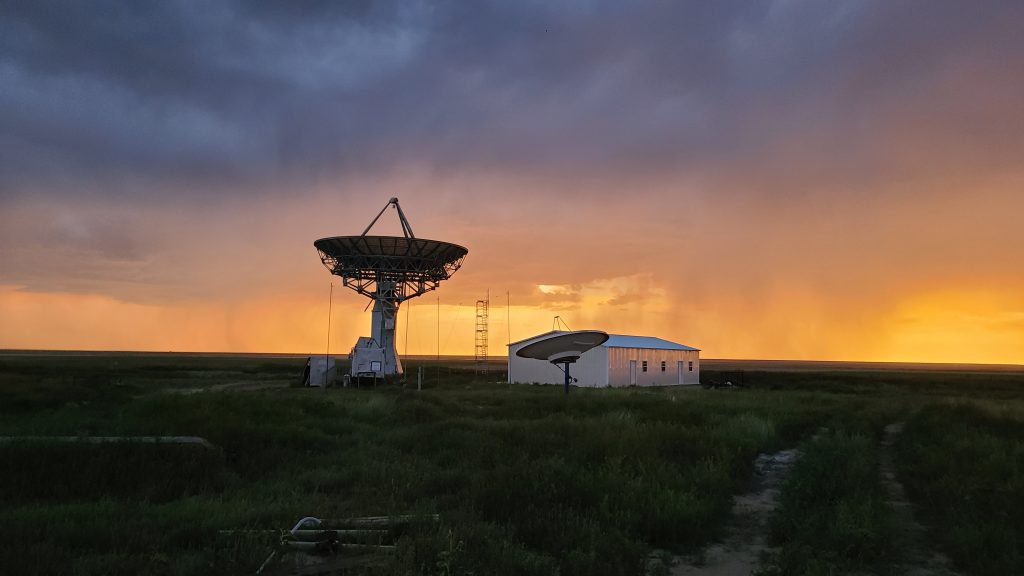
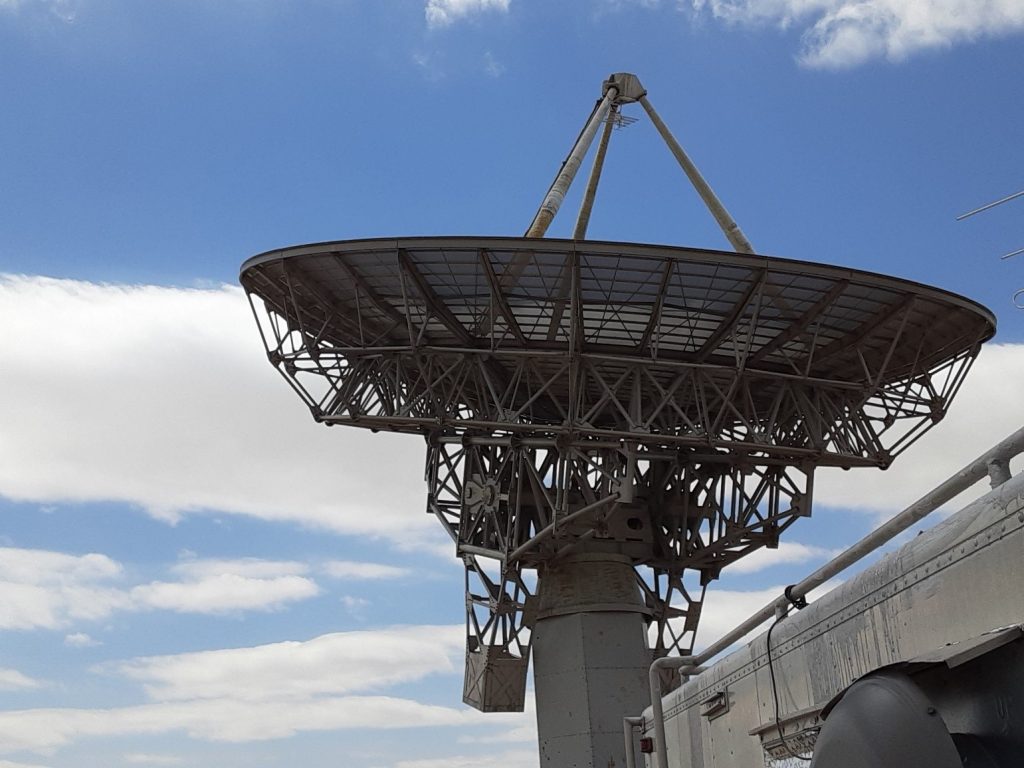
The 60 Ft Diameter Radio Astronomy Dish Antenna stands 55 feet tall, weighs over 65 tons and is made of aluminum and steel. It can point in any direction at any elevation so is full hemispherical. The dish is so well balanced that it only takes 3HP motors to drive it from horizon to horizon in just a few minutes. The Facility and dish were built around 1959 and used to study high speed microwave communication at great distances in support of our northern defenses or DEW Line. In about 1973, when Satellite and fiberoptic communications took over, the facility was put up for government auction and sat unused for about 40 years. After some time, Paul Plishner, a prominent radio and microwave contractor, purchased the facility donated it to the DSES who have been working diligently to restore it since about 2009. The DSES has repurposed the dish and facility for Amateur Radio Astronomy and Ham Radio. So far, we have detected 24 Pulsars, mapped the Hydrogen radio Emissions of Milky Way Galaxy and done countless radio experiments. The facility is completing a new building as an operations and educational facility and has many new projects on the horizon.
When operating EME most people were awestruck, pondering the distance and speed. The children thought that it was really cool. As we explained the other things that we do, we dispelled some misunderstandings and enlightened visitors about our Kiowa County operation.
According to the FCC there are about 43 Ham Radio Operators in Kiowa County and many more in the surrounding counties. Several hams from those counties showed up for the event but we had members from the Front Range and as far away as Oregon and Arizona come in to help with the event. Almost everyone who wanted to was able to be a guest operator for the EME and many were given a tour and demonstration of the general-purpose ham radio station at the facility. During the open house day, many ham radio stations across the USA were contacted from our ham radio station K0PRT.
DSES holds this open house only once per year. However, the public can stop by whenever there is an official work party on site. The Deep Space Exploration Society site is open to scheduled visits from educational groups or other social groups wishing a tour and presentation on Radio Astronomy. Also, the general public can join the Deep Space Exploration Society by signing up for membership on our website at https://dses.science/ for a small membership fee, entitling them to all of our meetings and events onsite.
The Pork BBQ catered by the Michelle Nelson, the mayor of Haswell and her family, was definitely a hit with everyone. We asked for a donation to support the BBQ and raise money for the Haswell Community Center and 4H club.
Duncan WE7L hears his voice bounced off the moon:


Photo Credits: Marc Slover, Roger Oaky, Bill Miller and Bill Thomas
Bill WT0DX represented DSES at three recent ham radio events: The CSVHF Conference, the Rocky Mountain Division Convention and the Denver Radio Club Hamfest. In each case, a posterboard display was set up, site videos were displayed, and club brochures were handed out. The upcoming Open House was also promoted.
The annual CSVHF conference was held July 27-30 in Little Rock, AR. There were about 150 participants. The posterboard display was set up in the main meeting room and the Friday night swap room. In addition to talking about the club, several folks said they were interested in attending the Open House.

The Rocky Mountain Division Convention was held August 11-13 in Albuquerque, NM. They provided a free table for clubs in the swap meet area. There were about 400 attendees, and many interesting conversations. Unfortunately, many of the folks thought that the DSES site was too far away for an Open House visit.

Bill also had an opportunity to discuss DSES with David Minster NA2AA the CEO of ARRL. He was unaware of the club but found it very interesting.

The Denver Radio Club Hamfest was held on Sunday August 27th at the Adams County Fairgrounds. This is a well-attended hamfest and we had many good conversations about the club, with quite a bit of interest in the Open House. Also, Paul NO0T managed to secure a great donation to the club of several HF Yagi antennas.

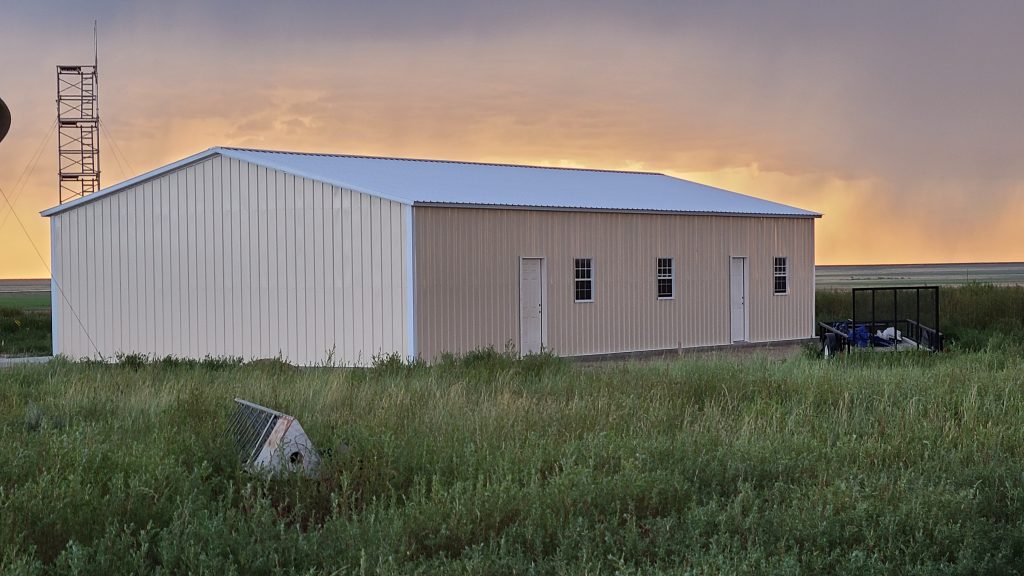
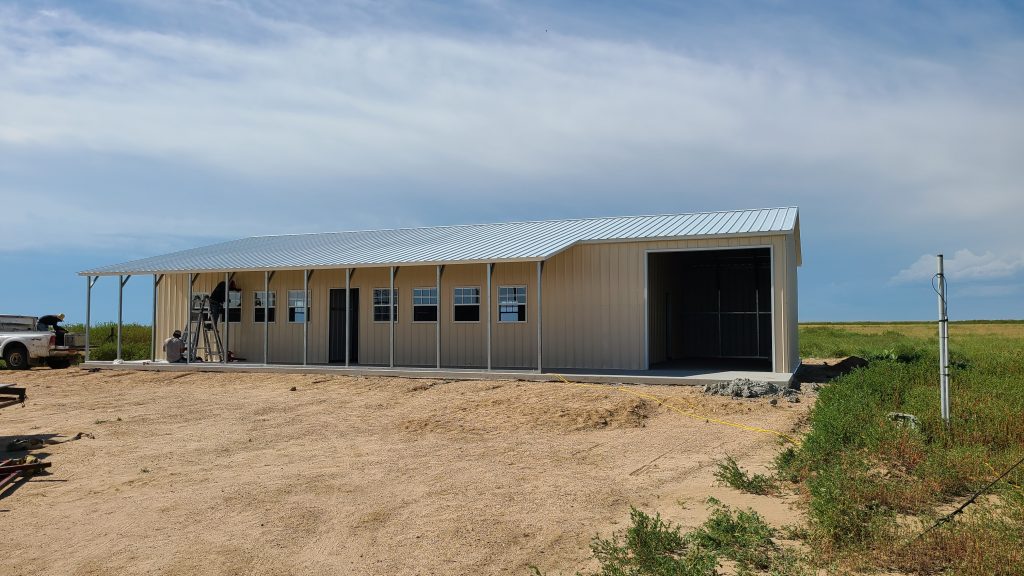
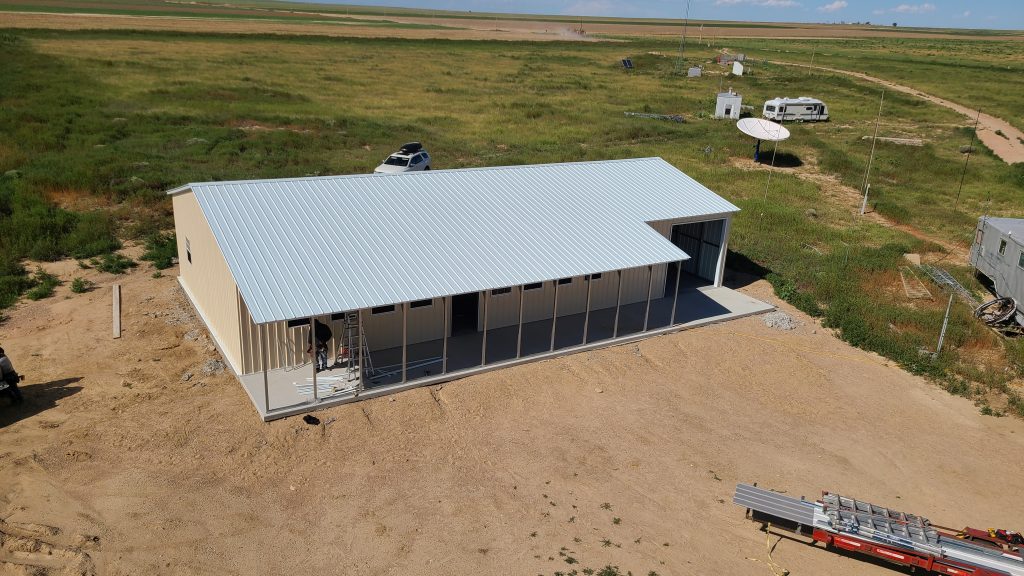
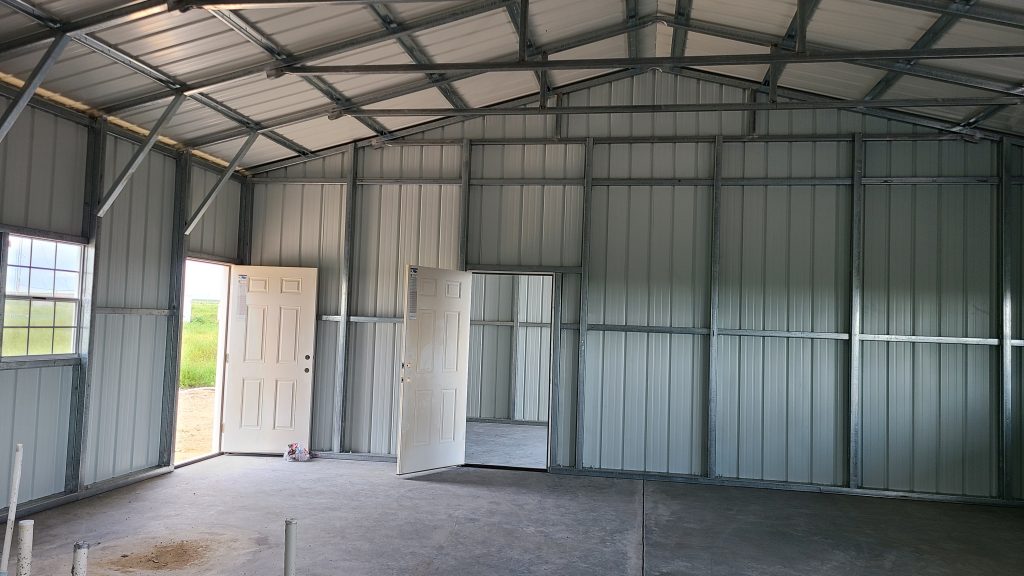
An update on the progress of our DSES building project. Our DSES Vice President and Project Manager, Bill Miller, has spent many hours and has made many trips down to the Plishner Site near Haswell Colorado to make this project happen. After many delays, some due to COVID, in finding contractors for concrete, plumbing, and electrical as well as building manufacturers to provide a 60-foot by 30-foot structure, DSES has finally made some progress. We still have many hours of interior/exterior work and antenna towers to place before we can move our current operations from the existing communications trailer and the underground bunker. This future work will still require many trips and hours on site to complete these tasks. We hope our local Colorado DSES members will be able to provide some help in completing these projects. DSES will provide dates and times of these trips so members can plan their time at the Plishner Site. A big thank you to Bill Miller for taking on this project and to those other members who were able to assist him over the past few months.
Myron Babcock
President/Treasurer
DSES
Cool Science Festival Presentation on Saturday October 11, 2020
Rich Russel made an online presentation at the Cool Science Festival. The presentation covered the science of radio astronomy and the accomplishments of the Deep Space Exploration Society. The presentation was streamed live on Facebook and Youtube. You can watch the presentation here:
This 8-day regional event, designed to ignite wonder and inspire curiosity about the world around us, attracts between 10,000 and 20,000 attendees each year. For more information about the Cool Science Festival go to:
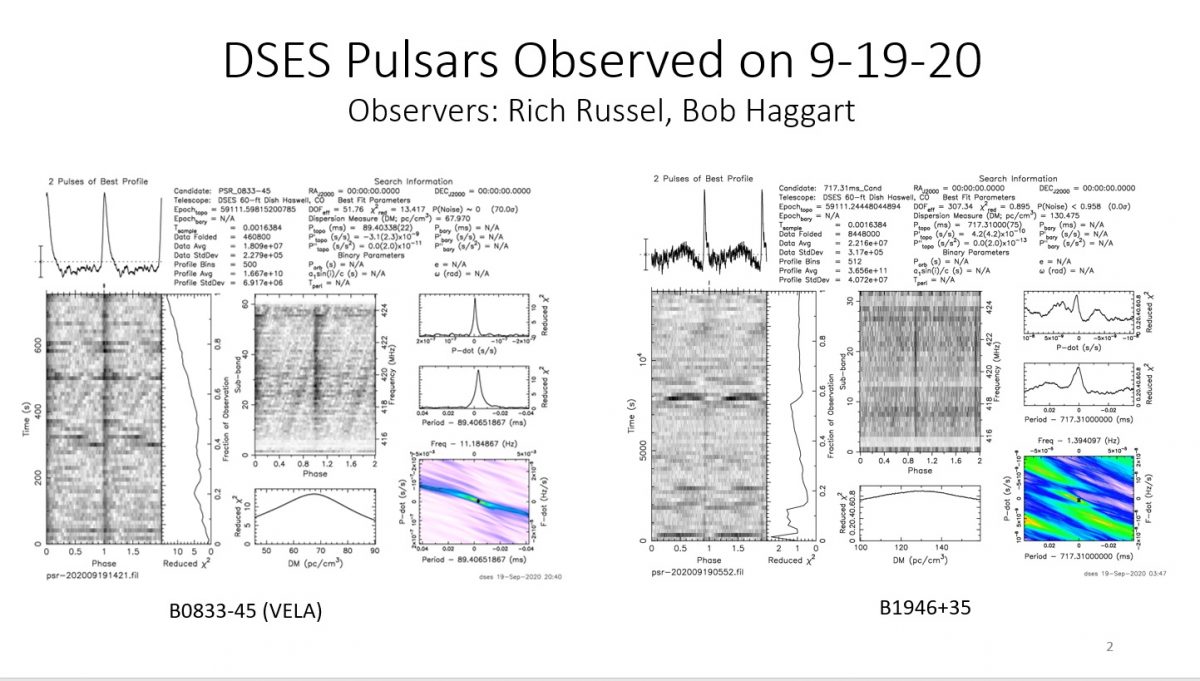
Bob Haggart and Rich Russel did an observation all nighter on Friday/Saturday (September 19, 2020, GMT) and observed 2 pulsars.
VELA (B0833-45) is one of the strongest pulsars at 5 JY while B1946+35 is at 0.145 JY.
DSES is one of the most northern amateur stations to detect VELA. We detected it in 15 minutes at 5 to 6 degrees elevation.
This make 13 pulsars and puts us 5th on the international amateur pulsar hunter list. http://www.neutronstar.joataman.net/
The DSES team of Rich Russel, Ray Uberecken, and Glenn Davis observed for pulsars on Saturday September 5, 2020 at the DSES 60-foot dish antenna at Haswell, CO.
The team successfully observed 5 pulsars which we hadn’t been able to detect before.
The success is attributed to the calibration of the antenna pointing system and the new automatic tracking system developed by the System 1 team.
We started with calibrating the azimuth of the antenna (it was 2.5 degrees off!) Elevation was good. Glenn put the offset in the auto tracking system and we were able to detect the B0329+54 pulsar within 30 minutes. (We use the B0329+54 pulsar, the first one we successfully saw last May, as a starting reference. If we can observe this, we know our system is working.) Every pulsar we looked at after that was detected – we just ran out of time for more!
It is possible we missed observing previous pulsars because our pointing accuracy was off.
See the slide set for our observation summary.
https://dses.science/wp-content/uploads/2020/09/8-Pulsars-Observed-so-Far-9-5-20-r3.pdf
We are pretty sure we observed the Crab pulsar. The last slide shows an analysis of the time between pulses we measured for the Crab pulsar, compared to the standard reference database.
More detail to come at the next science meeting
Our total pulsar count is now 8!
By Dr. Richard Russel, DSES Science Lead
The pulsar, B1133+16, was observed on the 60 ft dish antenna by Rich Russel and Ray Uberecken after 4 hours of tracking and collecting data on the pulsar.
This pulsar is the weakest object observed by DSES at 0.257 Janskys!
The pulsar is noted for having a “conal double” peak in its profile. Our observation picks this out very well.
The PRESTO analysis program results are shown below.

The conal double plot is produced from the raw data and plotted in excel.

PSR B1133+16 is located at RA 11h 33m 27s Declination +16.07°, in the northeast part of the constellation Leo. It was observed with a pulse period of 1.187 seconds. Our center frequency was 417 MHz, and we used a 10 MHz bandwidth.
(The name B1133+16 conveys the celestial sky coordinates, referenced to a standard year epoch. In this case the B indicates the position is from the year 1950, the “Besselian” year, named after the German astronomer Friedrich Bessel.)
Congratulations to the entire membership for turning the DSES dish into a world class scientific instrument!
Thanks!
Dr. Richard Russel
DSES Science Lead
By Dr. Richard Russel, DSES Science Lead.
The pulsar, B0329+54 (J0332+5434)1, was observed on the third try just before the team was ready to pack up for the day on Saturday, May 2, 2020. A final modification of the software defined radio settings was tried (all the gains were set to a minimum) did the trick.
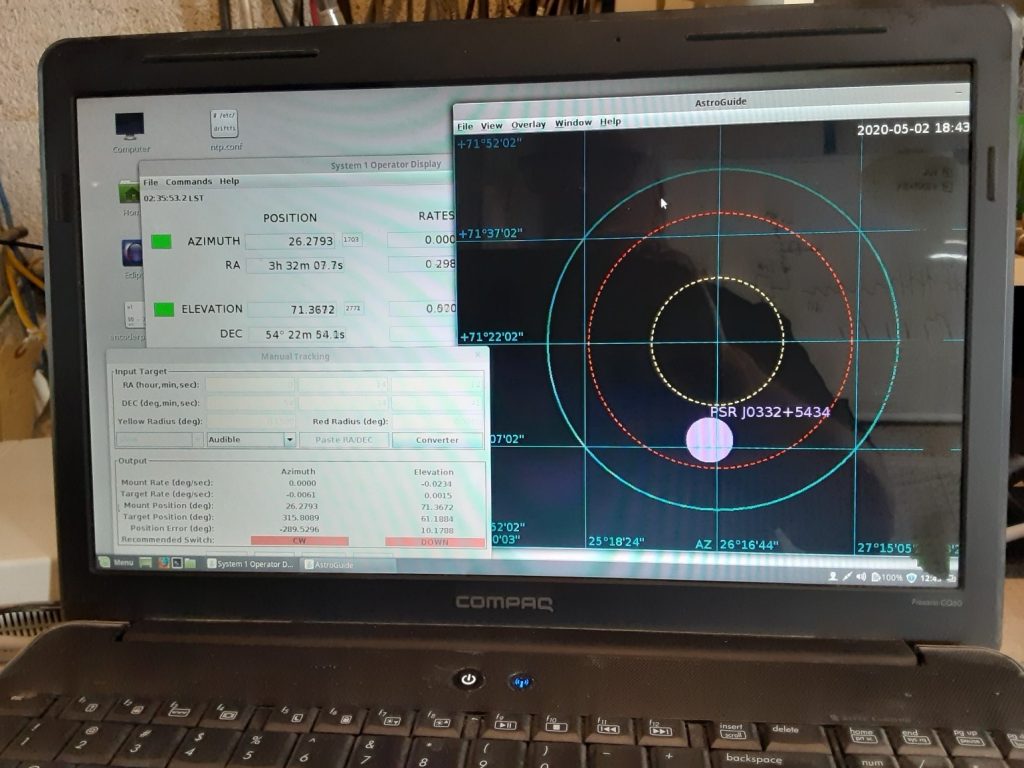
The 60-ft dish was setup to manually track the pulsar using the System 1 tracking program software developed by Glenn Davis and Phil Gage. This program allowed us to track the pulsar’s position by keeping it in the bullseye.
We observed at a frequency of 420 MHz, with a bandwidth of 10 MHz.
The pulsar system was initiated last year by Steve Plock. Our mentor throughout the effort has been Dr. Joe Martin (K5SO) in New Mexico. Joe validated that we made a successful pulsar capture.
The GNU radio software was turned on to start the acquisition.
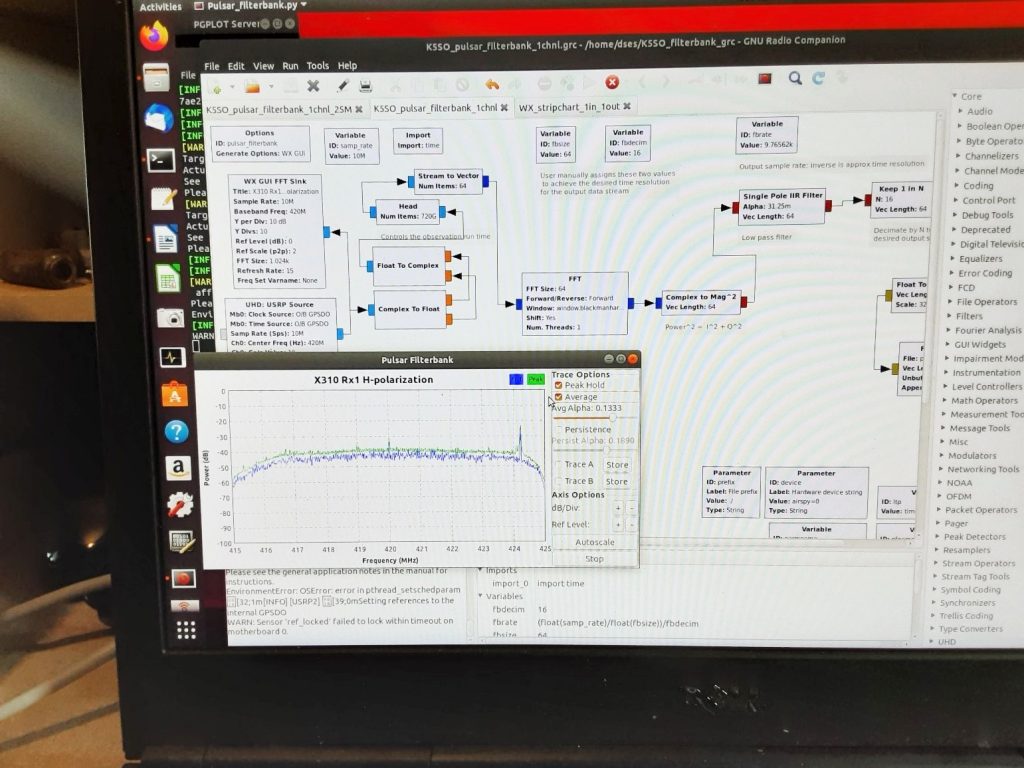
It should be noted that you cannot tell if you have the pulsar real-time because it is pulsing way below the noise level. After about 30 minutes, we stopped the acquisition and we moved the post-processing over to Bob’s new workbench.
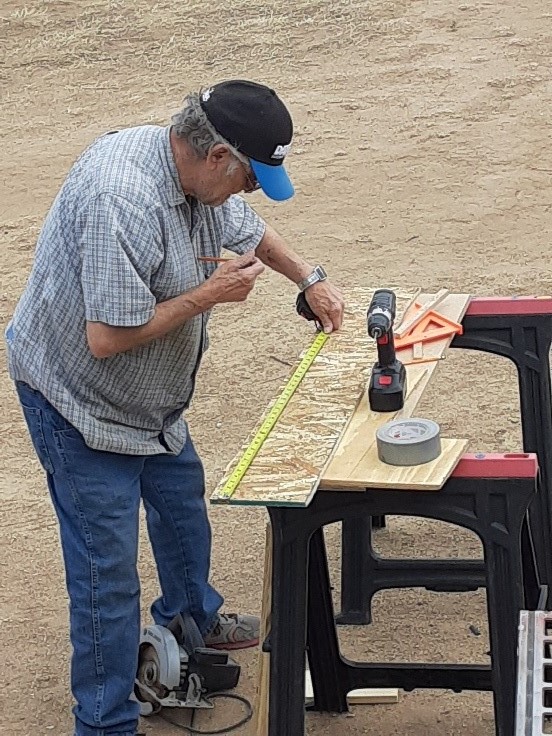
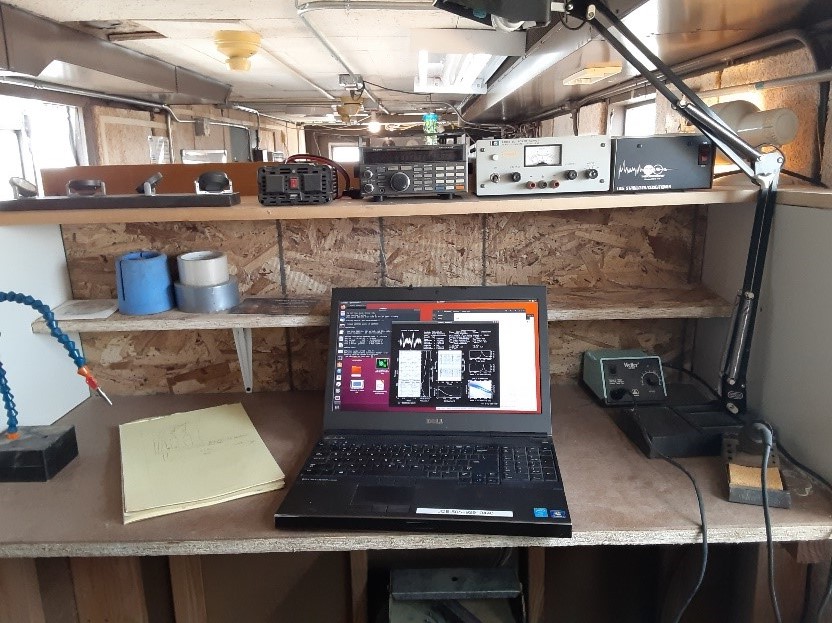
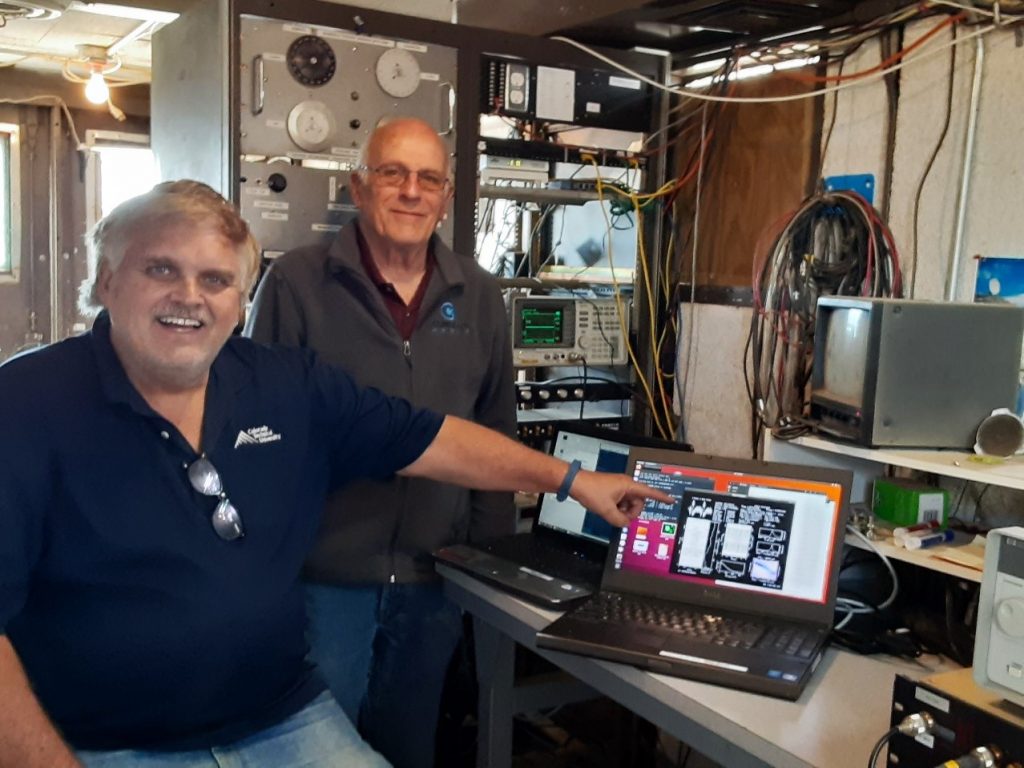
Rich and Ray celebrate our first pulsar! (Bob’s taking the picture)
The first iteration of post -processing requires that the pulsar period be estimated with a program called TEMPO. The first iteration is shown below. It clearly shows a pulsar because of the prominent peaks and the lines tracing down the plots, however it is not quite set to the optimum period.
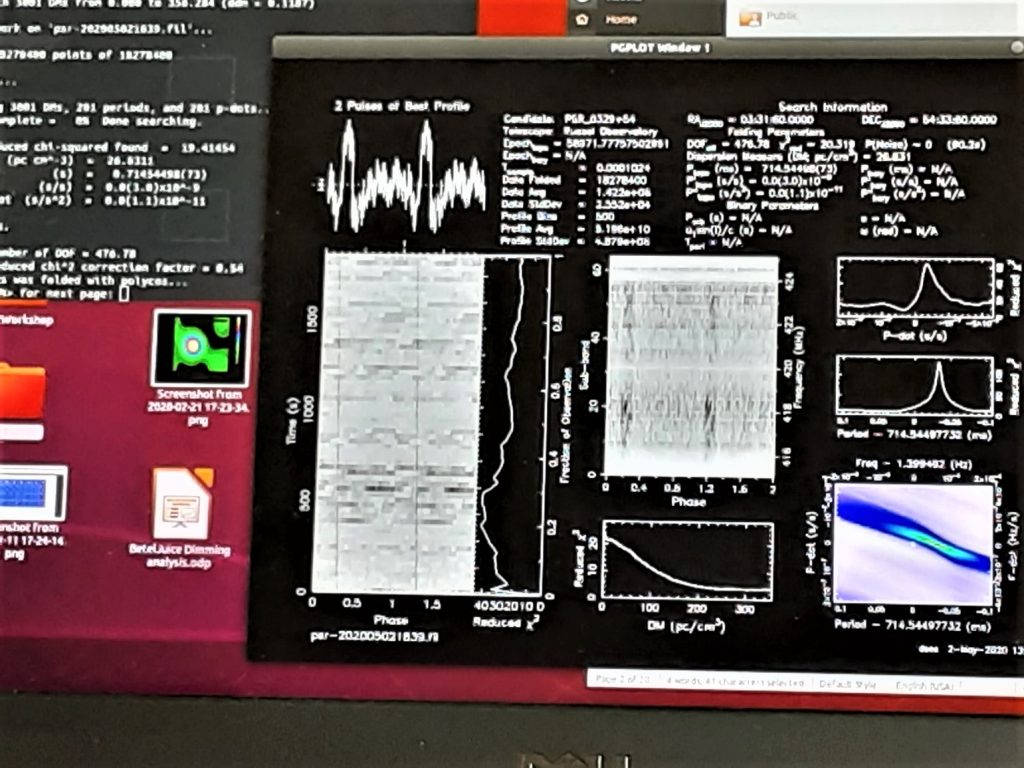
After some more iterations the final picture looked cleaner.
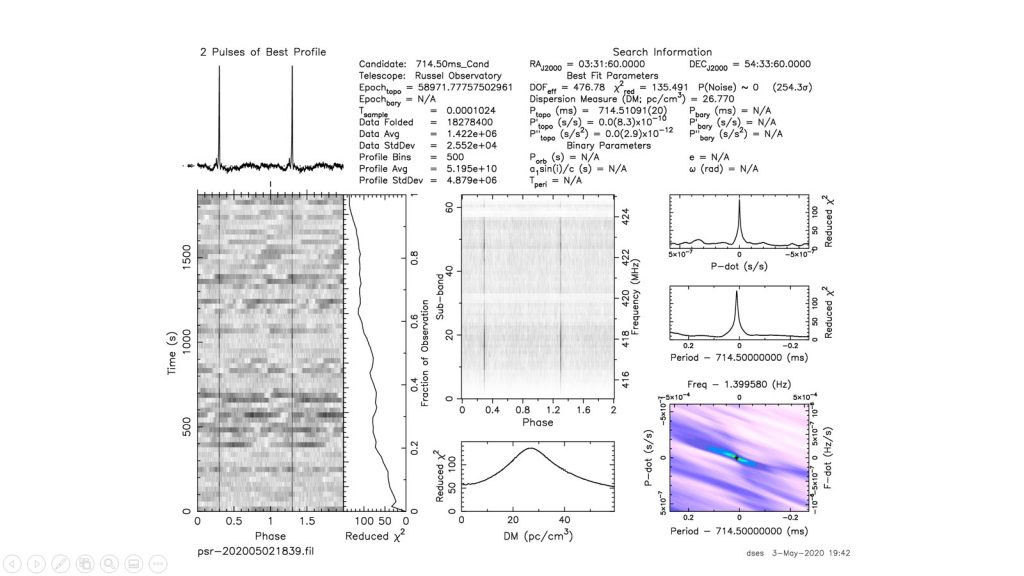
More analysis using the resultant data files allowed us to verify the pulsar as B0329+54 (J0332+5434).
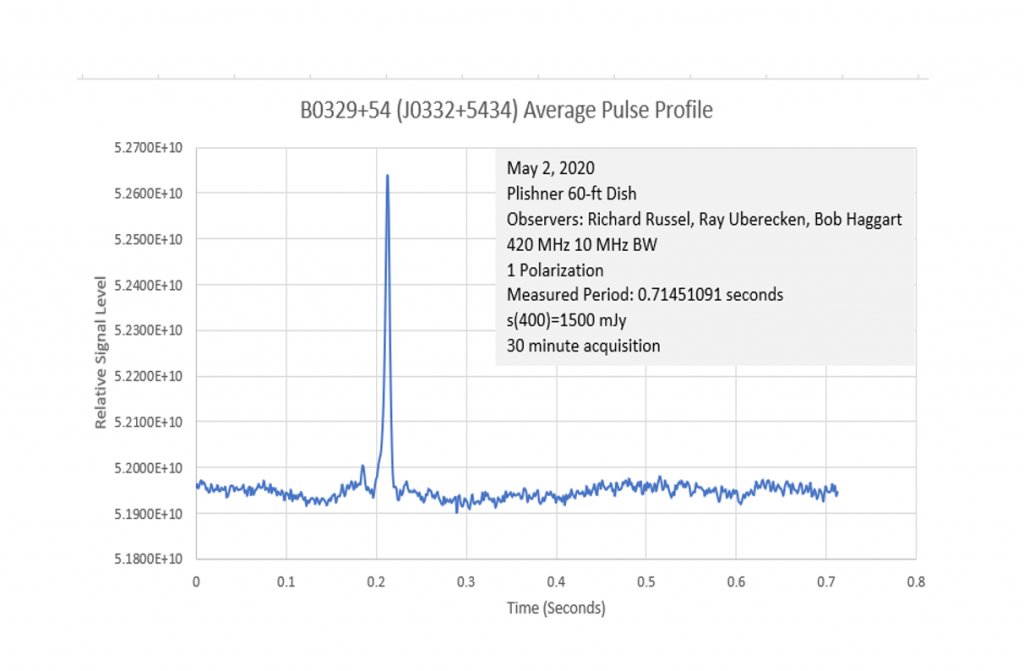
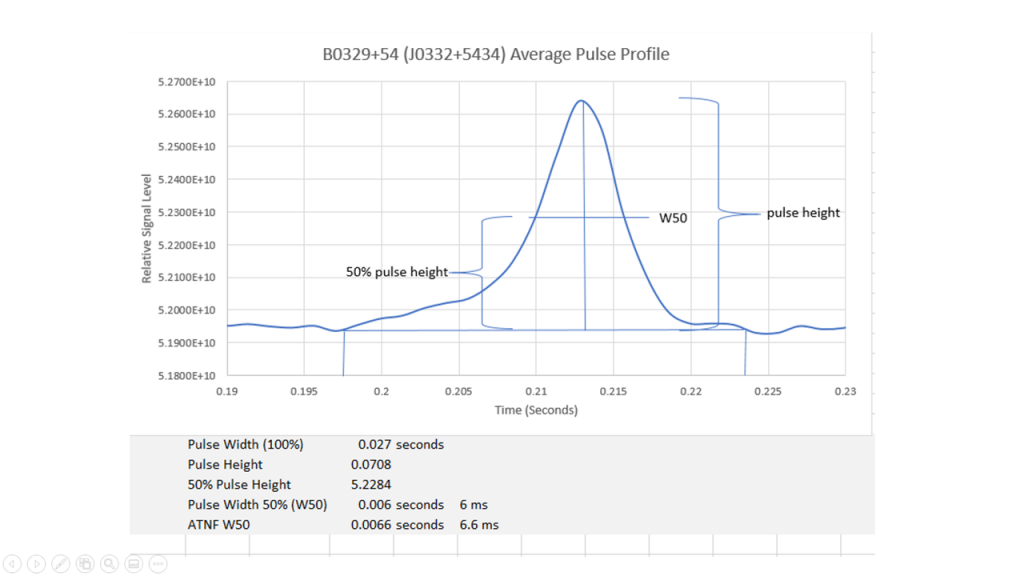
Even the pulse width at the 50% height (W50) was estimated. The preliminary analysis below shows a measured W50 of 6 ms. The current value in the ATNF database is 6.6 ms. This is real close and confirms our observation.
More observation runs are planned and DSES can can consider itself one of the few amateur organizations to accomplish pulsar observations2.
Reference: