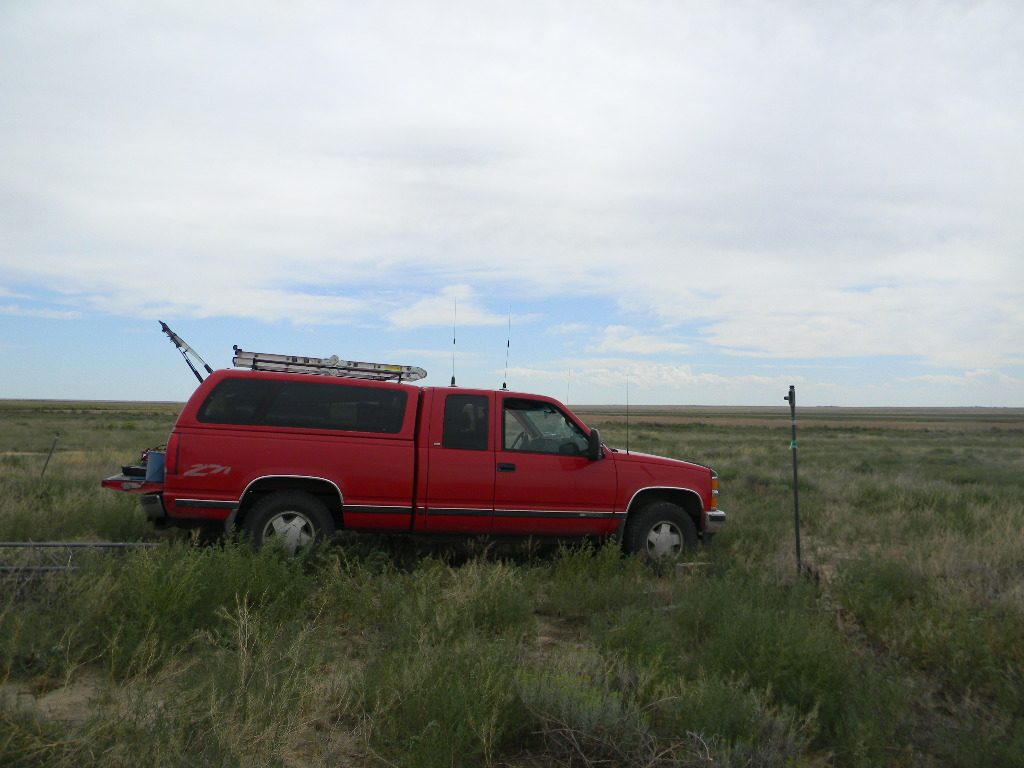
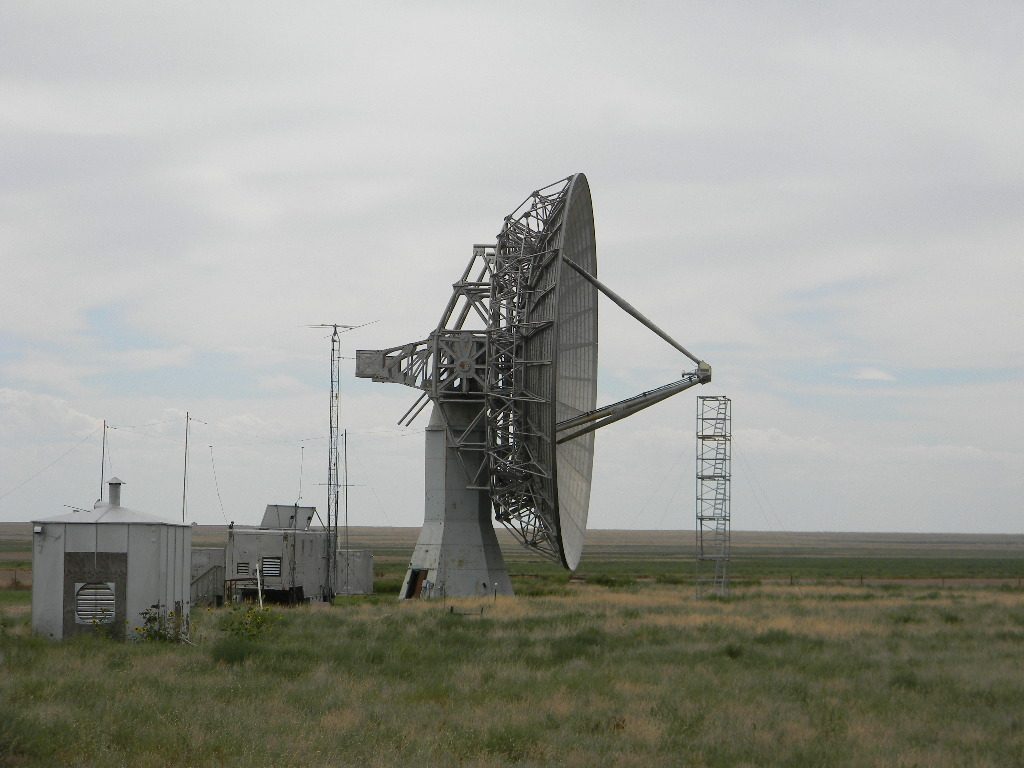
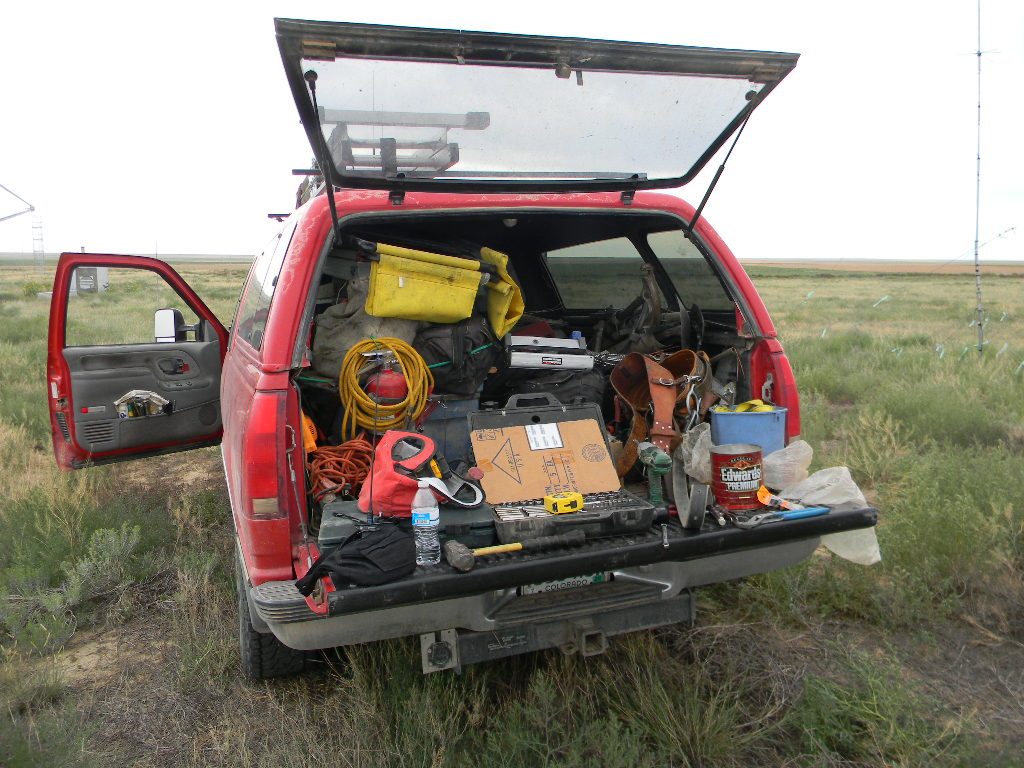
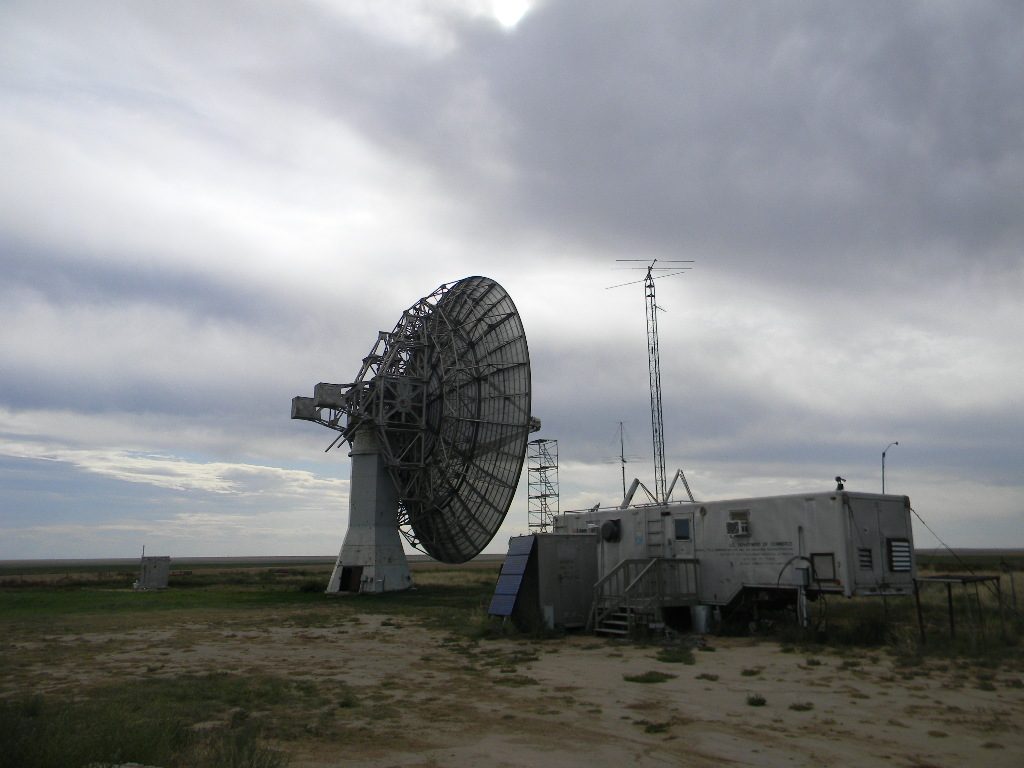
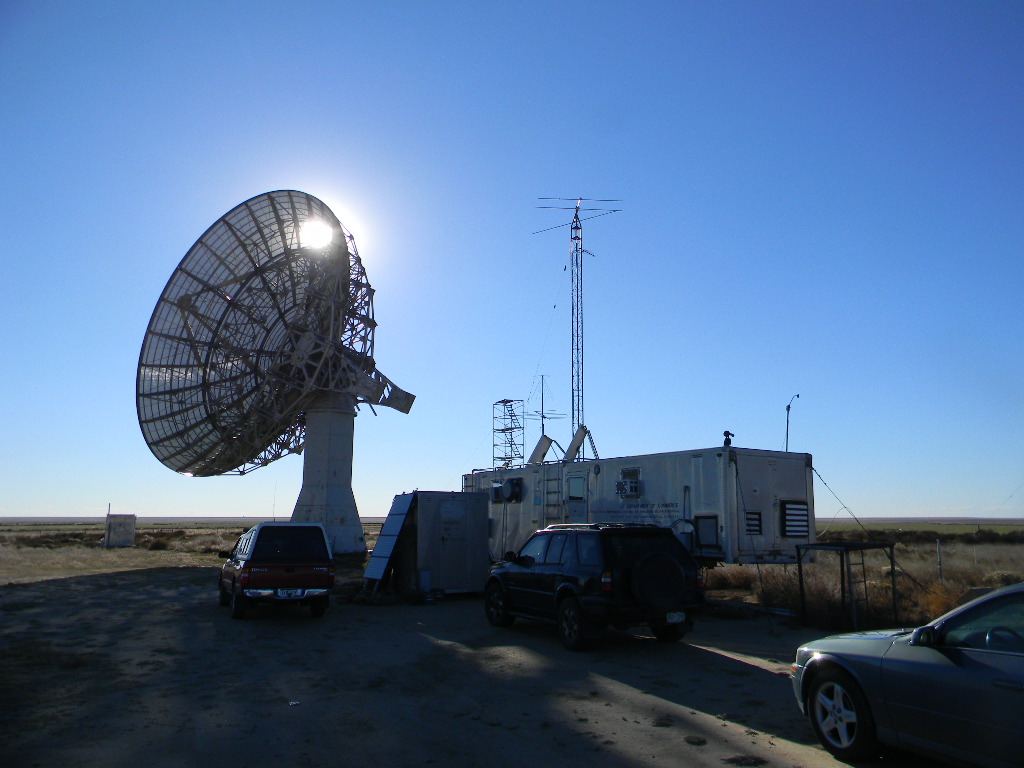
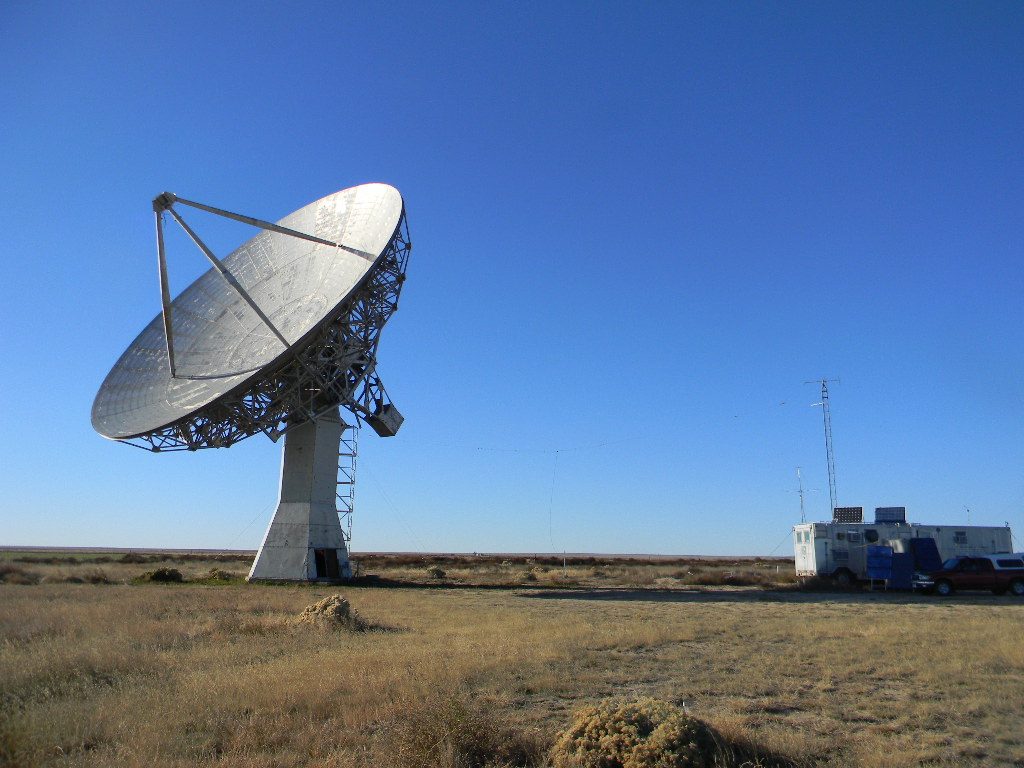
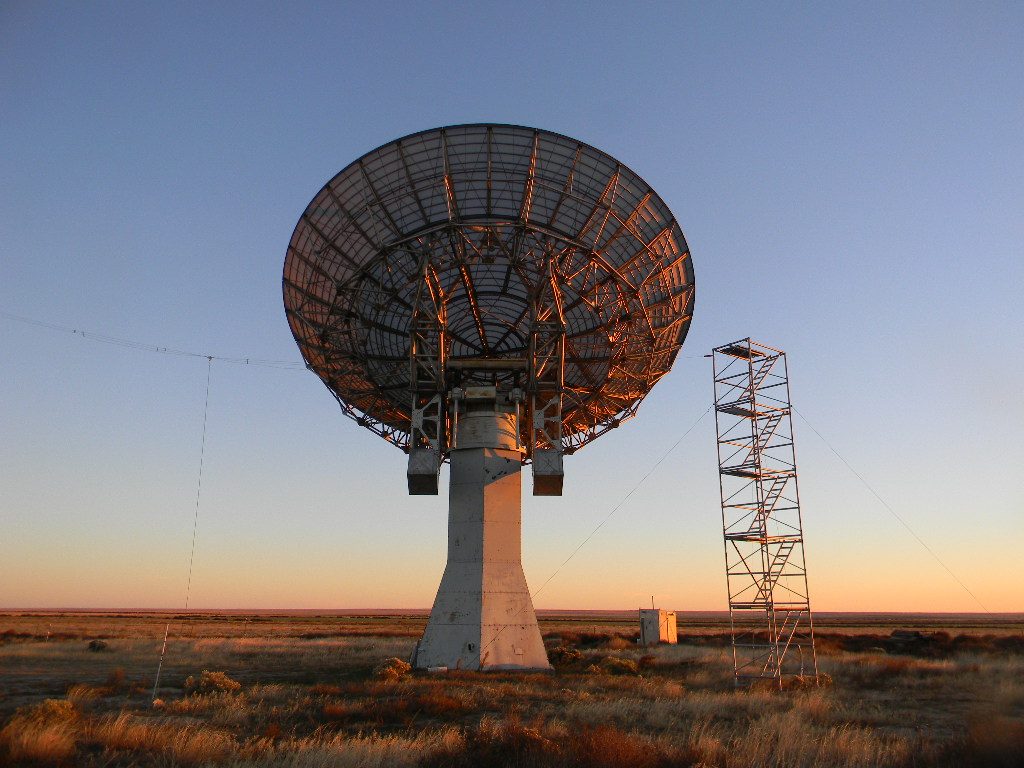
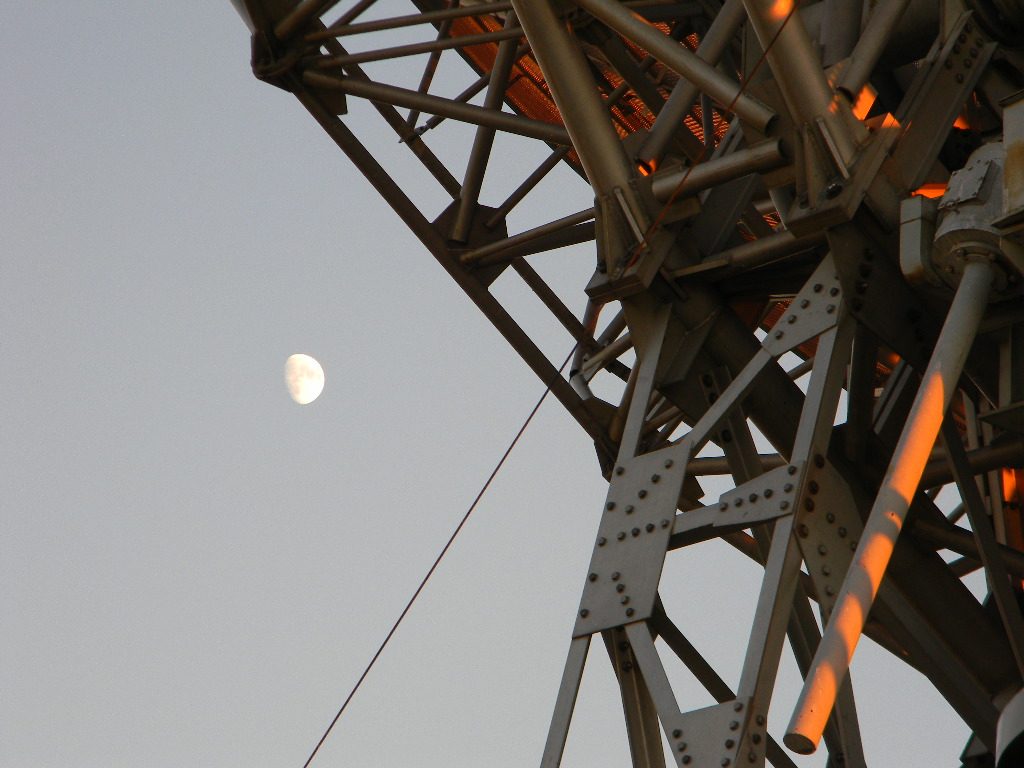
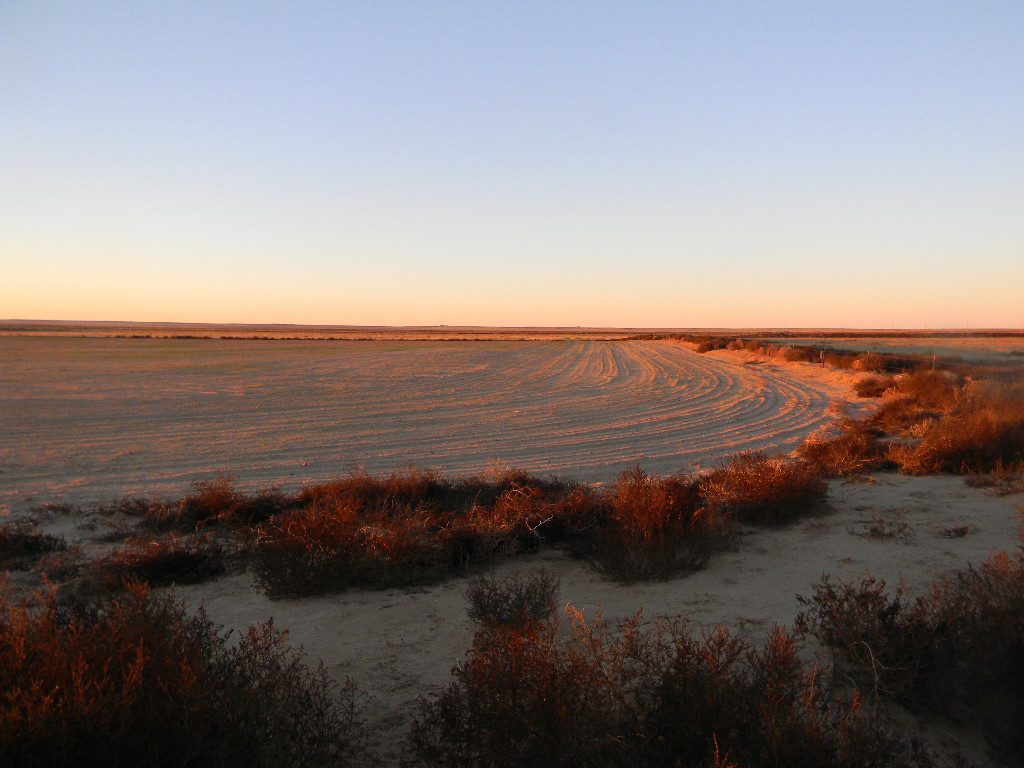
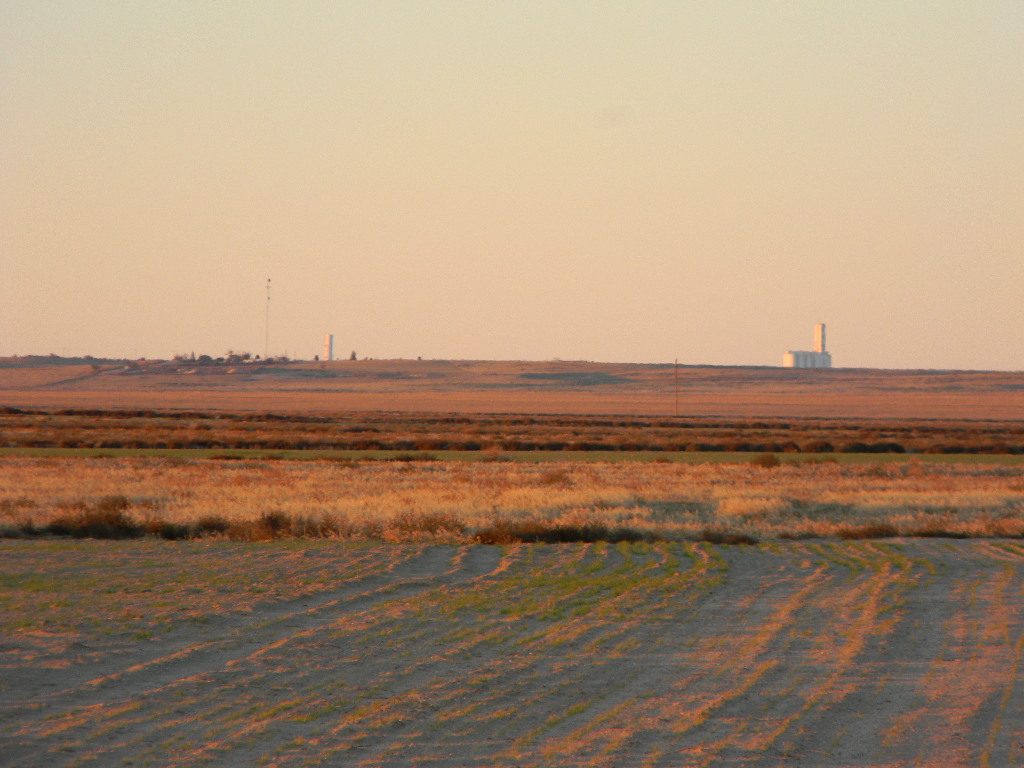
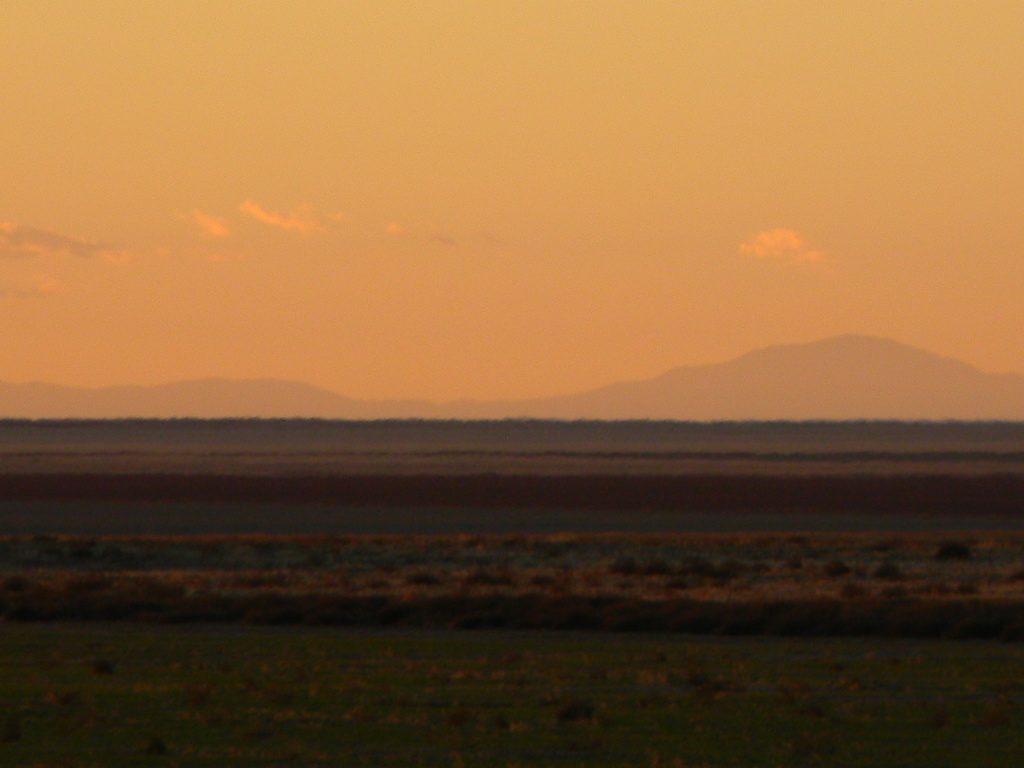
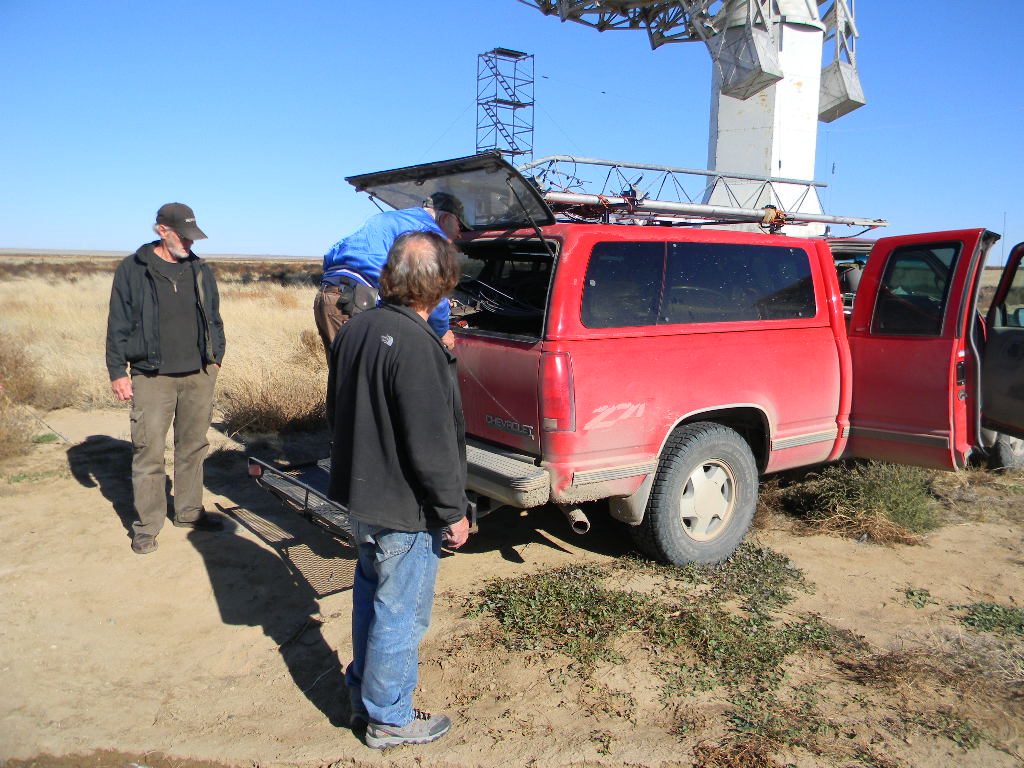
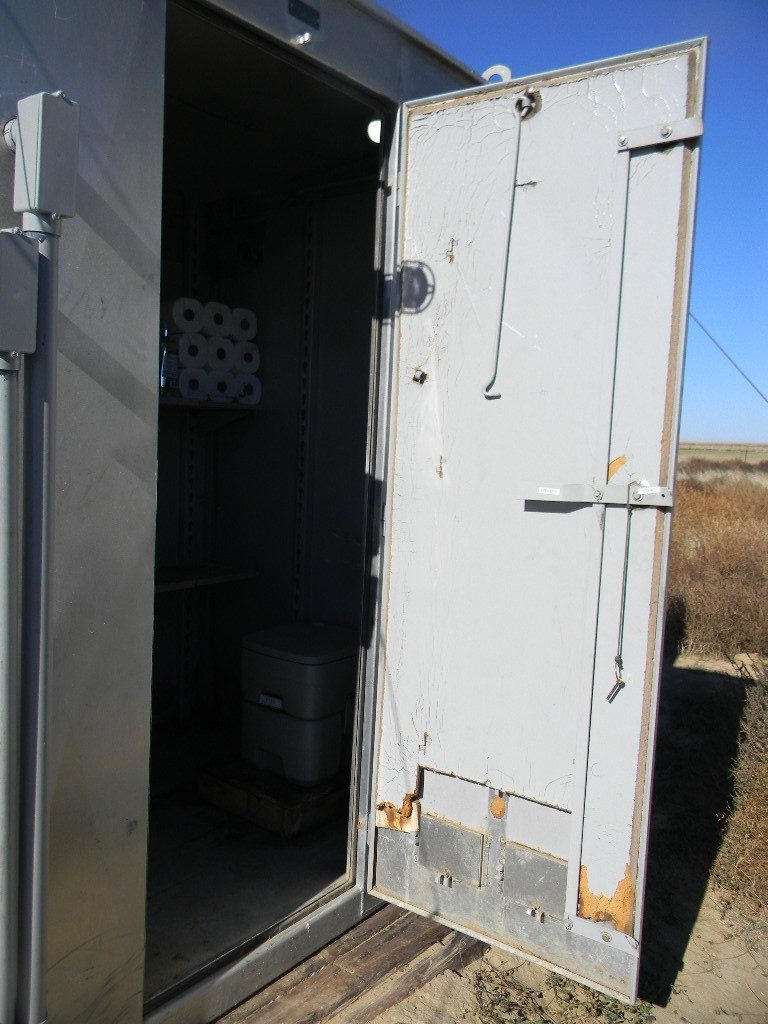
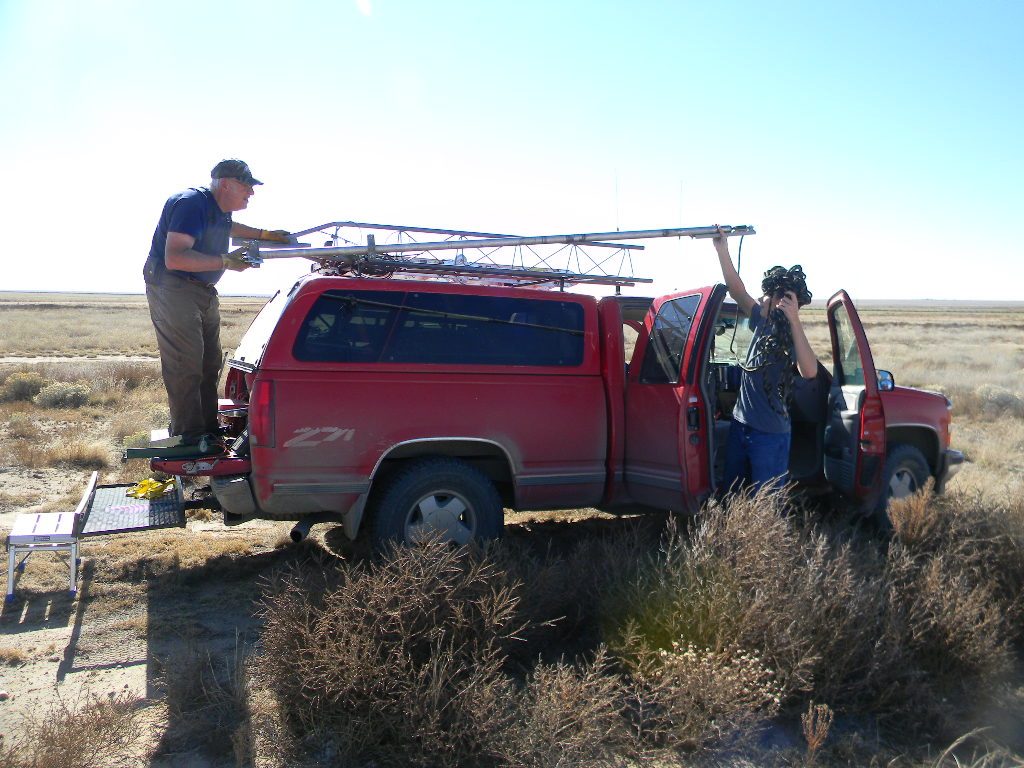
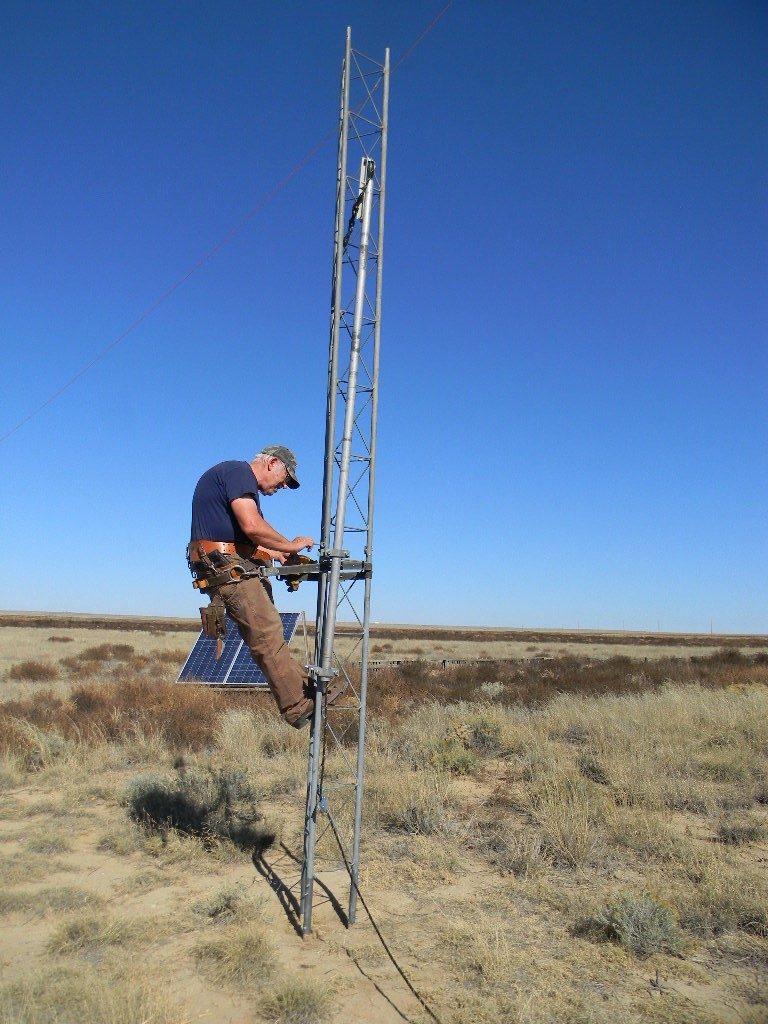
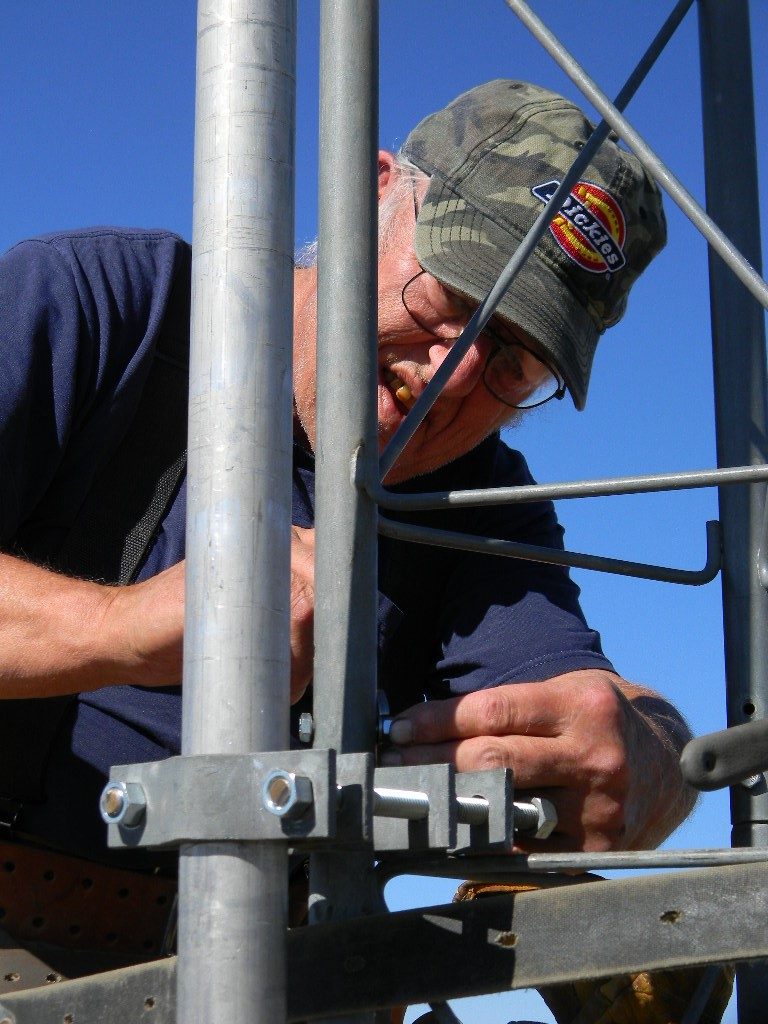
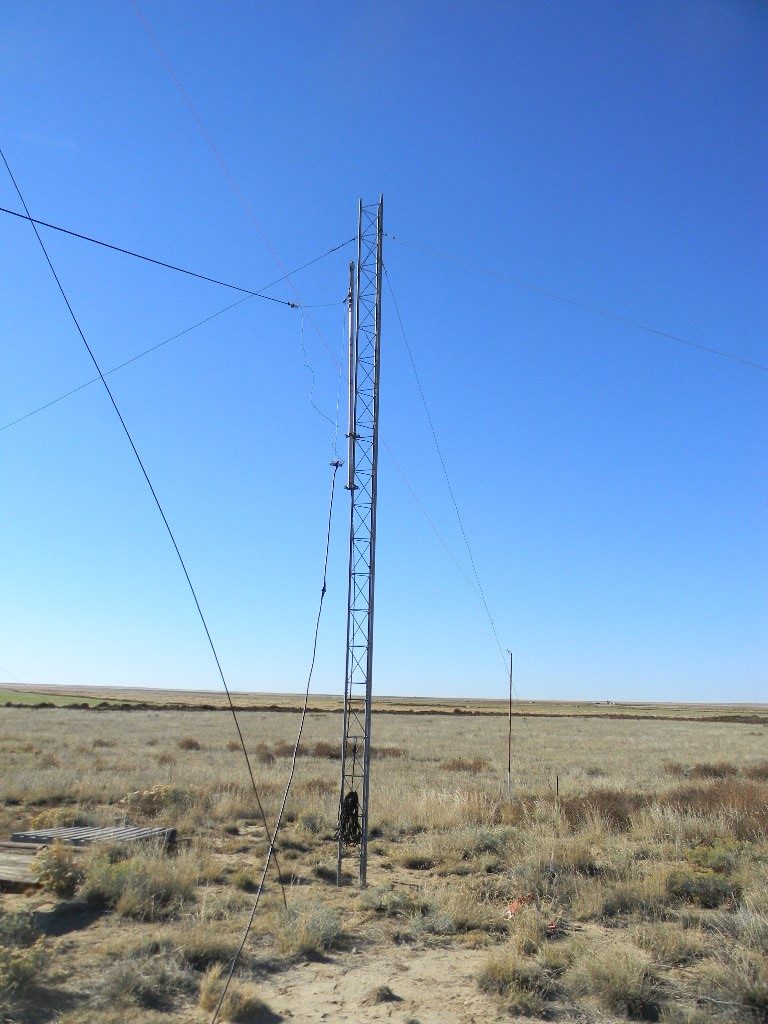
Ed, Steve, and I traveled to our radio telescope site, leaving from the Ellicott Fire Department a little after 7:30 am. We encountered just a little fog on the way.
Steve worked primarily on troubleshooting the amplifier failure on the 60-foot antenna fiber optic feed. Steve found a power supply no longer functioned. He wrote me later, “Damaged parts have been ordered and will be replaced at the earliest convenience.”
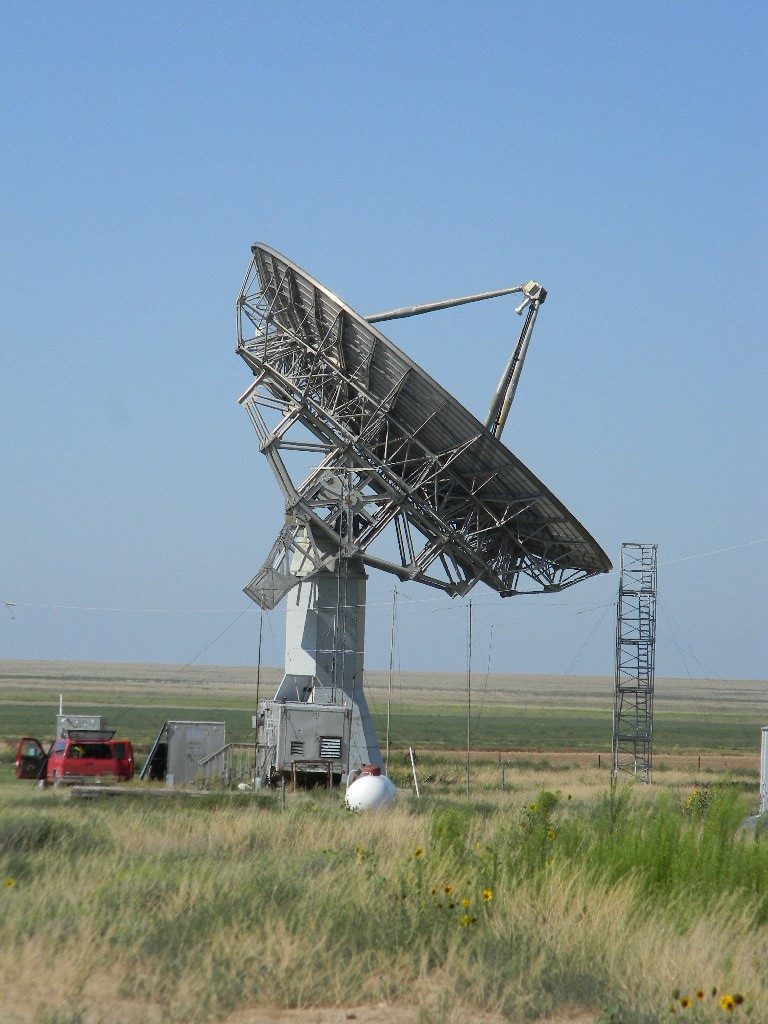
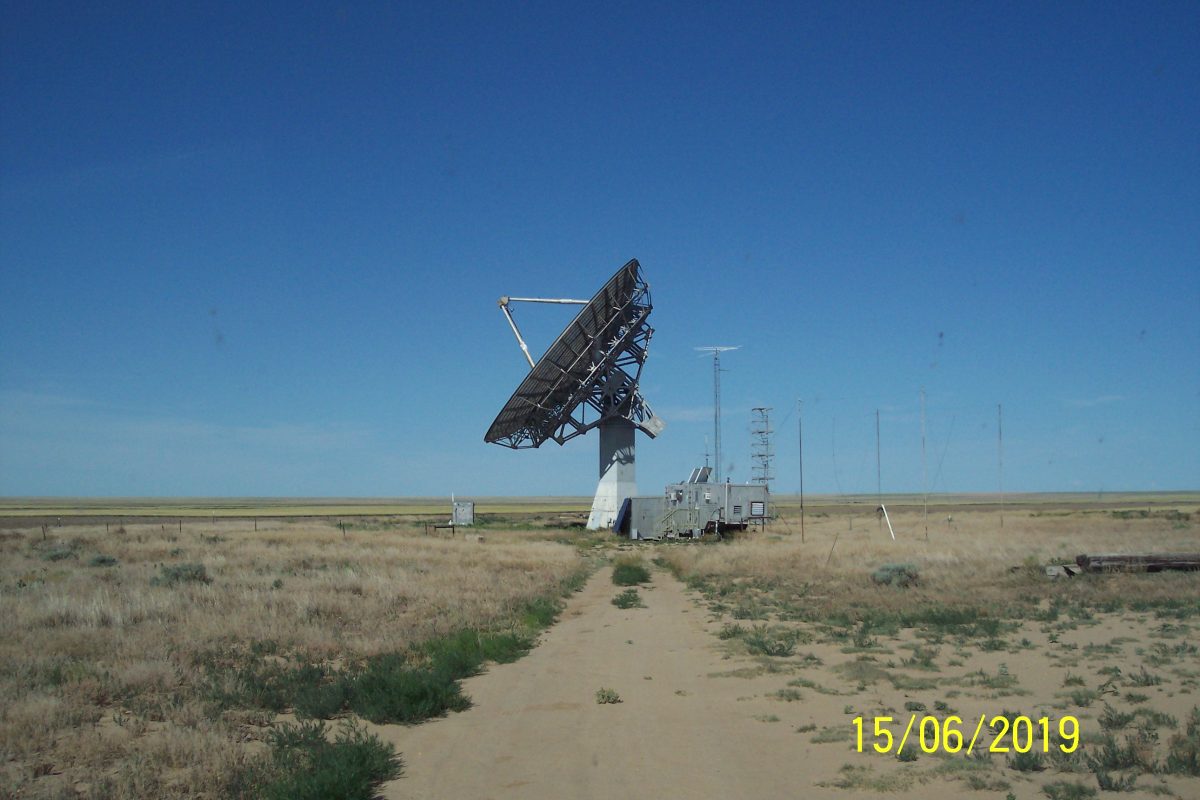
The 60-foot antenna dish was rotated so that Steve could access the feed from the service tower.
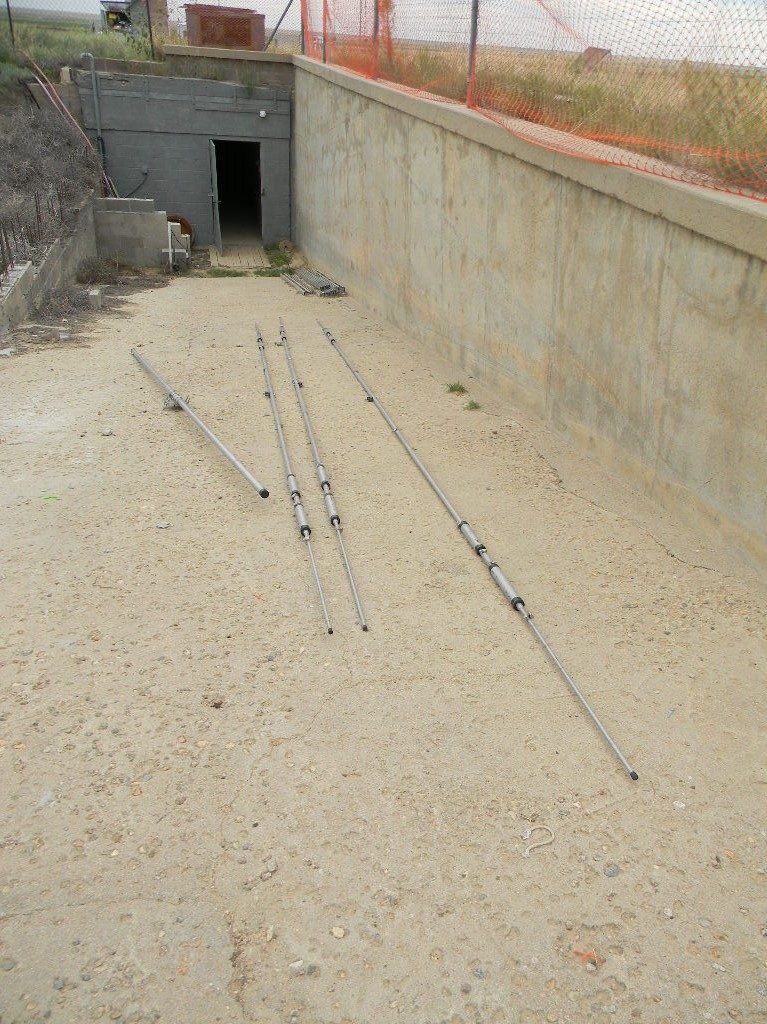
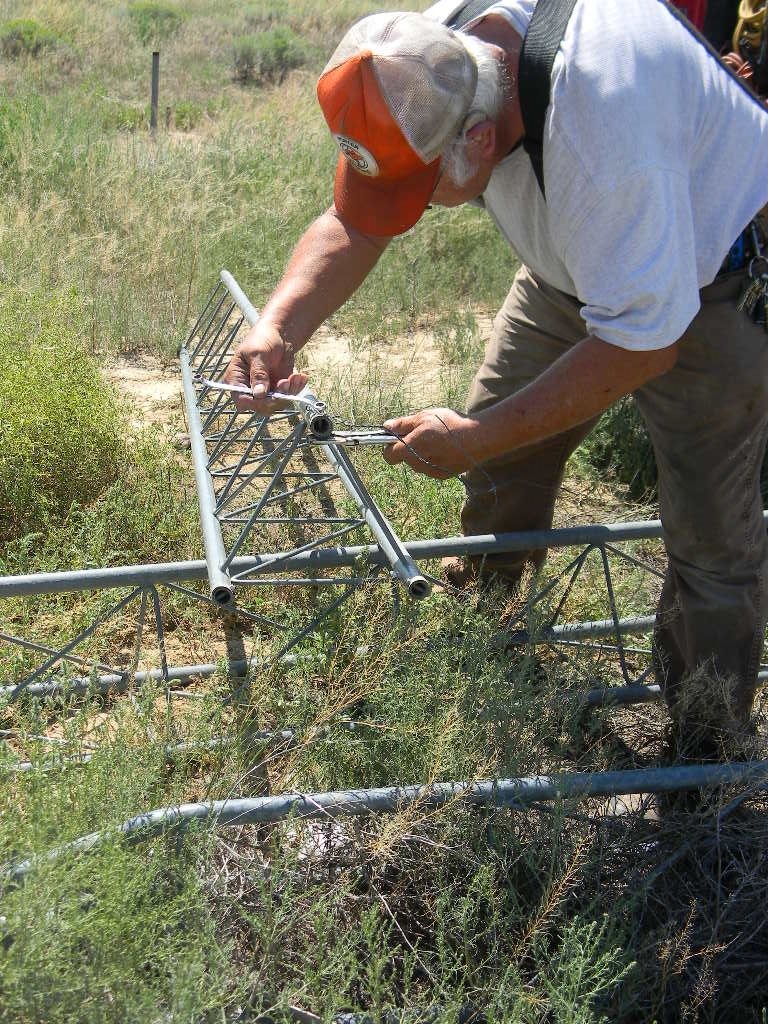
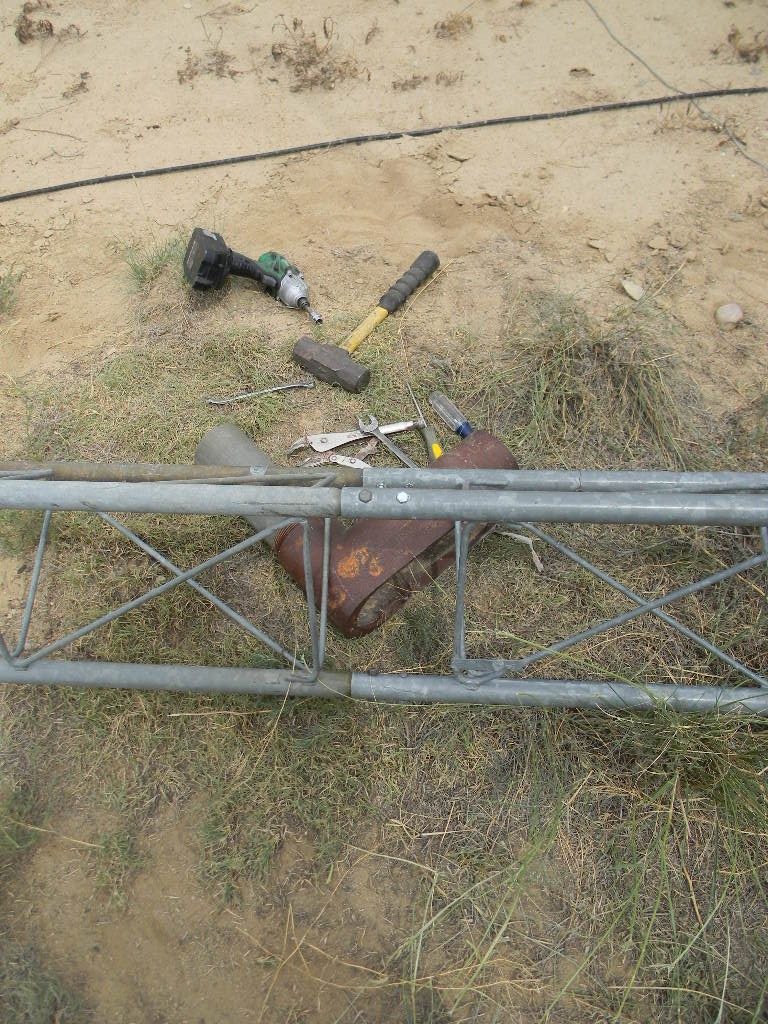
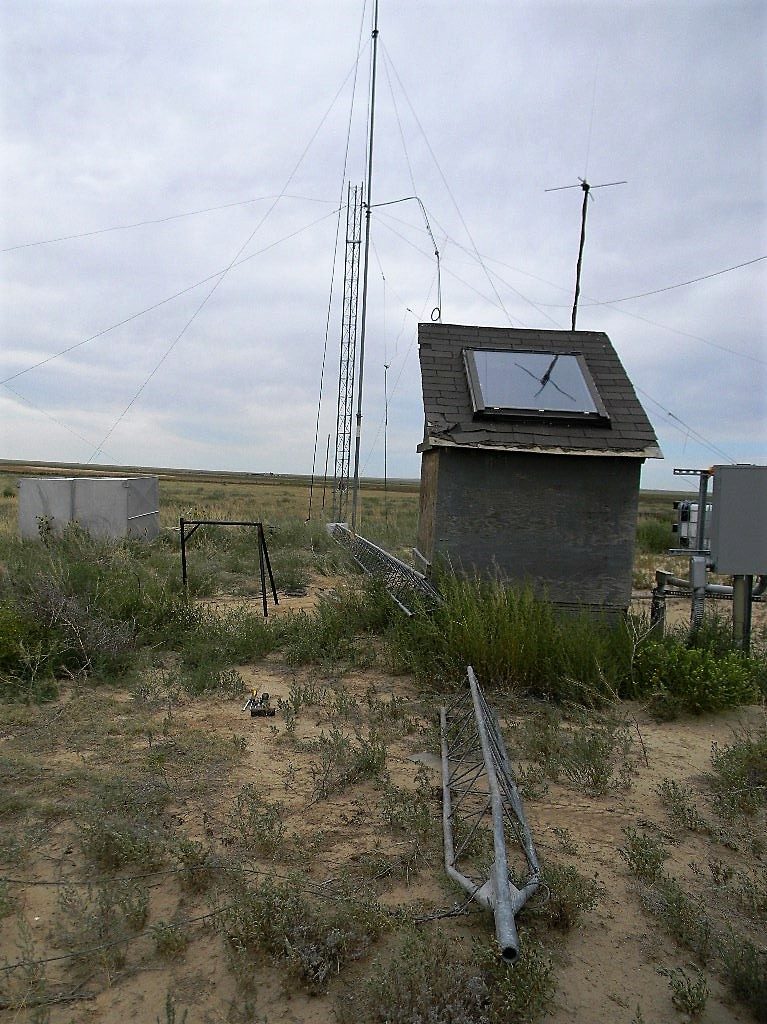
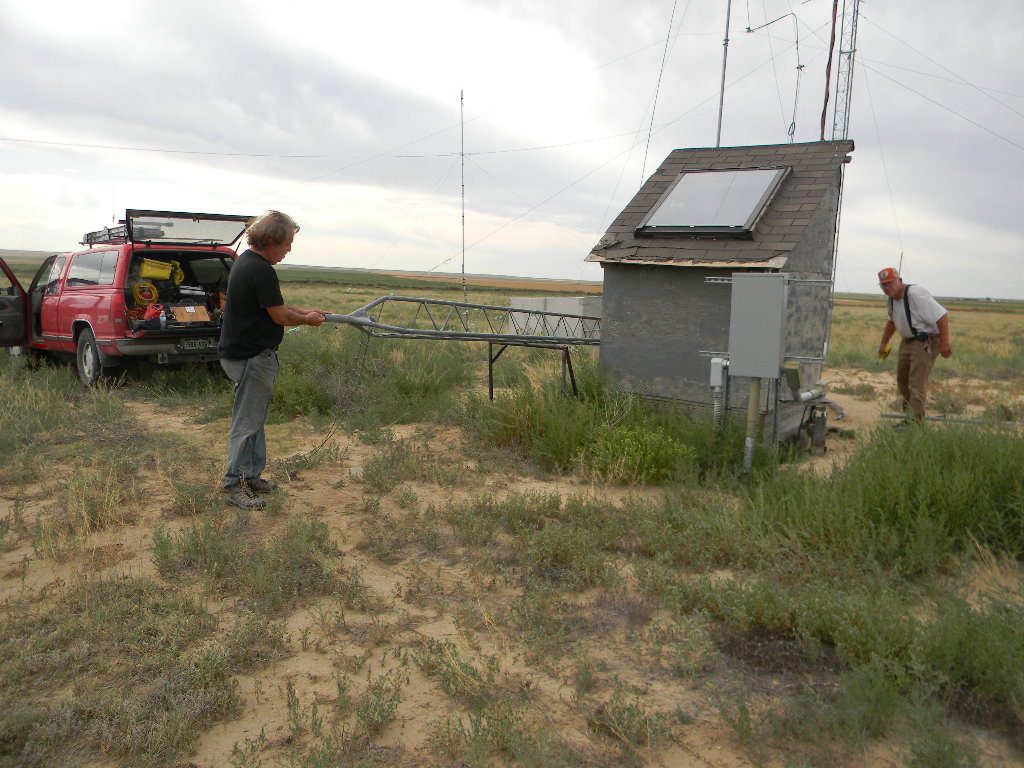
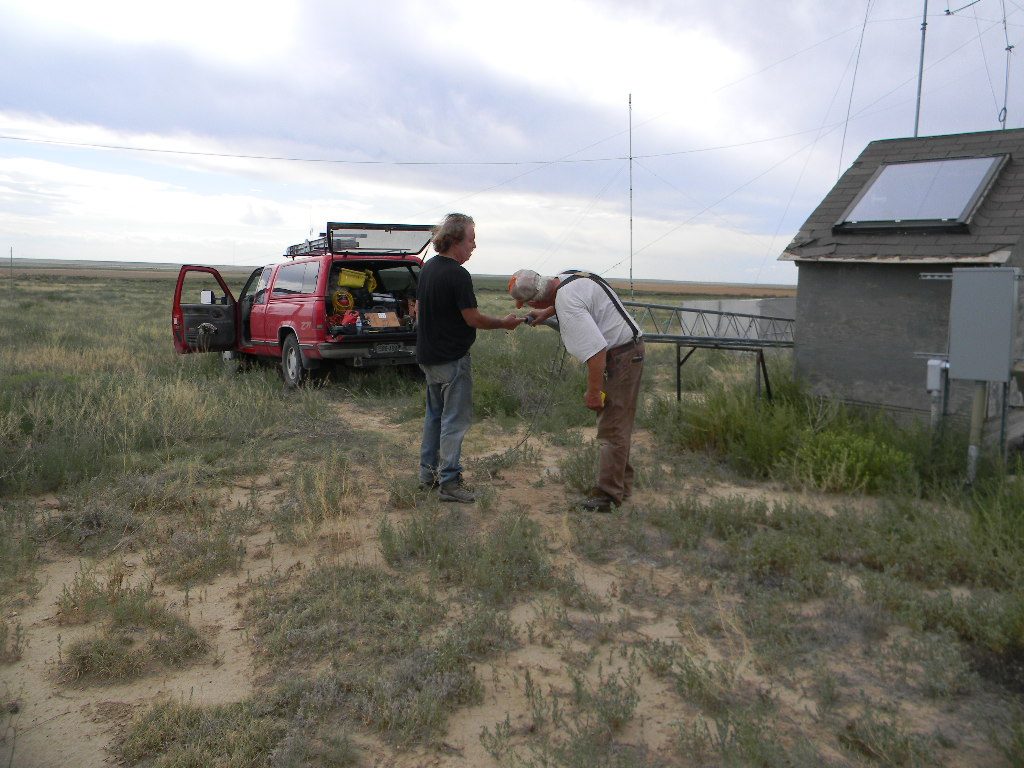
Ed Corn and I worked on assembling the 3-element tri-band Yagi antenna from Myron Babcock, and then the ham radio tower by the bunker, on which the Yagi antenna will go. We measured and reassembled the three Yagi antenna elements and the boom support for them. We’ll wait to combine those until we are ready to attach the antenna to a mast and on to the tower. The antenna will operate on the ham 10, 15, and 20 meter bands. We decided to set the lengths so that the antenna tunes best in the center portions of the bands.
Assembly of the three elements of the tri-band Yagi antenna and its supporting boom.
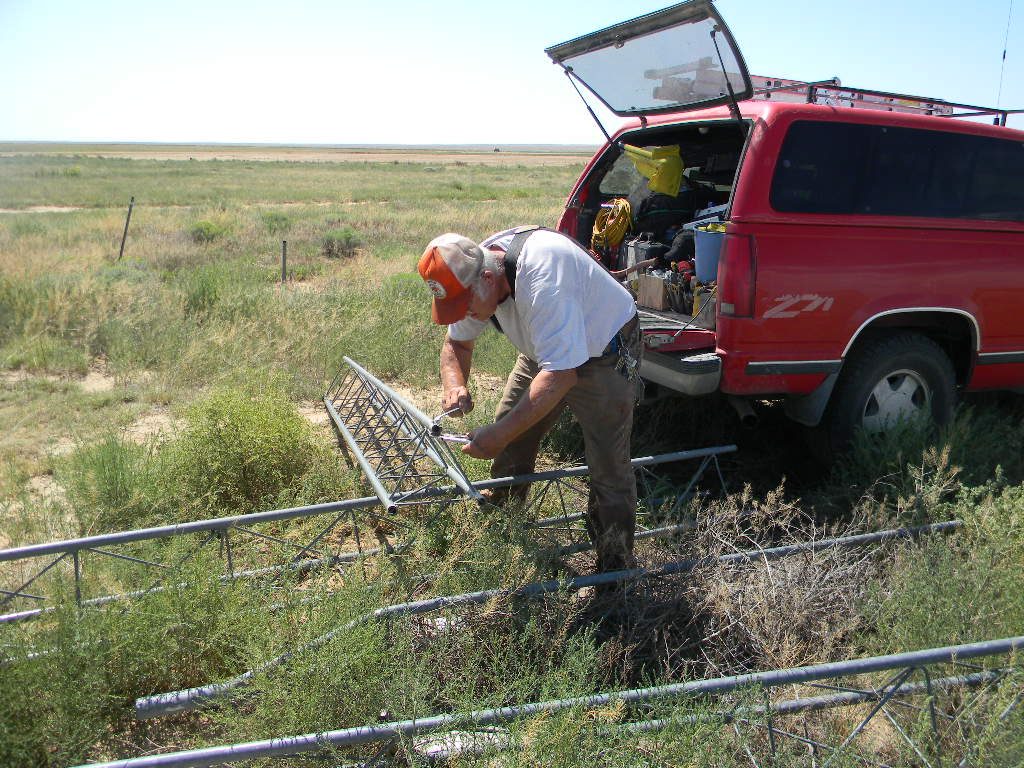
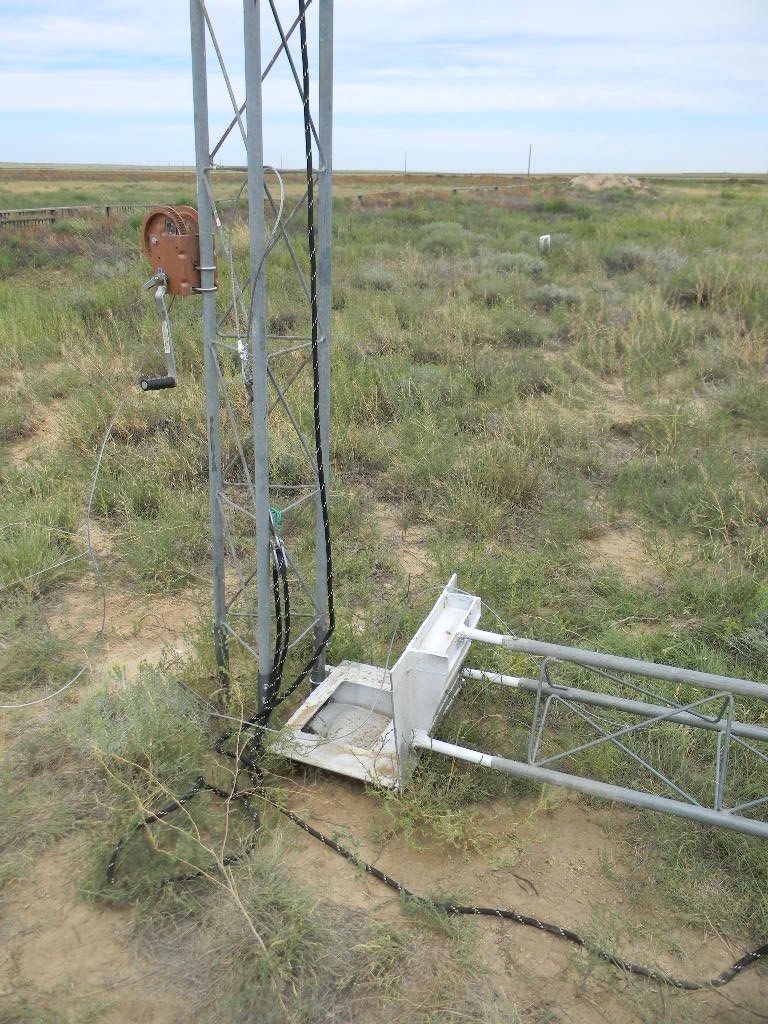
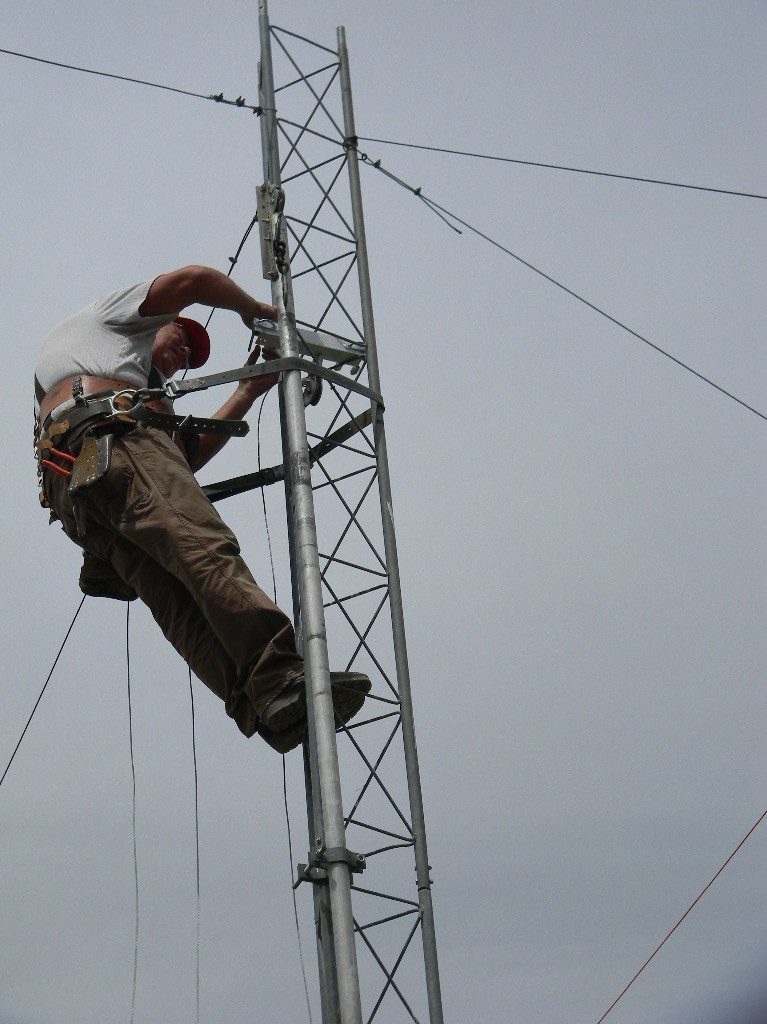
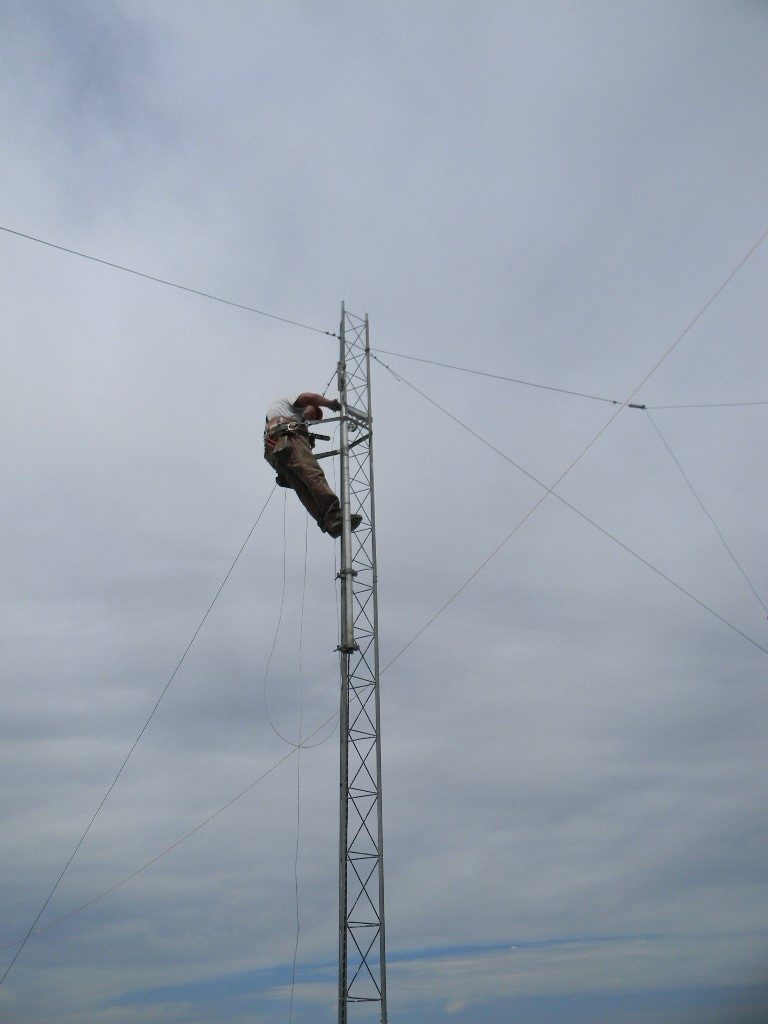
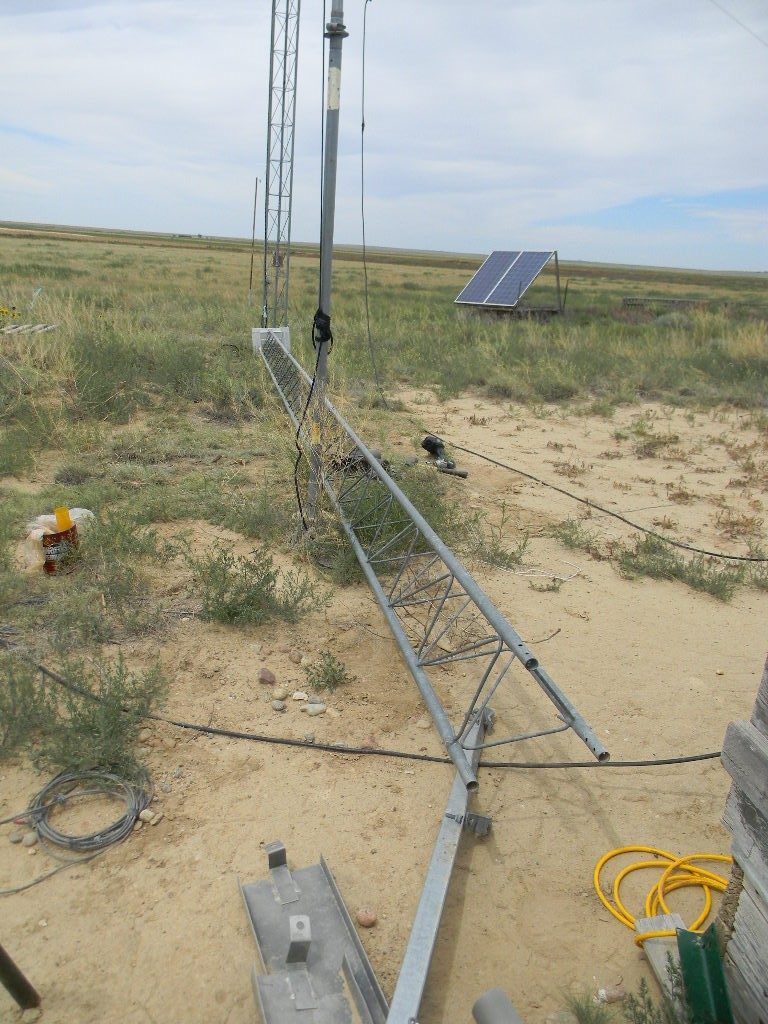
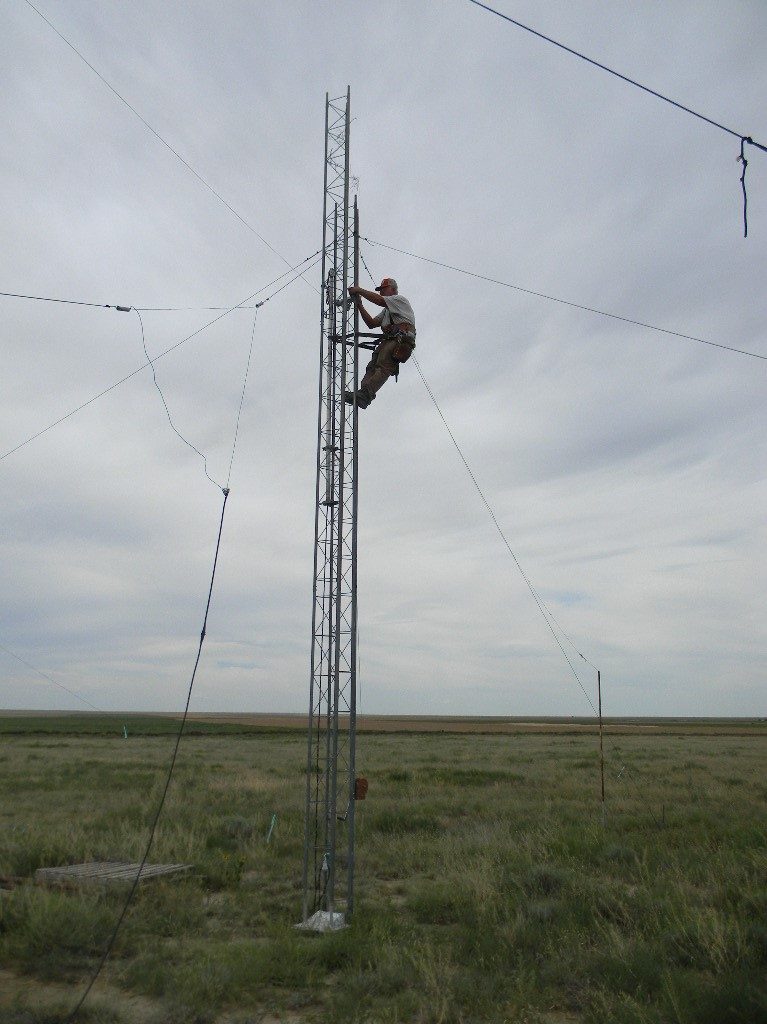
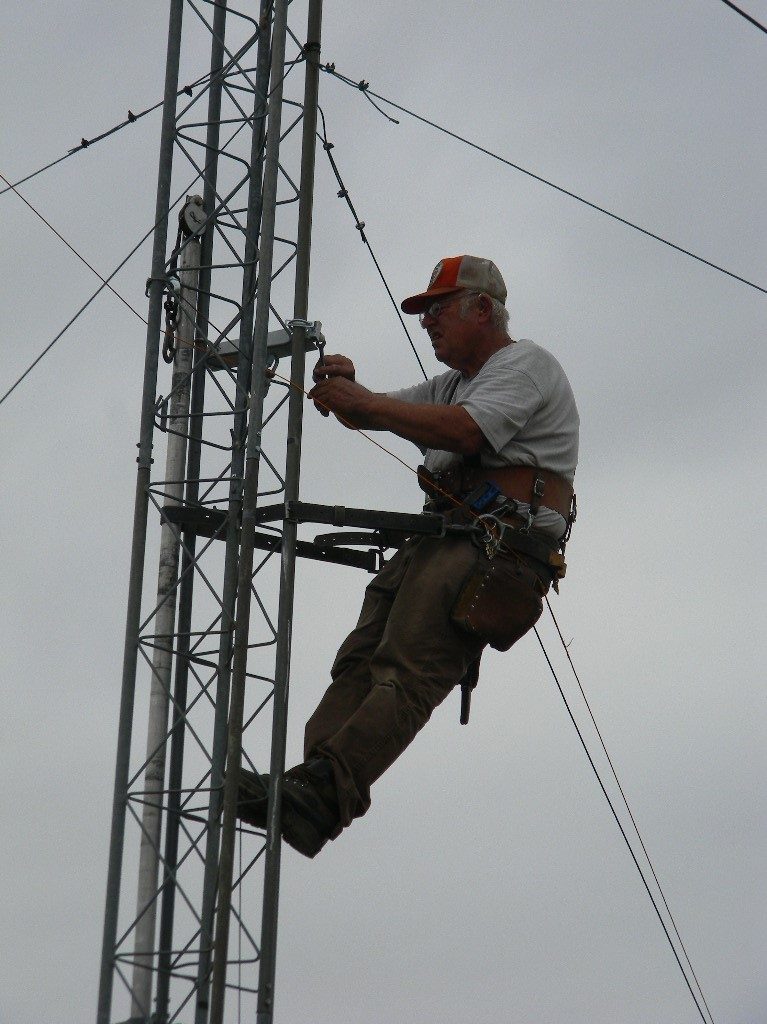
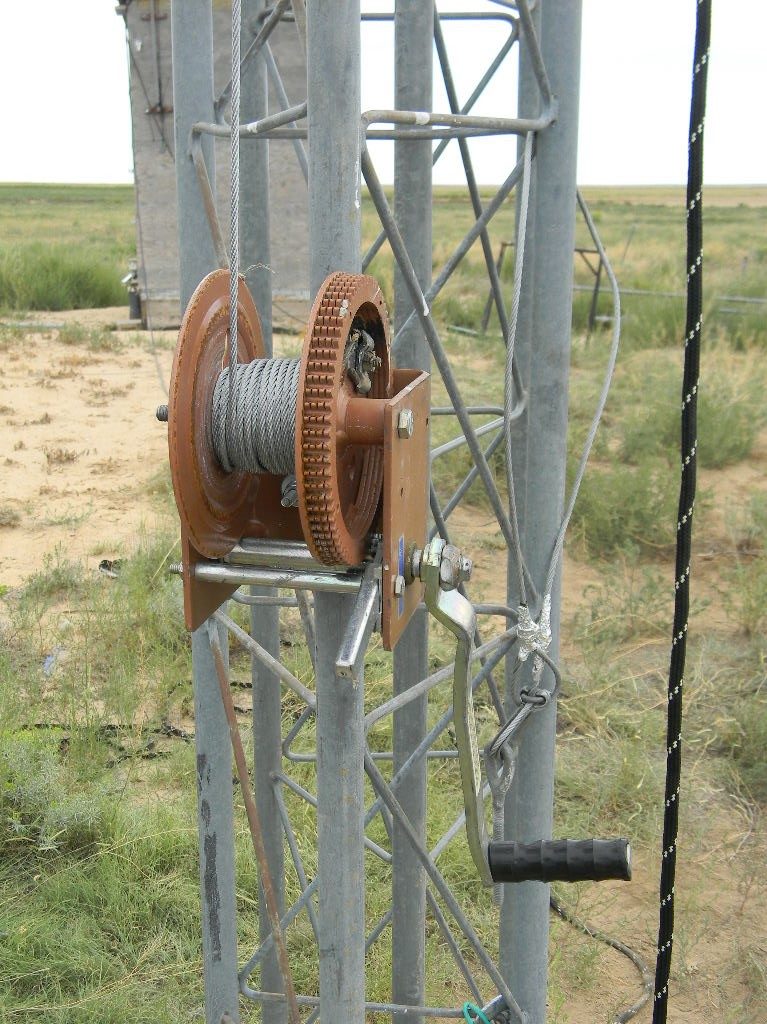
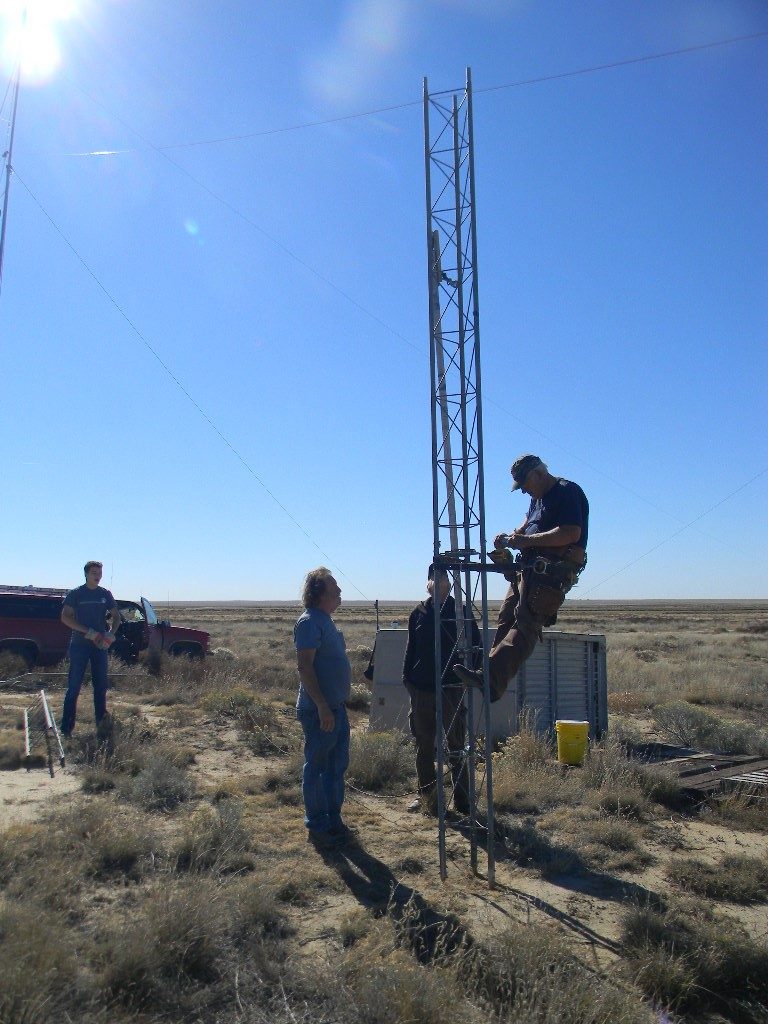
We assembled the tower components out to a length of 50 feet, including the top that will hold the rotor. The tower is now designed and built to rotate from a pivot point next to the existing tower that had been started earlier. Ed climbed that original tower to install the pulley; the pulley leverages and pulls up the 50-foot tower by rotation at the pivot. We tested lifting the 50 foot tower with the hand crank winch that I think came from Steve. The design works. We eventually will need to take down the mast that supports the 80 and 160 meter dipole antennas, to complete the tower build-out. We plan to re-attaching those antennas to the tower itself, when we are ready to complete the tower. Ed has already fabricated two standoffs that will attach to the sides of the tower, and centrally support the dipole antennas.
Ed from time to time went to help Steve. And Steve once in a while came to help with the tower assembly.
Ed removed metal plugging the insides from a previous tower connection.
The base of the new antenna tower pivots next to the already existing support tower. The rotating winch on the support tower will pull the antenna tower and lift it up or down.On each of the three connecting tubes, on each of the tower elements, a set of two screws each were bolted to fasten the connections.Ed Corn attached a pulley (fabricated before) to the support tower.Three of the 10-foot antenna tower sections connected, and connected with the base pivot. The cable from the winch has been threaded through the pulley on the support tower above, and connected to about the 20-foot point on the antenna tower. The pipe mast visible in the photo is the center support for the existing 80 and 160 meter dipole antennas. The new antenna tower, besides supporting the directional antennas at top, will replace that mast and support those dipoles.We tested rotating up the antenna tower with three 10-foot sections assembled. After Ed verified that the placement of the pulley was good, he securely fastened it. The winch with cable installed, used to lift and lower the antenna tower for service. The handle crank is geared. The lock pin enables free movement, movement in one direction, and locking.The top section of the tower, ready to be attached.Steve helped Ed and I complete the final assembly of the tower.
We had a lunch break together in the bunker. I brought a small coffee maker and brewed coffee for Ed and me.
The weather was good, considering the heat we’ve been having lately. High cirrostratus and mid level clouds from storms in the distance covered us for the afternoon, and kept the heat and sunshine comfortable. We saw rain showers in the far distance, but those never came close enough to bother us. The bunker thermometer read 75 F, and outdoors was probably just a little warmer.
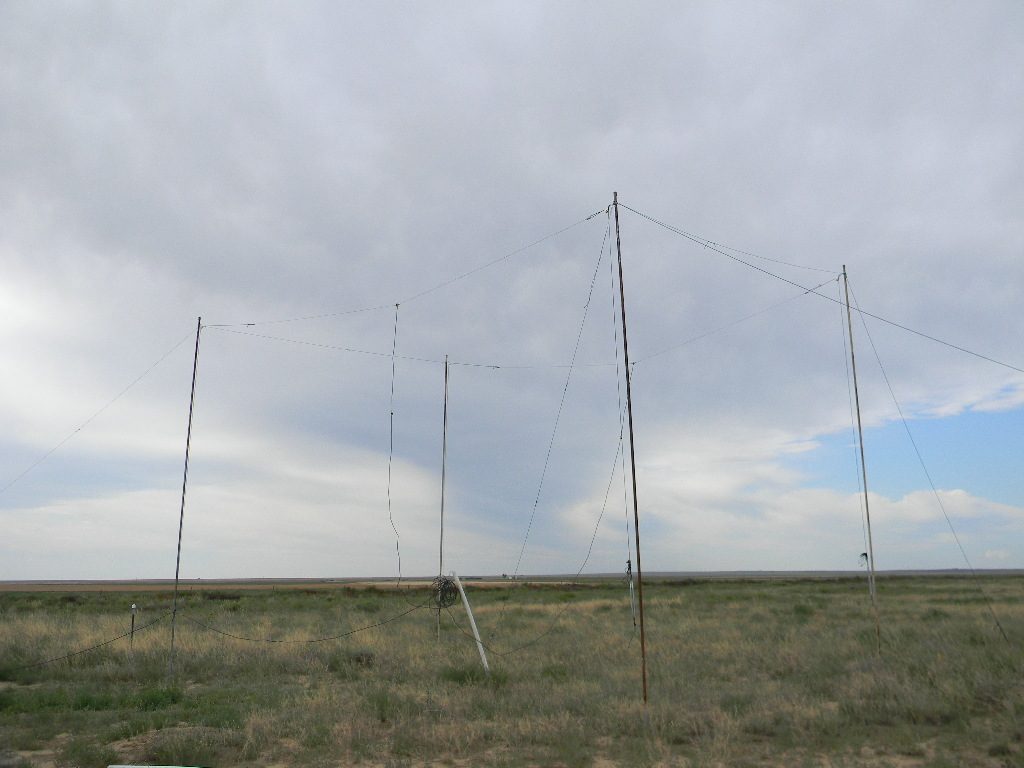
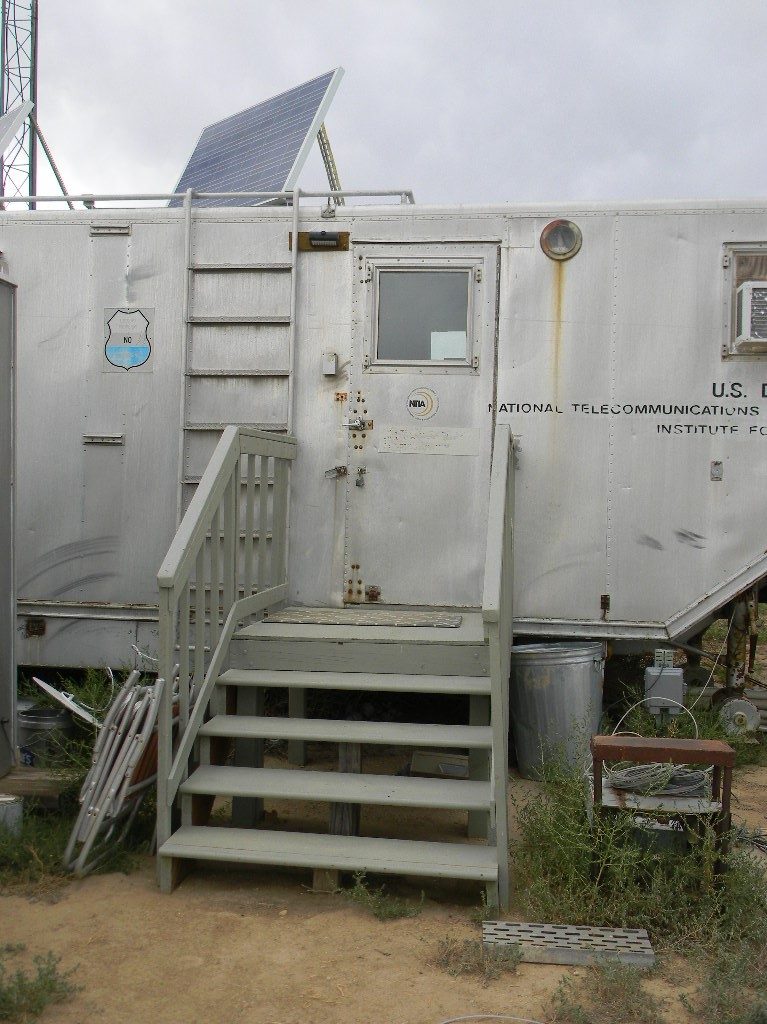
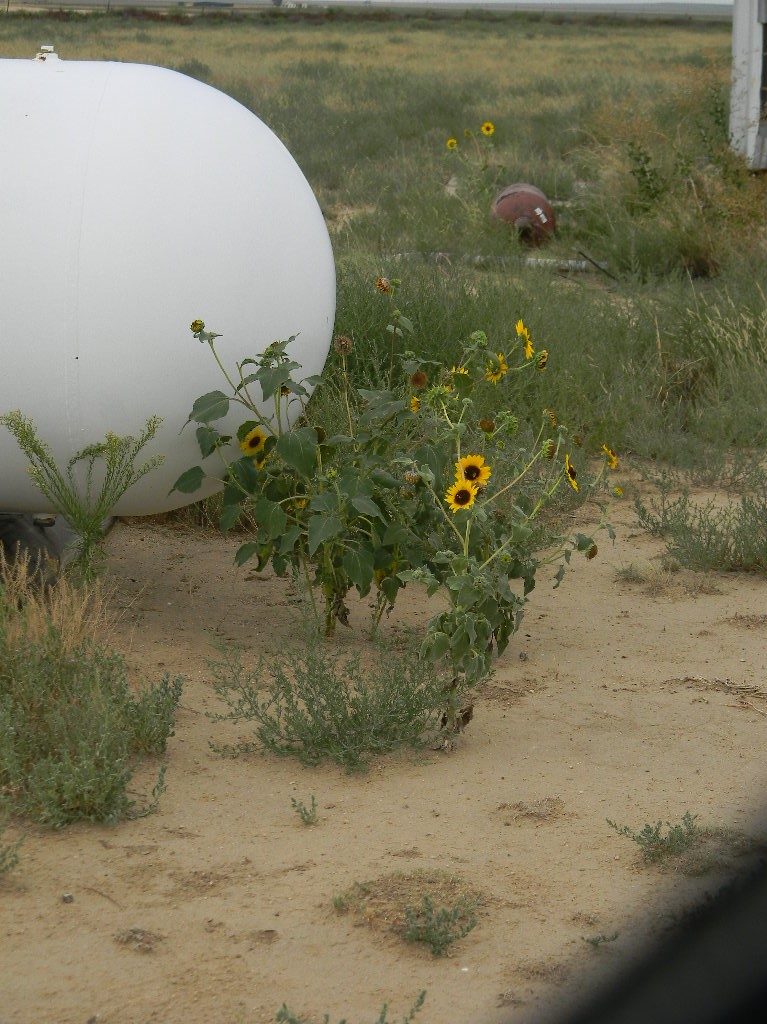
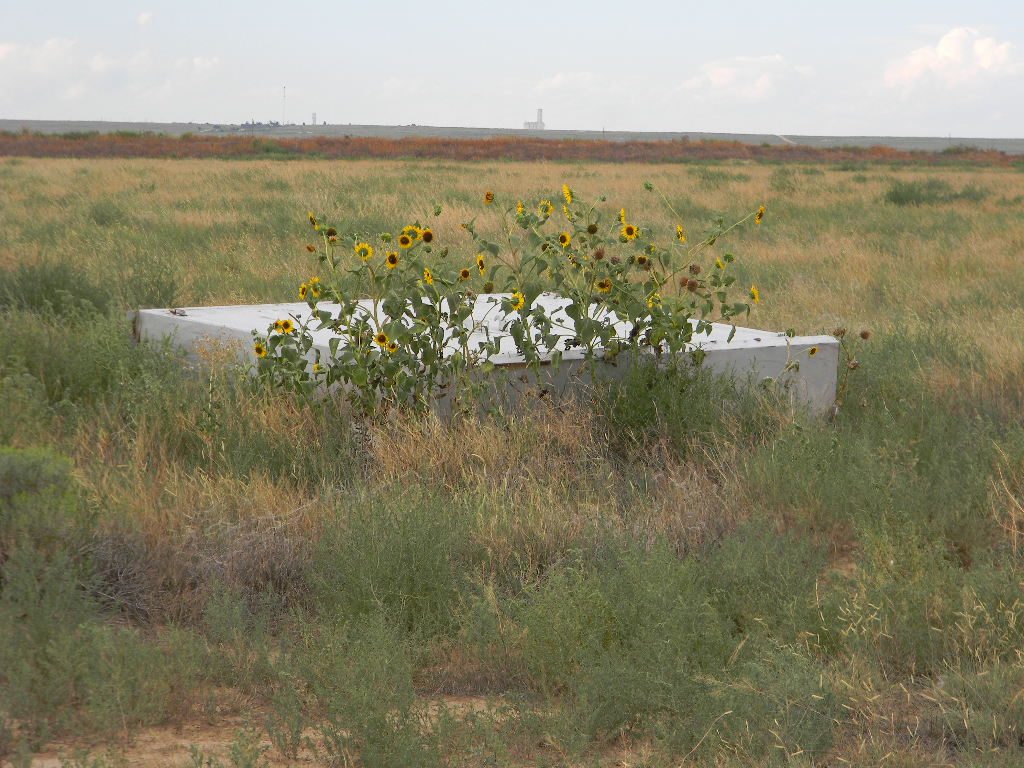
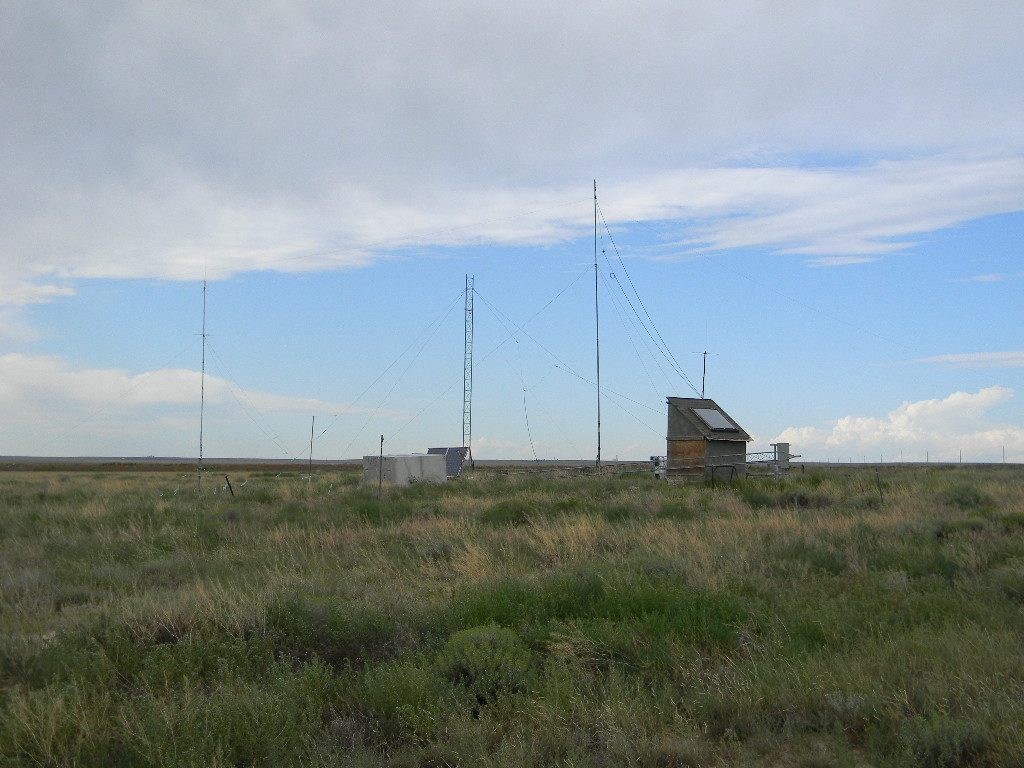
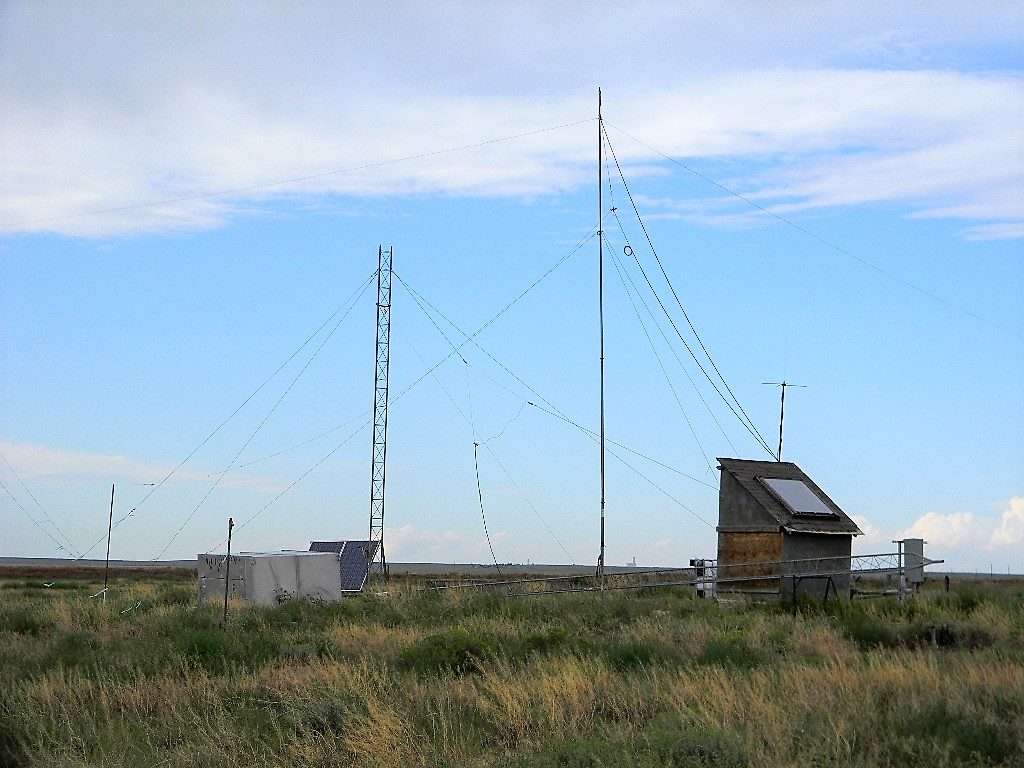
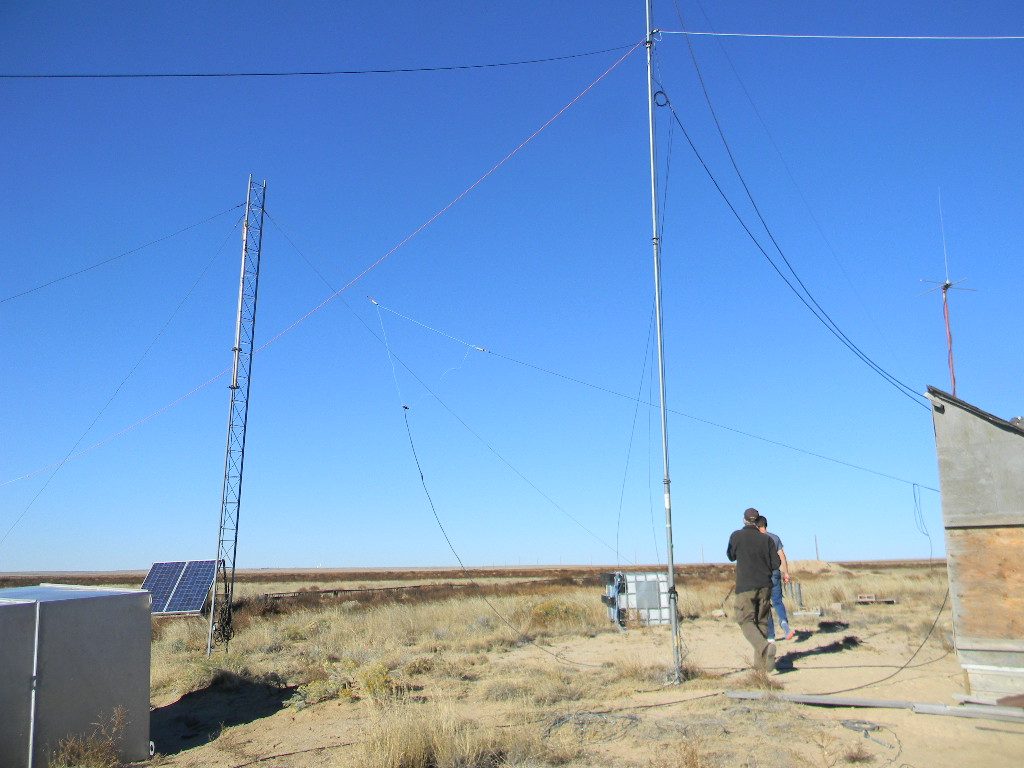
The Radio Jove phased dipole antenna array.Bob Haggard’s steps provide much easier access to the Communications Trailer.Sunflowers were blooming everywhere.The bunker antennas in their configuration right now.
During a break I got on the air at the bunker station, and made 12 contacts for QSO parties that were running: 1 to Hawaii, 5 to Ohio, and 6 to Kansas, on CW and SSB, on 20 and 40 meters. I submitted our logs to those QSO parties later.
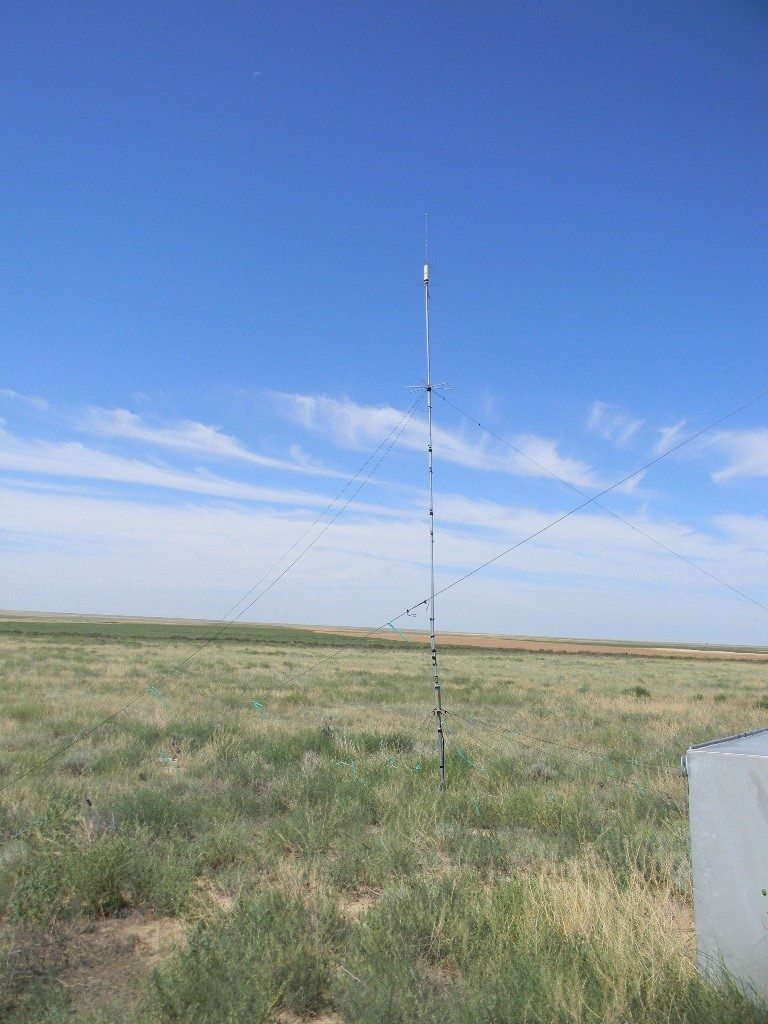
The 5 band vertical ham radio antenna, still in good working condition after the repair from the May storm. Photo taken in the late morning soon after we arrived. We used this to make our 12 ham radio contacts on the 20 and 40 meter bands.
Here is a quick site
trip report on the work the System 1 team (Phil Gage, Lewis Putnam, Dave Molter
and Glenn Davis) completed at the Haswell Site yesterday (8/17/2019):
We installed Version 4.0 of the System 1 software. This version includes a major new capability that supports manual tracking of astronomical objects. I would like to demonstrate this capability at the next Science or Engineering meeting.
Version 4 included a software update to fix the Elevation Axis Bounce Issue (Erroneous Elevation Axis Status) that was identified earlier this summer and has been investigated for several years. The problem was related to the Elevation Axis Integrity Instruments 232M200 I/O module. Due to a board related hardware problem, the I/O board was always reporting bit 2 of the encoder position data as “stuck” on (1) which would create erroneous Elevation encoder data. The fix required both a hardware and software modification. The hardware modification included moving the bit 2 pin to an unused position on the connector to the I/O module (see #3) then provide a software fix that would read data from this new bit position and re-incorporate the bit data back into the Elevation encoder position data – bypassing the bad bit. This hardware/software solution has fixed the problem. The Elevation Axis is now providing the correct encoder positions through it’s range of motion and the “bouncing” has been eliminated.
Dave Molter moved and soldered the “bad” Elevation Axis hardware pin to support the software modification that fixes the Elevation Axis Bounce issue.
Collected Voltage to Rate information for both axis – data below:
Voltage
(V)
Azimuth
Rates (Degs/Sec)
Notes
0.00
0.00
Minimum
Potentiometer Setting
0.20
0.04
0.39
0.08
0.50
0.11
Normal
Potentiometer Setting
0.75
0.17
1.50
0.33
Voltage
(V)
Elevation
Rates (Degs/Sec)
Notes
0.05
0.06
Minimum
Potentiometer Setting
0.17
0.07
0.35
0.08
0.75
0.11
1.52
0.15
Normal
Potentiometer Setting
3.72
0.30
4.24
0.34
5.00
0.42
Please note: We were unable to produce zero rates on the
elevation axis – even with the potentiometer turn all the way down.
Additionally, though we believe we returned the potentiometers back to their normal positions, whoever returns to the site for the next data collection, please ensure the potentiometers are at their normal positions before use.
My wife and I spent the day at the site cleaning up the last of the electric basic infrastructure build out. That portion is complete with the following items completed.
Basic plug ins complete including a GFI plug near the sink and one in the bathroom for portable heater.
A pre wire and extra switch in bathroom for future ex-host fan and an electric water heater for shower and kitchen sink.
Box and wiring for sewer pump when that project starts.
Wall switch and permanent light in sleeping area.
The tunnel lights now have a control switch at both ends.
240 volt plugins for amplifiers at the Amateur operating position.
The sub main electric panel in the battery room is complete and the main panel has the trim cover installed.
There will be extra plugs and services that will be needed in the future but basic build out is complete.
* *
Scheduled Maintenance Trip Report for July 20
Steve and I went down
Friday the 19th. We met Paul Berge at the house in Haswell. Paul and his wife
came down Thursday and stayed over Thursday and Friday nights. Steve and I
stayed in the bunker Friday night.
Paul worked on finishing installing the control wiring in the pedestal in the conduit for mechanical protection, and he installed heavy duty override switches in the override panel in the comm trailer. He also gathered information for some updates on the control wiring. He will be working on the updates at his home computer.
Steve worked on the
fiber link from the feed point to the comm trailer. The wind came up Saturday
so Steve will complete work later as the wind was a safety issue trying to work
up at the feed point. Steve did say the az/el readout worked after cycling
power.
I have the two 30 amp plug-in circuits at the old generator building completed to give us 2 more RV parking spots with heavy enough power to run 1 air conditioner in each RV. Just for information to turn lights on in the generator building you will have to turn the circuit breakers on in the distribution panel in the middle of the North wall.
DSES Plishner Site Trip Report 6-14-2019 By: Bill Miller, Bob Haggart. Photos by Bob Haggart.
Location: Plishner Radio and Space Science Center, Haswell, Co. Attendance: Steve Plock, Rich Russel, Jonathon Ayers, Floyd Glick, Bob Haggart, Bill Miller
Accuracy: This is only a summary of my work on Friday and Bob Haggart trip from his report for Saturday and you should add your own and correct anything I missed. WKM.
Bill Miller’s Work Trip Report, Friday, June 14th Bill was the first to arrive at the site about 10:15 on Friday 6/14 and started by opening the trailer and removing the exhaust fan cover. He lubricated and reattaching the fan wires, started the air conditioners, swept the Comm. trailer floor and removed the mud left from the last visit. Steve came in shortly after and he and Bill went to the top of the tower to inspect the Liquid-tight conduit that Steve had previously installed for the elevation position synchro wiring.
Jonathon Ayers came in and assisted Bill to hook up the wiring to the synchros on the elevation axis in the top deck.
Bill then got some assistance from Floyd Glick while hooking up the wiring in the control deck of the dish pedestal. Thank you to Jonathon and Floyd. The goal was to attach the Elevation position synchro encoders to the synchro panel in the Comm. trailer. This would match to connections of the Azimuth synchros previously installed. It would complete the synchro dish position indicator system which is an accurate minimal tech backup dish positioning system that needs no computer.
Bill was under a tight schedule as Rich had a pulsar observation planned to start at 3:30. Bill tested the system and it worked initially but then started tripping the ground fault interrupter on the synchro panel within a few minutes indicating that the insulation or electrical clearance of the elevation connections was breaking down somewhere in the path. Because this circuit is 120VAC, the ground fault interrupter is critical to safe the system with the many intermediate connections and it did its job. (Caution) Bill unplugged the synchro panel from AC and it should be left unplugged until we have a chance to trace down the fault in the elevation wiring. It is most likely in the old terminal box in the control deck, moisture in the system or hasty wiring in the elevation axis Encoder box. I also believe that the synchros in the elevation axis box are either bad or incompatible and should be changed out and matched to those in the trailer synchro panel. Ed Johnson has a box of synchros from the bunker.
Bill had to leave about 4:00PM while Rich, Floyd and Steve stayed to make their Pulsar observation. This seemed to be going well but the large storm was brewing in the area and I suspect they had to abandon the site that evening.
From Bob Haggard’s Work Trip Report. Saturday, June 15th Arrived at the DSES site 8:35am. Opened gate, opened the bunker to retrieve keys. Noticed the dish was setting at about 45 degrees. Opened the Ops trailer and the battery box for 110V AC power. Mounted the solar powered, dusk to dawn, LED porch light. Removed the camera and the broken rear trailer window. Installed the clear window and camera right side up. (there you go Rich) The molding to hold the window in was rotten, have to make 4 new ones. The putty was too old to be used, will need more on next trip.
Removed two folding chairs from battery box and stored them in the OPs trailer under the table next to the filing cabinet. Stored the donated table saw and stand in the battery box. Picked up all unused unwanted lumber (there you go Steve)
Secured the battery box and the Ops trailer. Returned the keys to the desk and secured the bunker and gate. Secured the main gate and departed at 2:45.
No one else showed up for this work day.
The weather was perfect, a mild breeze, just enough to keep you cool while working in the hot sun.
(Editor’s Note: This is Ed Corn’s report of our work at the Plishner radio telescope site during the weekend of May 18, 2019 – Gary, WA2JQZ)
I arrived about 9:30 AM and proceeded to the generator shed to install breakers and to survey the conduit route for 2 extra camper hook ups. The breaker box is ready. I will run conduit and wiring during another trip prior to the open house.
Steve Plock arrived shortly there after. We traveled separately so Steve could stay over with Paul Berge, as I have a graduation to attend on Sunday. We looked at the ham radio tower project. All the hardware is on site but tower climbing is out for most of us. Steve decided we will assemble the tower on the ground, and tip it up with a winch at a later trip. We need a few extra parts to do this which are easily obtained or fabricated. Gary Agranat arrived and went to work on the vertical antenna. The vertical was damaged during the blizzard storm several weeks ago. He has a list of all needed parts for fixing on the next trip.
Steve moved the dish to the work stand and checked the control voltage for the feed to the preamps, and adjusted for voltage drop in the line from the communications trailer.
Steve and Gary then worked on tuning the 16o meter and 80 meter wire antennas. (Gary added: We trimmed the lengths to retune the antennas to about the center of the ham bands. The 160 meter antenna was tuned to 1.9 MHz, with a best SWR of 1.7:1. The 80 meter antenna was tuned with an SWR of 1:1 from 3.8 to 3.9 MHz. Before the tuning, each antenna was slightly long, which therefore gave better performance at the low ends of the bands. The retuning enabled better resonance in the phone portion of the bands, where several members like to participate in nets.)
I moved into the bunker and pulled wire for the sub main panel in the battery room, in preparation for the hot water heater for the sink and shower and the sewer pump system. The sub main is complete, ready for extension of the conduit runs on a future trip.
Paul arrived late afternoon and stayed the weekend with several items he wanted to work on.
Deep Space Exploration Society members Bill Miller, Gary Agranat, and Tony Bigbee participated as judges at the 2019 Pikes Peak Regional Science Fair. The Fair was held at the University of Colorado at Colorado Springs University Center building on Saturday February 23rd. This year 115 students from 20 schools presented projects. The purpose of the fair is to encourage students to take more active interest in the study of science and mathematics, to encourage experiment and consideration of science careers, and to provide a means of reward and recognition. Informally the fair gives students an opportunity to interact with and get helpful feedback from specialists already in the fields.
Bill and Gary were at the science fair to judge and award prizes specifically offered by DSES. The prizes were offered to encourage projects related to astronomy and radio. However any outstanding STEM project related closely enough to the fields were considered. Bill and Gary interviewed 17 students in 16 projects at the fair, at the middle school and high school levels, with most of the topics in physical sciences or engineering. A scoring criteria was used based on the qualities of the ideas, hypotheses, methods, data, and lessons learned.
DSES awarded one Senior Division prizes and two Junior Division prizes:
For outstanding senior division project we gave a certificate and $100 to Mark Bloomfield. Mark received 6 additional special awards from other organizations, and he placed 3rd in the Fair’s Senior Physical Sciences category.
• Mark Bloomfield [grade 11] [project SC9], Coronado High School/David Bloomfield: ‘‘Charged up: Testing lithium ion battery performance using a Raspberry Pi load cell’’
For the two Junior Division prizes we gave a certificate and $50 each to Hailey Kressen and Benjamin Homan.
• Hailey Kressin [grade8] [project 8E10], The Classical Academy JHS/Candus Muir: ‘‘A sixth sense: Omnidirectional presence detection system’’. Hailey received 6 additional special awards, and she placed 2nd in the Grade 8 Physical Sciences & Engineering category.
• Benjamin Homan[8] [8E1], Monument Academy/Karl Brown: ‘‘Does pressure affect carbondioxide absorption by polyethyleneimine?’’ Benjamin received 5 additional special awards, and he placed 4th in the Grade 8 Physical Sciences & Engineering category.
Tony participated as a general Award Judge for the Fair itself. He judged middle school social and behavioral science projects.
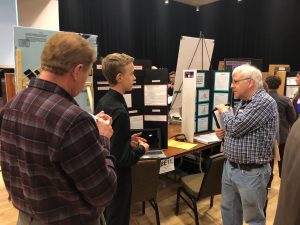
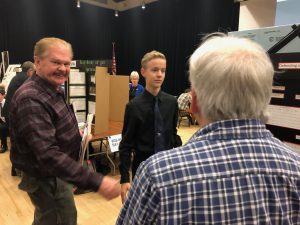
Tony took a few minutes to take some photos. The first three photos are from when Bill and Gary interviewed Connor Takenaka about his cybersecurity project. The third includes Tony.
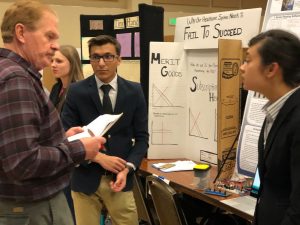
Bill is show interviewing Josh Nakka and Katelynn Salmon for their Senior level science project “Engineering a portable refreshable braille device for improved communication.” Gary is interviewing Jenna Salvat for her Senior level science project “A geothermal analysis of metamorphic lithologies surrounding Cripple Creek and Victor Diatreme”.
Projects Bill and Gary interviewed:
“Shields Up” by Samantha Cerniglia. She tested the ability of several materials to block cosmic rays. She built a cloud chamber to do the tests.
“LED Lights: Hero or Zero” by Michael Wu. He tested energy efficiency savings claims of a set of consumer LED lights, and found those fell short.
“Energy Efficiency” by Samantha Schaefer. She tested the effects of placing different colored filters on solar energy panels.
“This Will Blow You Away” by Levi Archambault. He tested the efficiency of windmills with different number of blades, with different wind speed conditions.
“Prevent Basement Floods” by Austin Cellar. He designed and tested a low cost device to detect basement water leaks and flooding, and send an alarm.
“Cleaning glasses with portable ultrasonics” by Ty Rockey. He researched, designed, and tested a low cost device to clean eye glasses using water cavitation.
“Does Pressure Affect Carbon Dioxide Absorption by Polyethyleneimine (PEI)” by Benjamin Homan. He tested the ability of PEI to absorb carbon dioxide at sea level and 7350 foot elevation pressures. He utilized previous research by others and theory that predicted lower pressure would result in less absorption, due to fewer number of molecules per volume. The material would be applicable to CO2 scrubbers in submarines and spacecraft. Benjamin won one of our two Junior Division prizes.
“Analyzing how various hydroelectric designs can ameliorate the accessibility of tides” by Chandler Wilburn. He tried to design and test an alternate way to generate electrical power from tides, using a large pressure plate instead of flow past a turbine.
“Neodymium field slide” by Amir Laarja. He tested different position configurations of magnets in a generator, to test differences in efficiency.
“A sixth sense: Omni-directional presence detection system” by Hailey Kressin. She designed and tested a system to detect the presence of approaching objects within 1.5 meters in 1 second, to aid people who are blind. Hailey won one of our two Junior Division prizes.
“Cybersecurity: Defending our Computers” by Connor Takenaka. He tested the effectiveness of different length and complexity passwords to prevent or delay hacking.
“Variable scintillation frequency in muon detection” by Xander Duvall.
“Using Solar Radiation” by Erick Lopez. He tested the effectiveness of several designs for homes to retain heat from solar heating.
“Engineering a portable low-cost braille device for improved communication” by Josh Nakka and Katelynn Salmon.
“A geothermal analysis of metamorphic lithologies surrounding the Cripple Creek and Victor diatreme” by Jenna Salvat.
“Charged up: Testing lithium ion battery performance using a Raspberry Pi load cell” by Mark Bloomfield. He developed a Raspberry Pi constant load cell to test how temperature, drain rate, and charging patterns affected energy recovered in charging. Mark won our Senior Division Prize.
Bill presented the DSES awards at the science fair awards ceremony on the following Tuesday, February 26th.
Personnel present – Bill Miller, Ed Johnson, Steve Plock, Ed Corn, Myron Babcock, Bob Haggard, Glenn Davis, Phil Gage, Hans Gaensbauer, Rich Russel.
Rich Russel and Bob Haggard showed up Friday, joined later that day by Hans Gaensbauer. All three spent the night and Rich did radio astronomy observations. Bob Haggard finished the new front stairs for the communications trailer. Thanks Bob they look great! Everyone else came the next day. Glenn Davis and Phil Gage upgraded the software on pointing System 1, and Glenn installed the NTP server as well. Bill Miller and Ed Johnson were able to demonstrate go-to functionality on System 2 and the PID algorithm employed operated flawlessly. A milestone has been achieved and Ed plans to attempt sidereal tracking as his next step. Congratulations to all members of both pointing teams!
The fireproof door for the bunker hallway was cut to size by Steve Plock, Myron Babcock and Hans Gaensbauer. Ed Corn continued with electrical buildout in the bunker.
Again many thanks to all who participated and worked in the spirit of friendship and cooperation.
Bob Haggart N0CTV is working on building a new stairway and porch to the communications trailer at the radio telescope site. He started the work at home after taking measurements. Today he traveled to the site to continue the work. With him were his grandson Allen and Allen’s friend Ben. Bob writes:
“We arrived at 11 AM. Worked on the porch and covered the fan with 24″ X 24″ plywood. Ran out of time but did get the porch assembled and painted inside and out. The hand railing is only temporary and will finish next work day on the 17th.”
Bob’s work is replacing a small simple set of metal steps that has given us access to the communications trailer.
The original set of steps to the communications trailer. Bob’s new porch and stairway is replacing this.
The new porch and stairway provide a great improvement.
Bobs has built this new porch and stairway. It is larger, sturdier, and gives much better support. The handrail is temporary. The permanent handrail is planned to be installed on the next group work trip on Nov. 17.
Bob Haggard N0CTV, standing with his work.
Thanks to Bob for all this work, and for improving the access to the communications trailer.
This is a summary of our activities at the Plishner radio telescope site during the third week of October 2018. Steve Plock, Ed Corn, and Gary Agranat contributed to this report.
Participants this weekend were Gary Agranat, Paul Berge, Tony Bigbee, Ed Corn, Hans Gaensbauer, Dave Molter, Steve Plock, and Rich Russel.
Our plan for the rest of the year is to work at the site during the third weekend of each month. The Friday evening is devoted to astronomical observing, and the rest of the weekend is then devoted primarily to infrastructure and equipment work.
60-foot Antenna Observing, by Gary Agranat, WA2JQZ
On Friday afternoon and evening Rich, Gary, and Paul did 1420 MHz neutral hydrogen observing with the 60-foot antenna. The primary observing goal was to take regular measurements of the hydrogen signal along the Milky Way galactic plane at 10 degree intervals, from the galactic center to about 110 degrees (a little more than the first quadrant). The Doppler shift of the hydrogen was measured at each 10 degree point. From that, Rich later used some basic geometry to derive a velocity and distance from the galactic center for each measurement. A second goal was to observe several known, strong galactic radio sources that could be used in the future for calibration of our observations, and also to see if we are capable of observing those sources in a consistent way (without unknown biases). A third goal was to observe additional galactic sources as targets of opportunity, to see how well we do, and to also see what problems we hit.
Galactic plane observing started at about 5 pm local time, when the galactic center in Sagitarius had risen high enough in the sky for us to observe. The galactic plane and most of the other observing were done with the 60 foot antenna pointed along the meridian (180 degrees azimuth to the south and zero degrees to the north), in order to eliminate the Earth’s rotational motion in the Doppler shift measurements. We observed until about 10:30 pm, when the team was then quite tired. To warm us up during the evening, we made a batch of hot apple cider.
Details of the observations and results were discussed at the science meeting on Monday October 22nd, and those will be covered in a separate post.
– Gary WA2JQZ
60 foot dish antenna on Friday late afternoon, as the galactic plane observations started.
We’ll continue with the discussion of the weekend infrastructure work.
Saturday Infrastructure Work by Ed Corn, KC0TBE
Our first order of business was to re-service the toilet and spare in the outhouse. They now both have RV antifreeze for winter. Next installed was a portable heater for winter operations and I labeled all the breakers in the out house. I then labeled the doors with instructions for emergency exit and the safety pin for privacy at the main door.
With the help of Gary, Hans, and Paul we have the first 3 tower sections in place at the bunker, along with the first set of guy wires. [More about the tower below.]
-73’s Ed KC0TBE
DSES Site Work Report by Steve Plock KL7IZW, DSES President
Paul Berge worked on Friday, Saturday and Sunday. Because he travels from Lyons, Co. he prefers to maximize his efforts each visit. Also the weather window for the year is closing. I attempt to support his efforts as best as I can. Paul provided support for Rich Russel’s data acquisition which included galactic Doppler measurements. The team knocked off before midnight. Results have already been detailed in the Science meeting on 22nd of October.
On Saturday Ed installed a heater in the outhouse, winterized the RV toilets, and labeled the outhouse breakers.
During Saturday afternoon Hans, Ed, Paul, Steve and Gary all worked together to erect the new communications tower. The first set of guys were finished at 23 ft. by Ed Corn doing all the climbing. The majority of the rest of Saturday myself and Paul spent evaluating the elevation limit switch operation, including testing complete functionality with fault clearing via the built in override capability.
Later that day, Tony Bigbee showed up, and Paul and Steve supported subsequent hydrogen observations using the RASDR4 receiver.
The majority of Sunday was consumed by lubrication of the dish and adjustment of the azimuth drive chain. I also installed the conduit in the elevation bulkhead so that Bill Miller can complete his synchro wiring project.
Sunday Dave Molter worked into the night using the 500W floodlights and mixed over 1000lbs of concrete to try to prevent continued erosion in the ramp area. A big thanks to all who participated in this cooperative effort.
– Submitted by: Steve Plock, President DSES
Photos by Gary, from Friday and Saturday:
Position of the 60-foot antenna as it is pointed due south, at 180 degrees azimuth along the meridian.
The Moon with the 60-foot antenna.
View from the base of the dish antenna, looking towards Haswell.
Haswell as the sun set Friday evening.
Pikes Peak and Cheyenne Mountain were visible on the horizon, about a hundred miles to the west-northwest.
Work Saturday morning at the outhouse.
Work at the outhouse, including labeling.
Hans helping Ed unload tower sections and a jin-pole, for building up the ham radio communications tower at the bunker.
The first section of the tower had already been installed during the last work trip. Here Ed is safely secured to the tower after the second section has been hoisted with the jin-pole, which is also temporarily securely attached to the tower. He is fastening the bolts of the second section on to the top ends of the first section. He did this again with the third section.
Ed fastening the bolts of the second tower section on to the top of the first.
The team standing ready as Ed works on the tower. Hans is standing by the third tower section.
The tower at left with the third section up. A 6-meter delta loop antenna was hung from the tower to the doghouse. Stainless steel guy wires were also extended from the third section, per tower specifications.
Hans, Paul, and Gary installed supports for the guy cables, at one-third intervals around the tower.
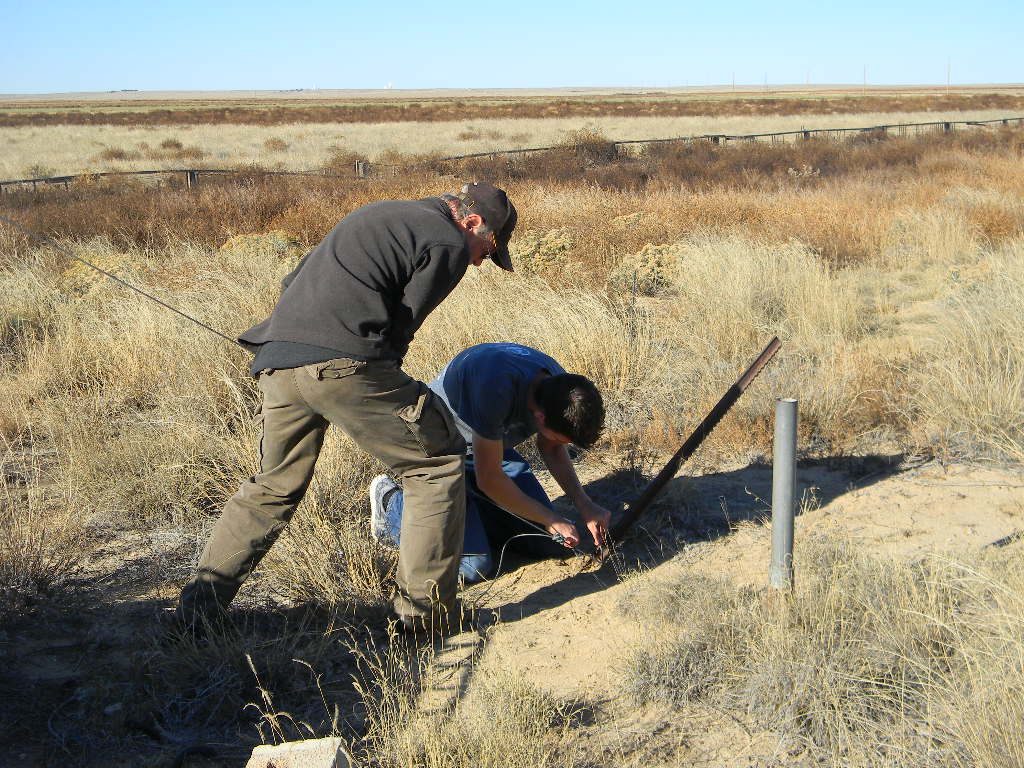
Hans and Paul securing one of the guy wires at the ground support.
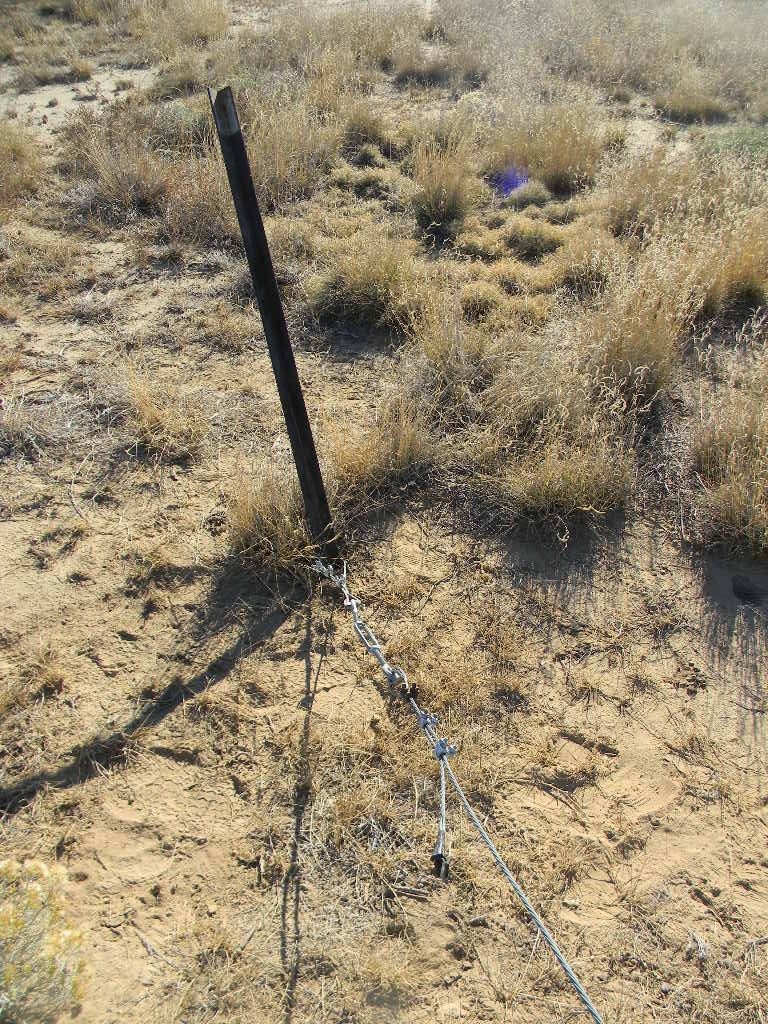
Configuration of the tower with 3 sections, until work resumes next time. The current plan is to install one more section with a rotator. The rotator shaft will have at least a triband HF yagi antenna and a 6 meter directional antenna for meteor scatter. Also, small horizonal supports will be added to support the 80 and 160 meter dipoles, currently supported at that position with a pole.
Here is our report of our work trip at the Plishner radio telescope site in Haswell, on the weekend of September 14-16, 2018. Opens as a PDF file. Illustrated with photos.