DSES Science Meeting, April 27, 2020

Meeting notes by Bill Miller, April 29, 2020.

We had 13 participants in the virtual science meeting:

Dr. Rich Russel, Ray Uberecken, Myron Babcock, Ted Cline, Bob Sayers, Jon Richardson, Jonathan Ayers, John R Kucypeh (sp), Xander Duvall, Tony Bigbee, Ed Corn, Gary Agranat, Bill Miller.

Ray gave a discussion of feed system modifications and plans fix the feed to enable Pulsar work.

Bill said we have to hold a virtual board meeting and elect officers from the board.  We also need to call the annual all members meeting.

Rich gave a presentation with slides (see below) on reduction and graphing of data sets from the  national observatories and Pulsar observations. He also discussed the data from his 9 foot dish and about how to understand the Hubble Galaxy and object classification nomenclature, such as MG0424+0435  where 0424 in the right ascension and +0435 is the declination.  He also discussed the gravitational lensing effect given by the gravity well of a foreground object bending the light  and radio emissions of a background object around it.  Prime examples of this are;  https://www.eso.org/public/images/eso9856f/ and https://en.wikipedia.org/wiki/Einstein_Cross  the Einstein Cross.  Rich gave data and discussion of the Betelgeuse dimming phenomenon and whether this may be preamble to the star going supernova.  While a supernova may be preceded by a few hours by an early warning detector of Neutrinos as Gary has outlined, it is unlikely that this is the cause of the dimming and Rich gave a discussion of his theory and simulation of a passing object shading Betelgeuse.

Xander Duval was in attendance and said that he had been invited to go to the state science fair when others dropped out.  At the Fair he won an award from Nasa on earth science systems and submitted his research paper to the Junior Humanities and Science symposium and scored another award in physical sciences there. We are happy that this worked out well and hope to help him with future work.

Bob Sayers has a 4 ft PVC Mag Loop antenna that he would like to give away.  This can be configured for use with a SuperSID setup.

Rich said that it can be used as part of the Astronomy League’s Silver/Gold certification for radio astronomy.  You need 5 projects, 2 of which you need to build yourself. Available projects are:

  1. SuperSID Monitor
  2. Radio Jupiter or Radio Jove
  3. Neutral Hydrogen (Hi) Measurement
  4. Meteor Scatter
  5. Itty-bitty Telescope

Jonathan Ayers has a paper up on the SARA Western Conference Proceedings.  Gary Agranat says check it out at http://dses.science/wp-content/uploads/2020/04/MitigateRFIinSCDriftScanDataPython.pdf [Python Program for Mitigating Radio Frequency Interference Observed in SpectraCyber Receiver Drift Scan Data Files, by J. Ayres]

Here is a drop box link to the meeting recording missing the first 10 minutes before I logged in.

https://www.dropbox.com/sh/2pqscwj7txr7d5p/AADq0yNlG2KI3ZZDE8lqfxEta?dl=0

These are the slides from our DSES Science Meeting, Monday evening April 27, 2020. Presented by Dr. Rich Russel. In PDF format.
DSES Science Meeting, April 27, 2020

Synchronized Multiple Radio Telescope Microwave SETI

This paper is an updated presentation by Skip Crilly K7ETI about the continuing SETI observation results we’re doing together. The DSES 60-foot dish antenna in Haswell and the 40-foot dish antenna at the Greenbank Observatory in West Virginia have been making simultaneous observations for SETI (Search for Extraterrestrial Intelligence) since November 2017. A third antenna in New Hampshire was added for taking data in December 2019. Simultaneous observing by sites distant from each other helps filter out local radio frequency interference (RFI). Signals observed at each site can then more confidently be identified as non-Earth in origin. This presentation summarizes the results, with additional data from February and March 2020.

The paper is available as a PDF file. Please click to read. Synchronized Multiple Radio Telescope Microwave SETI, by Skip Crilly [HamSCI 2020, March 2020]

This updates the previous presentation of February 2, 2020.

A New Map of the Milky Way

A new article appearing in the April 2020 Scientific American is “A New Map of the Milky Way” by astronomers Mark J. Reid and Xin-Wu Zheng.

https://www.scientificamerican.com/article/a-new-map-of-the-milky-way/

The article describes recent parallax studies, using Very Long Base Line Interferometry(VLBI) radio astronomy in Japan and North America, to more accurately determine the spiral structure of our Milky Way galaxy. The studies indicate also that the Sun is closer to the central plane of the Milky Way than previously thought.

These VLBI studies utilize natural MASERs that are produced by molecules of water and methyl alcohol in ionized regions just outside hot stars. Hot stars are always short lived, not lasting more than a few million years, because they rapidly burn through their nuclear fuel at their higher temperatures. They therefore are found close to their original location of birth. They are one of the features that define a galaxy’s spiral arms. And so to map the location of the hot star MASERS is a means to map the spiral structure of the galaxy. Radio astronomy VLBI enables angular position measurements to high resolution. The angular position measurements are used to measure the parallax over the course of a year, and therefore measure distance to more accuracy. The more accurate determination of angular position in the sky and distance therefore enables a more accurate mapping.

Radio astronomy observing and antenna repair at the Plishner observatory, February 15, 2020

Participants: Rich Russel, Bob Haggart, Glenn Davis, Lewis Putnam, Bill Miller, and Gary Agranat.

Photos by Bill Miller and Gary Agranat.

We worked at the Plishner antenna site in Haswell on Saturday February 15, 2020. We had three projects:

  1. Attempt at observing a circumpolar pulsar, utilizing the System 1 manual tracking system. (Rich Russel, Glenn Davis, Lewis Putnam).
  2. Complete building and installing shelf space in the Communications (Operations) Trailer (Bob Haggard).
  3. Repair of the 3-element Yagi ham radio antenna, to realign the three elements (Gary Agranat, Bill Miller, Bob Haggard).

1. The major task of the day was an attempt at a science observing run of a circumpolar pulsar. This is one of the brighter puslars in the sky. And being circumpolar, it is always above the horizon, though it can still get relatively low to the horizon. The observing technique required continually pointing a the celestial coordinates and integrating the signal for at least a half hour. By integrating over time, the random noise tends to cancel more, leaving the actual radio source signal the time to accumulate and sum to a higher level than the noise floor.

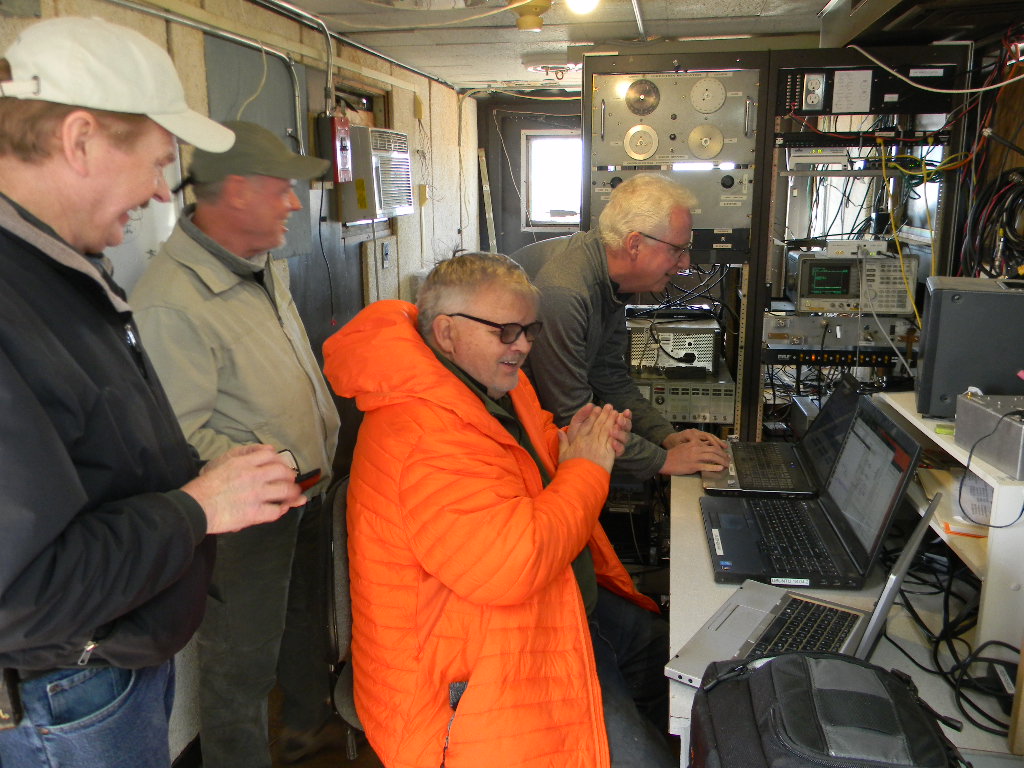
Science Lead Rich Russel (seated) and System 1 Lead Glenn Davis setting up the pulsar observations.
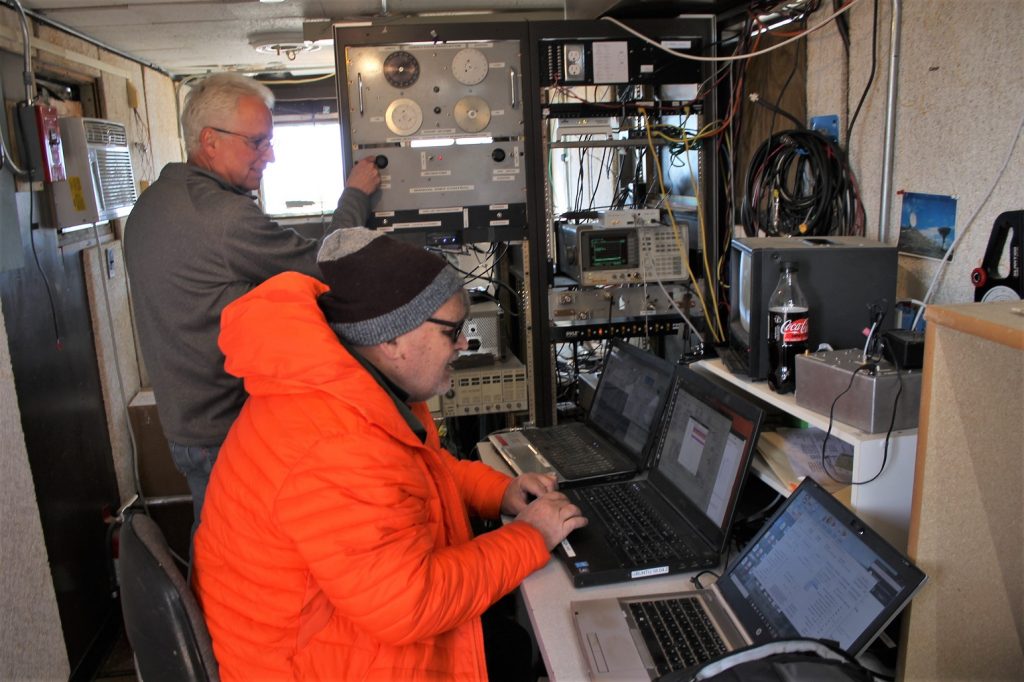
Bill Miller, Lewis Putnam, Rich Russel, and Glenn Davis in the Communications Operations Trailer during the observation runs.
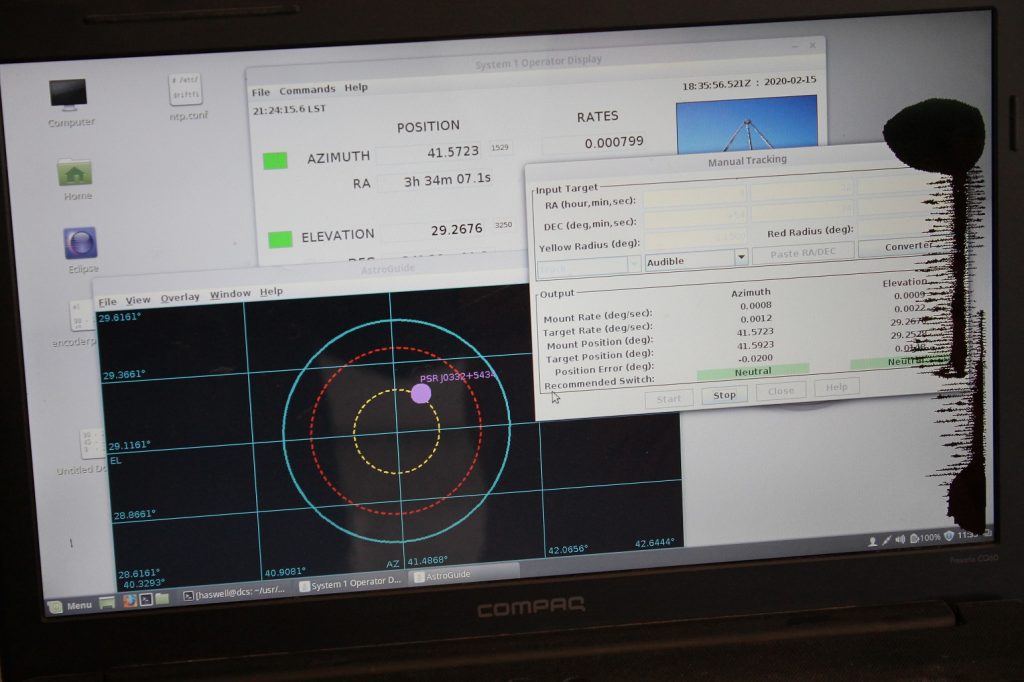
The display for the System 1 manual tracking. The circles in the black field represent the antenna beam width for different frequencies. The large blue ring represents a 4 degree diameter beam width, and is for the 408 MHz feed currently being used for the pulsar observing. The inner yellow ring is 0.8 degrees in diameter, which is for our HI hydrogen observing at 1.4 GHz. The pink dot represents where the center of the beam is pointing. A star field map is projected on the background black field. The upper part of the display shows azimuth and elevation of the antenna, and its conversion to the celestial coordinates of Right Ascension and Declination at the current time.
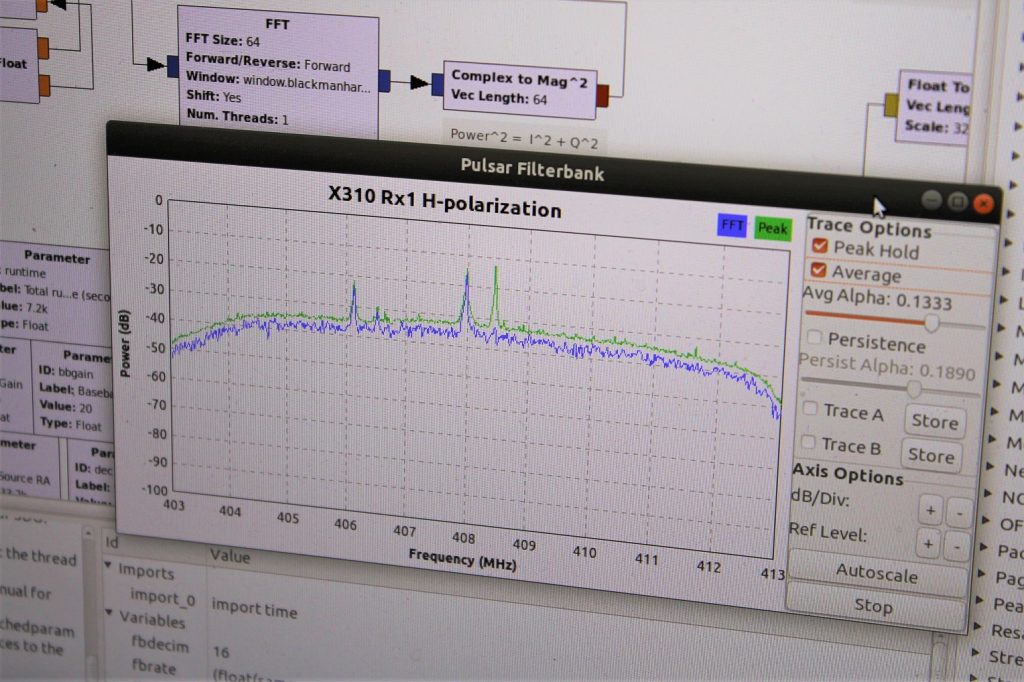
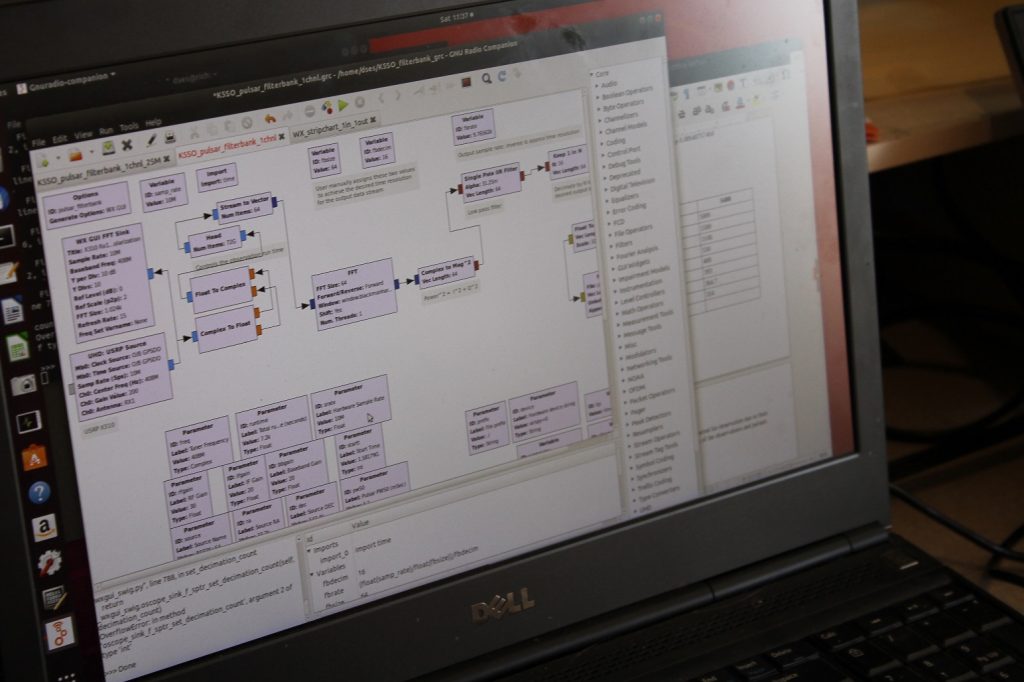
The signal strength across the frequency spectrum being observed. For pulsar observing, we cannot detect the pulsar signal itself in real time. We must integrate the signal over at least a half hour of observing. Then we process the signal, with an expected pulsar timing. That process averages out the background noise while adding the actual pulsar signal enough to elevate above the noise floor — in theory.
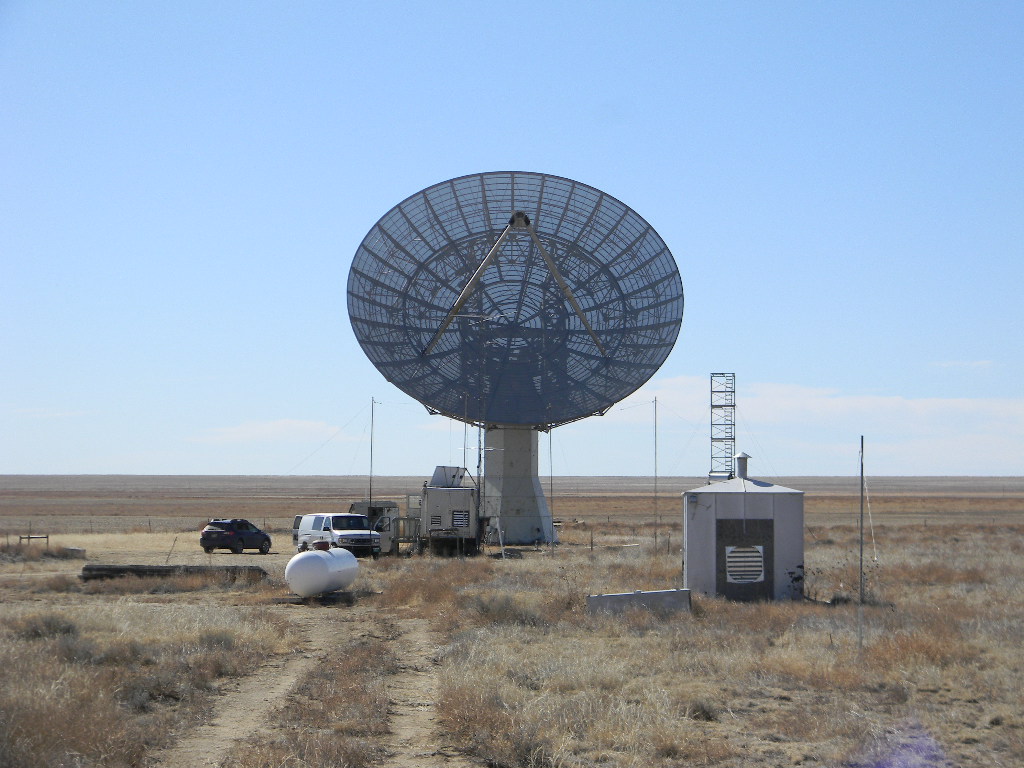
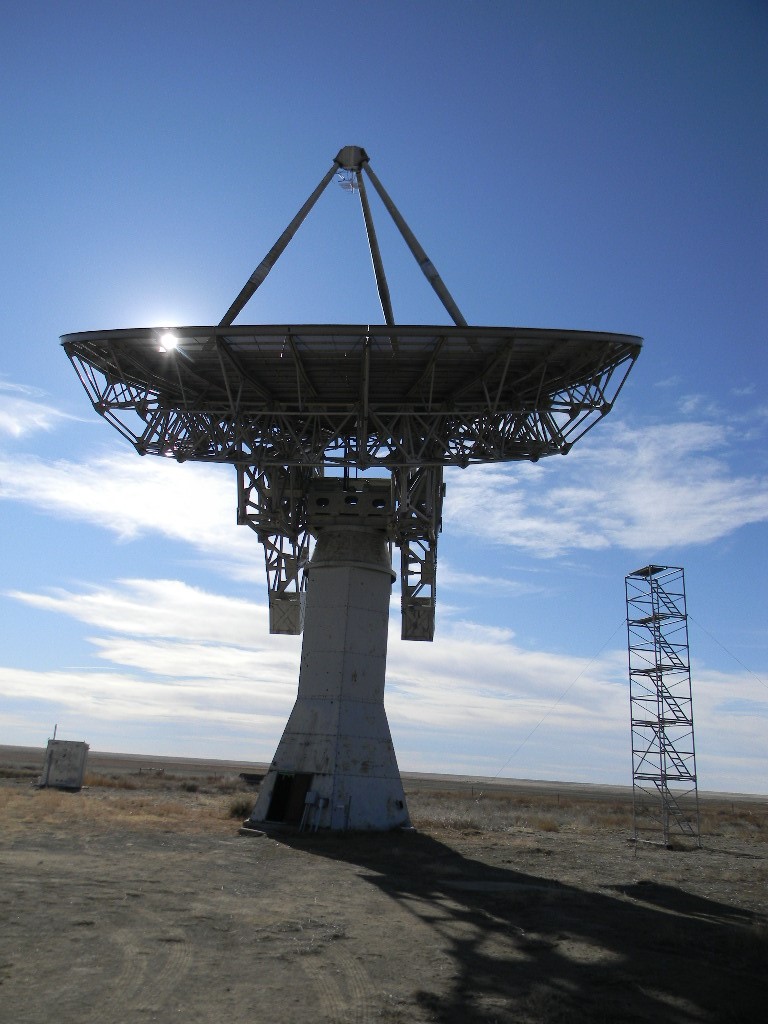
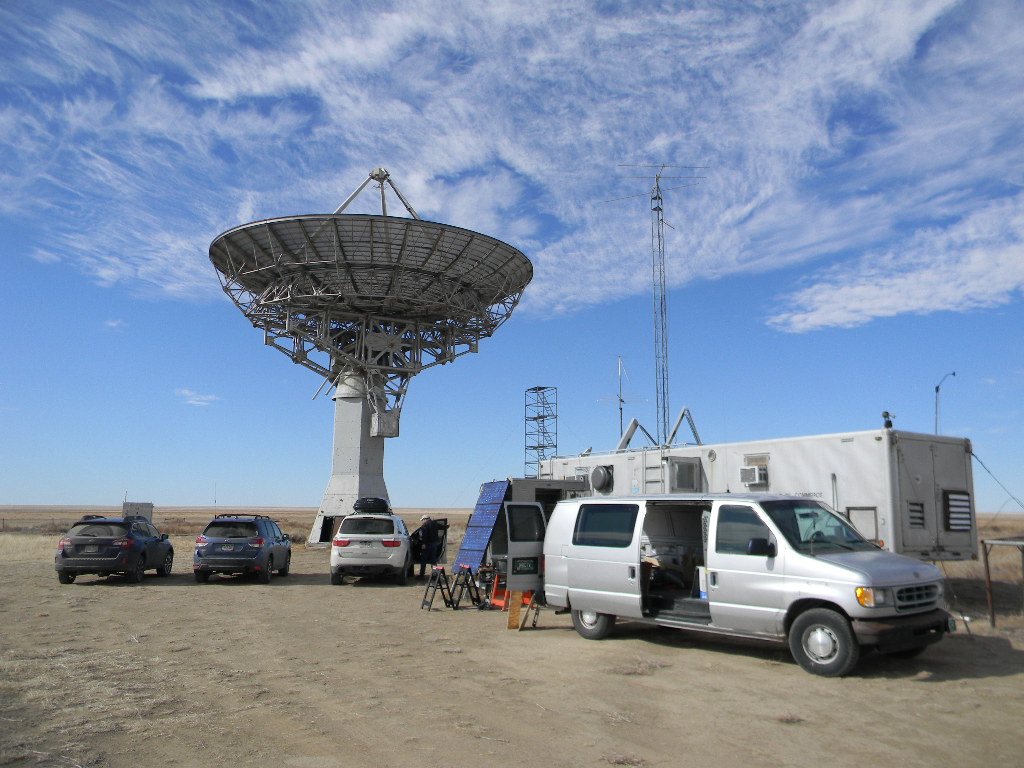
The 60 foot dish antenna turning to aim at the pulsar.
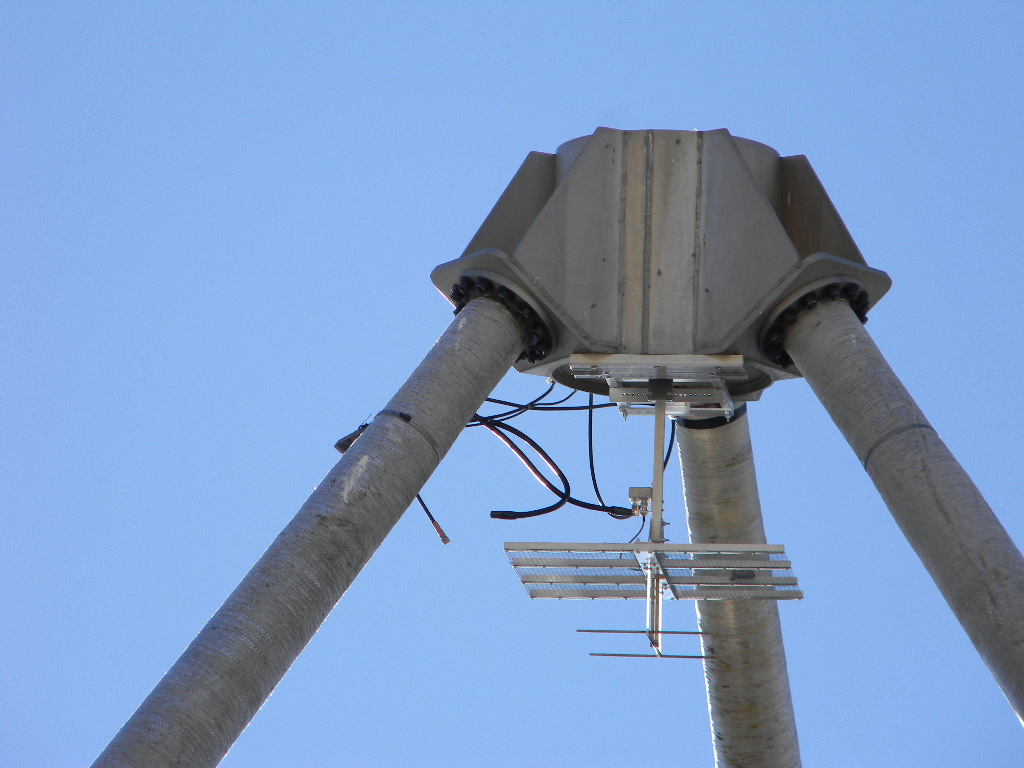
The 408 MHz antenna feed. Ray Unberecken has designed a base for the antenna feeds so that these can be easily swiveled out for service and changeout. Ray designed and built this feed.

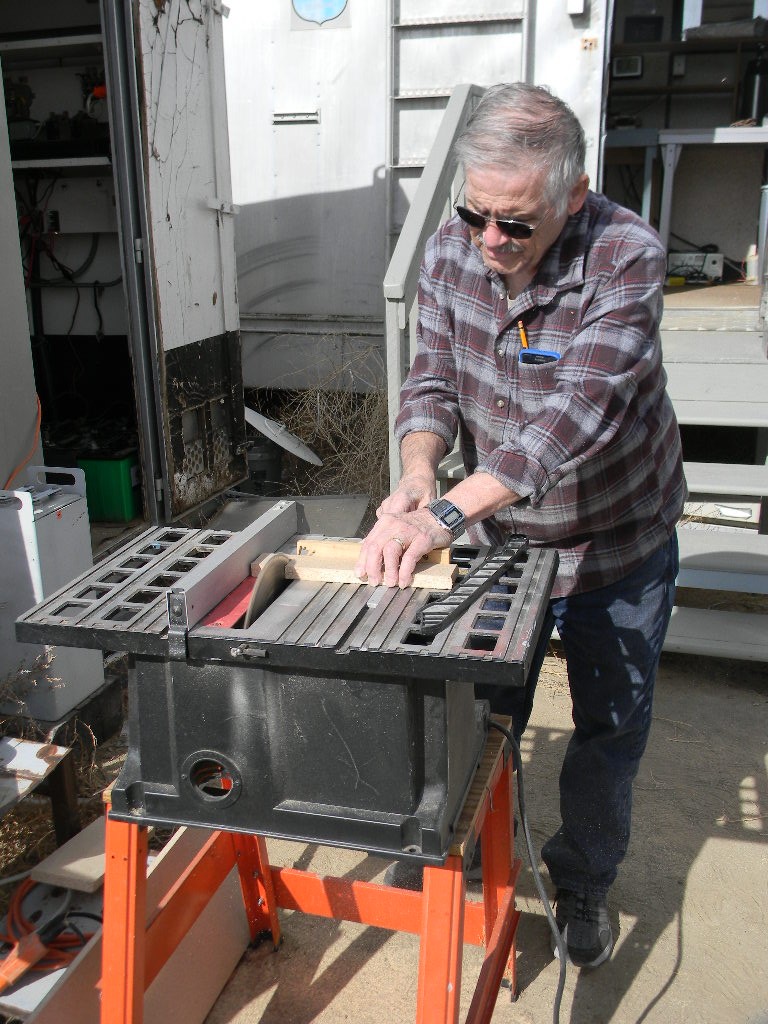
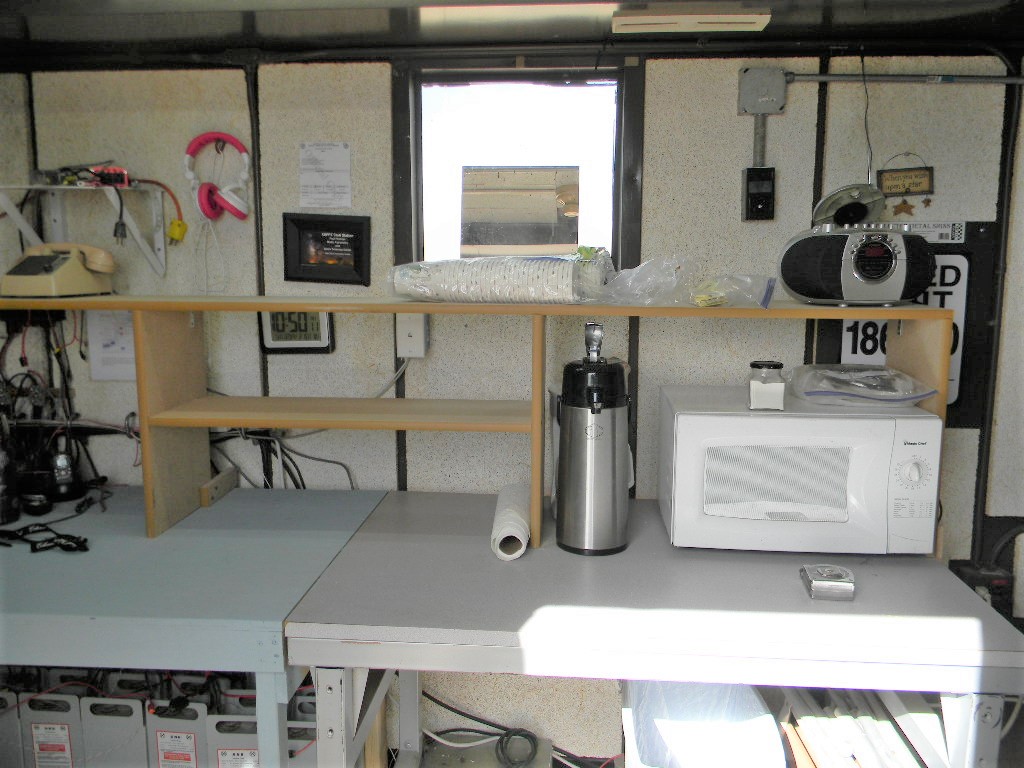
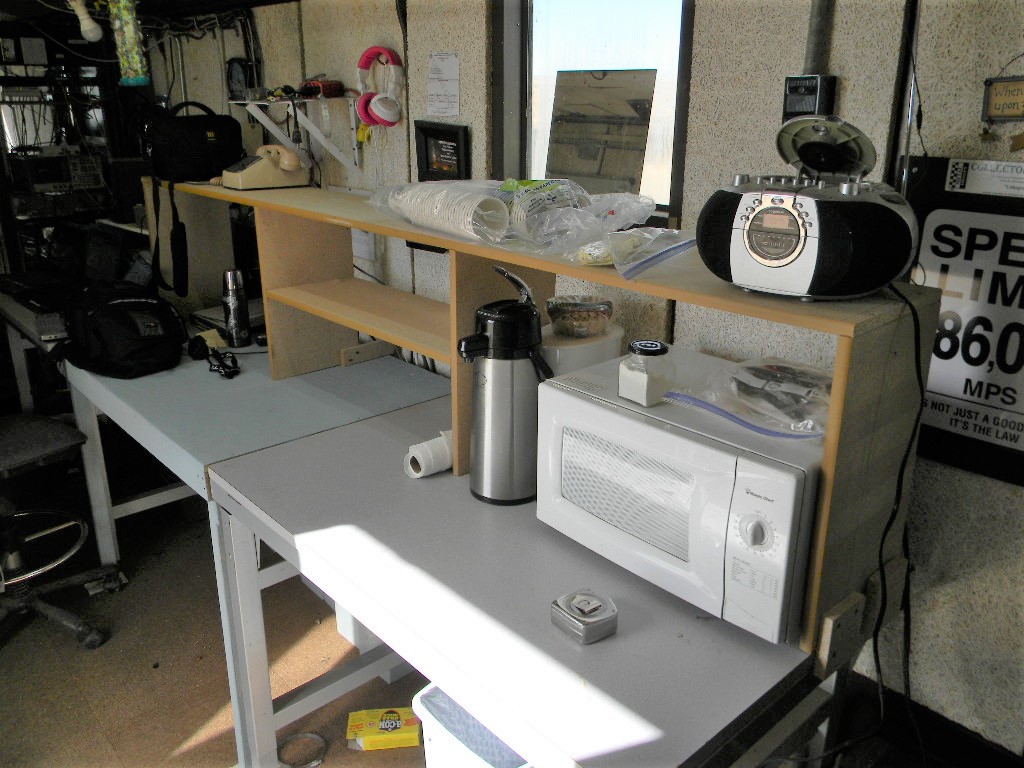
2. Bob Haggart worked on completing the building of desk and shelf space in the Communications Operations Trailer. The additional space is actually important, as that gives us a means to organize and better utilize our work space, and not instead have items pile up randomly.

Bob Haggart
New desk and shelf space in the Communications Operations Trailer.
New desk and shelf space in the Communications Operations Trailer. Note the addition of amenities, of microwave oven and coffee pots.

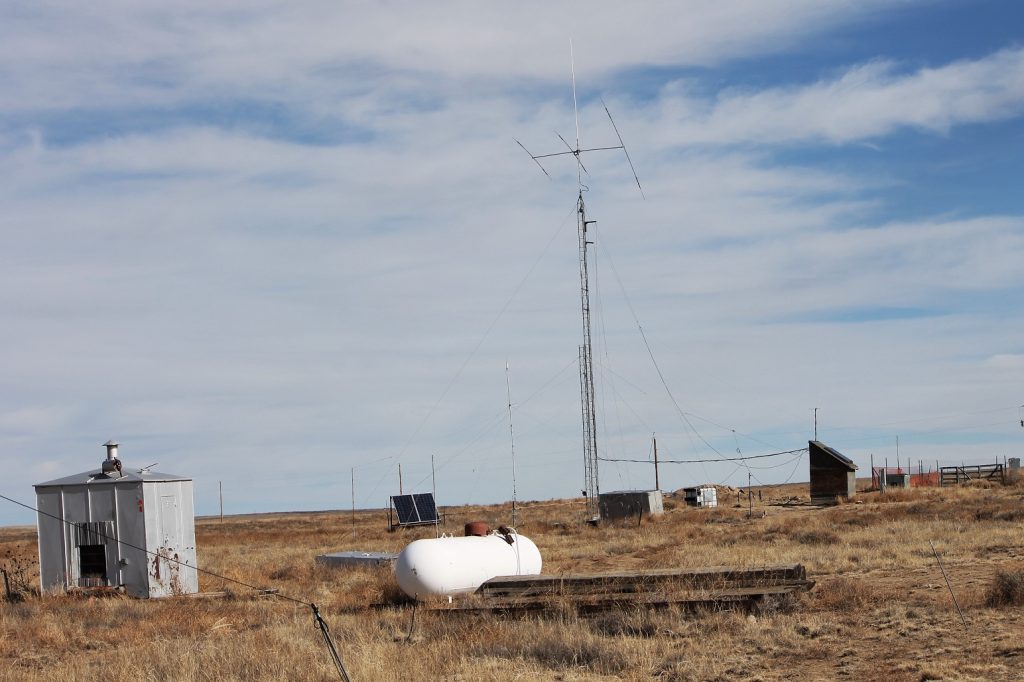
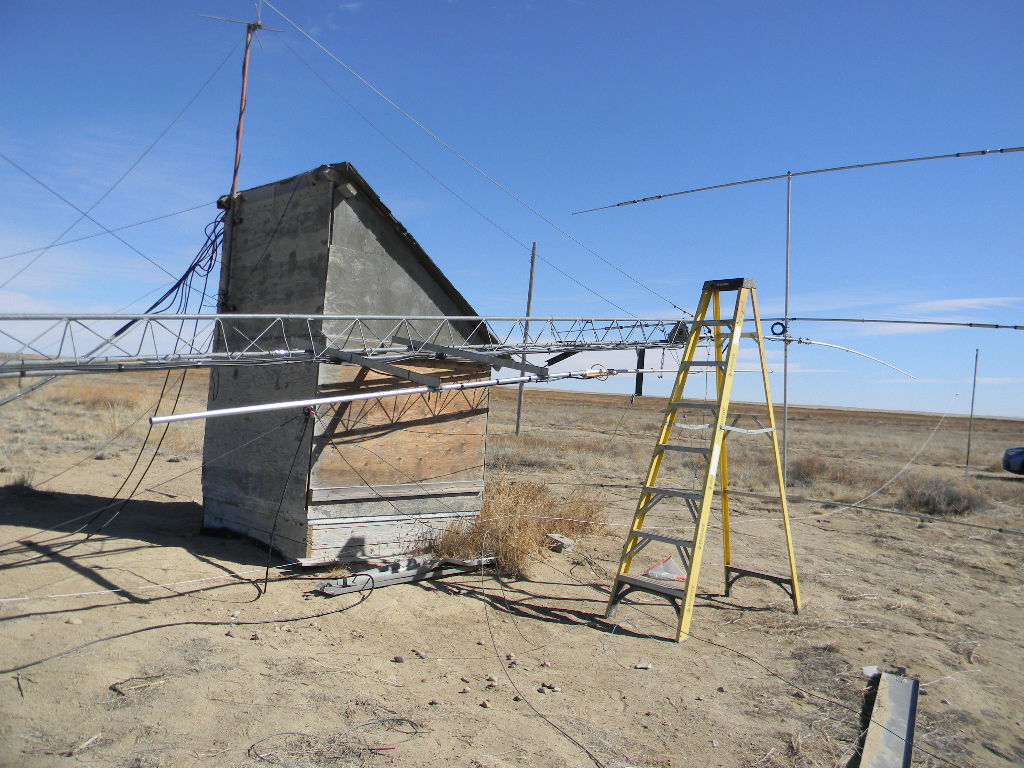
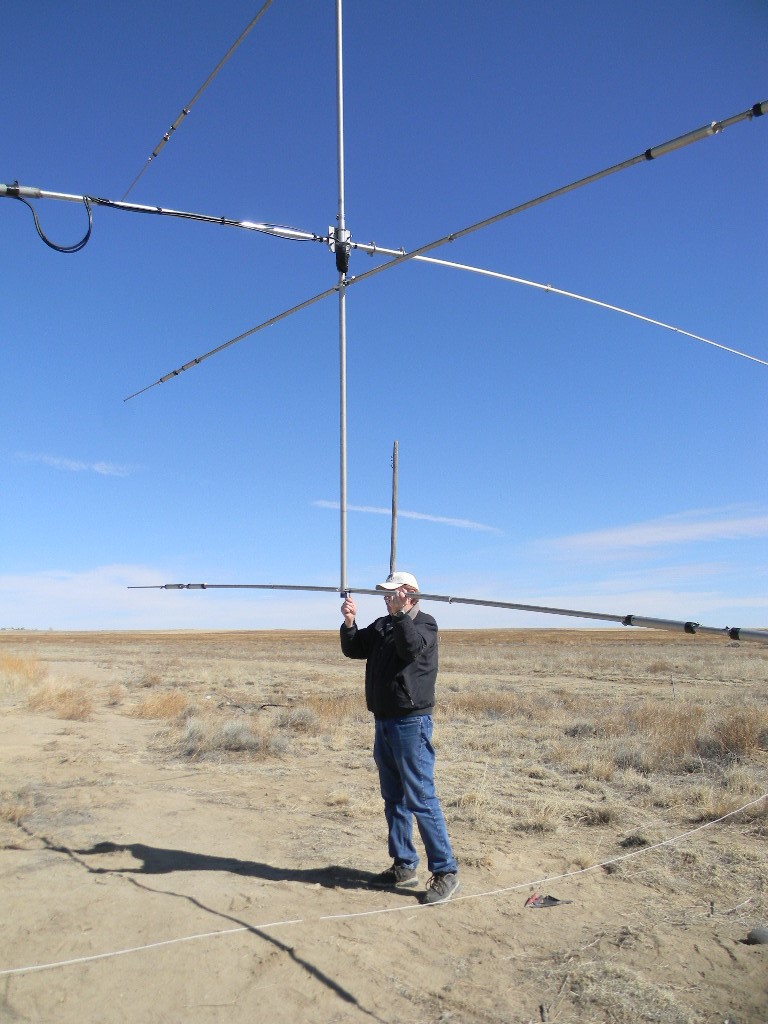
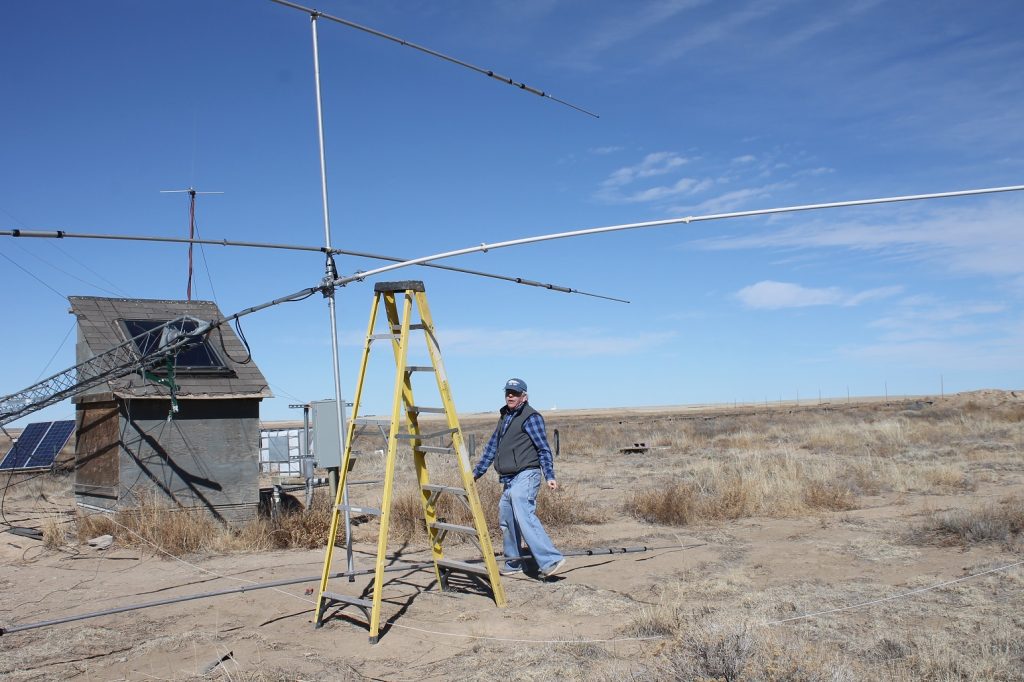
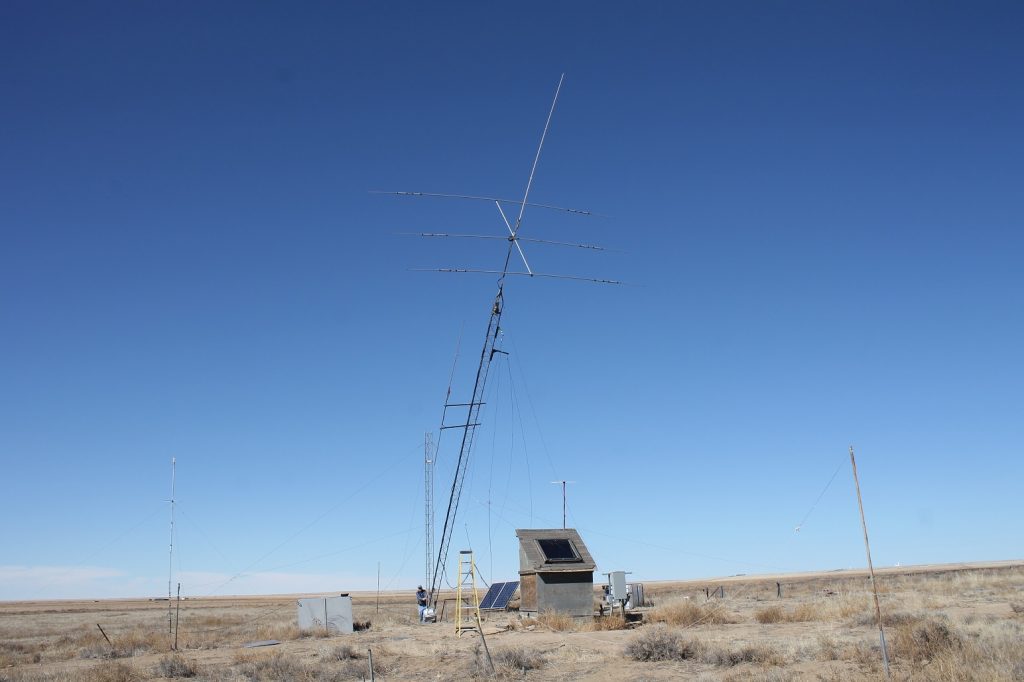
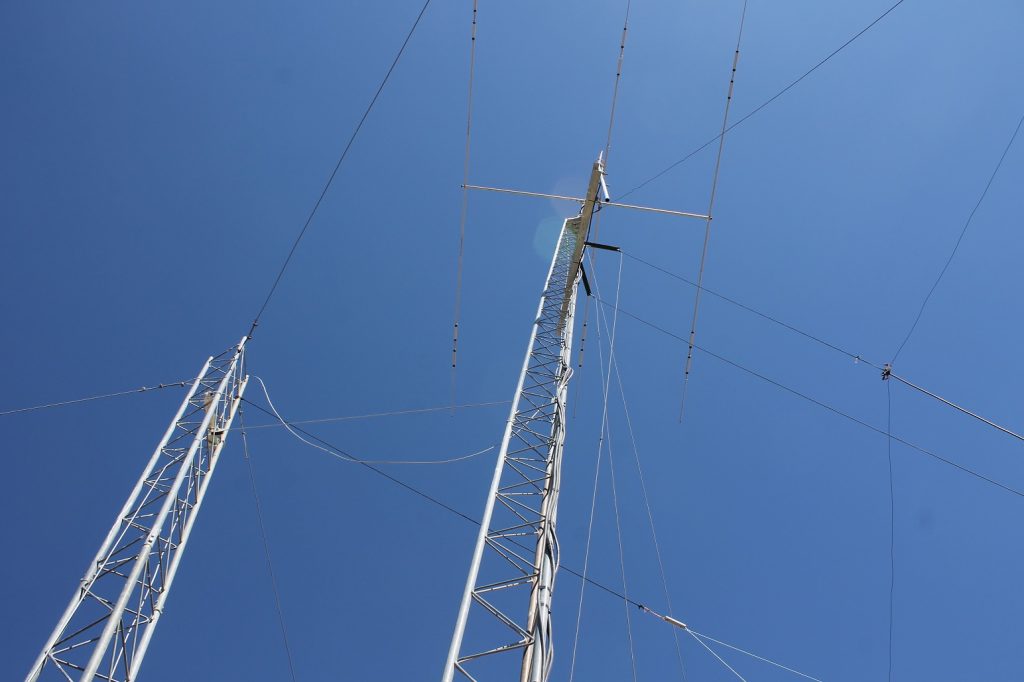
3. A third project was the repair of the front element of the 3-band Yagi ham radio antenna on the 40-foot tower. The front element had rotated slightly askew.

The front element of the 3-band Yagi ham radio antenna on the 40-foot tower rotated askew somehow. Fixing this was our third project undertaken this day.
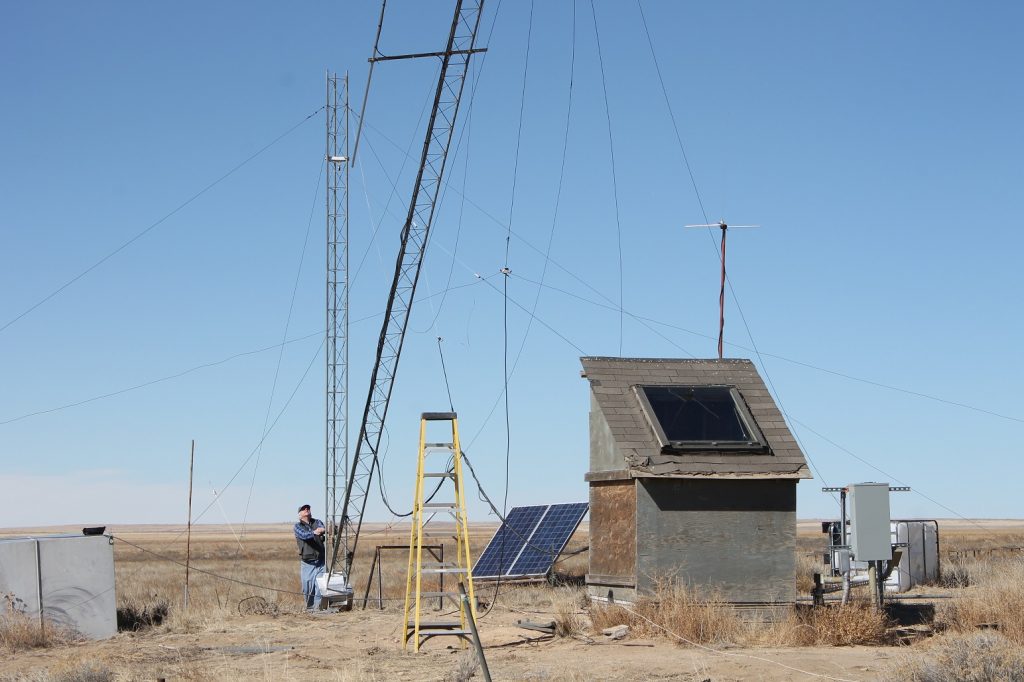
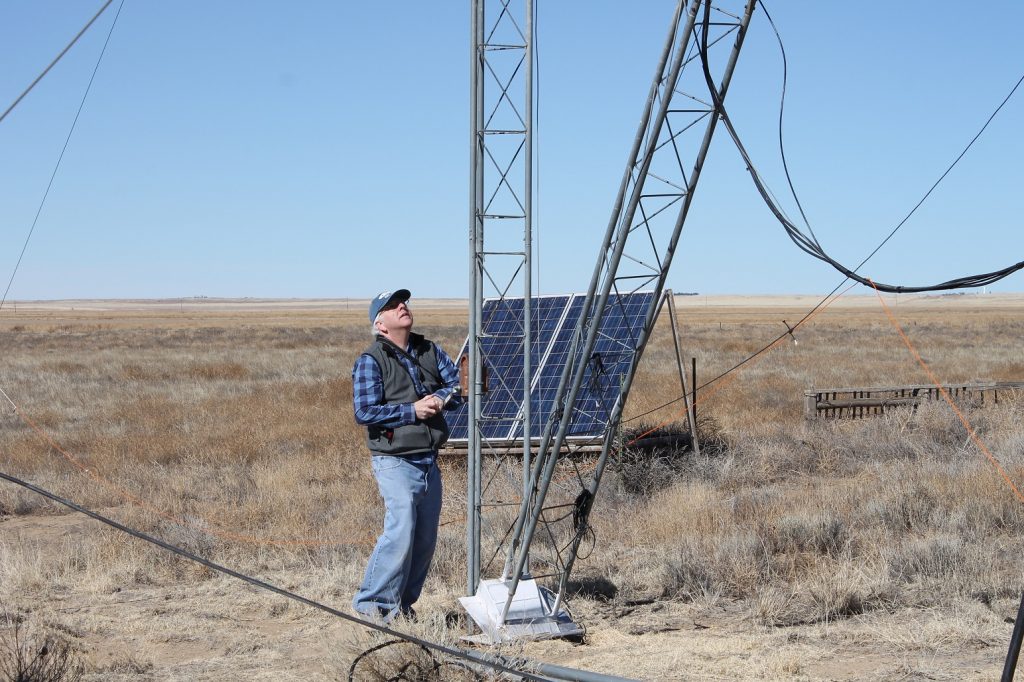
The tower was rotated down for service.
Bill Miller aligning the front element. Also working on this were Gary and Bob. Bob utilized cable lengths to help ensure actual evenness. We also used squares and levels.
Gary working on the antenna. The ladder was used to access and retighten the center supports at the mast.
While the tower was down for the service, Bill reinforced the structural support for the 2-meter band vertical antenna on a side support from the tower.
Gary raised the tower back up.
The 50-foot tower almost at its vertical position.

After the tower was raised back to vertical position, Bill and Gary slightly rearranged the positioning of the 80 meter dipole that is supported from a pulley on the tower. The repositioning separated the dipole with better clearance from other nearby wires

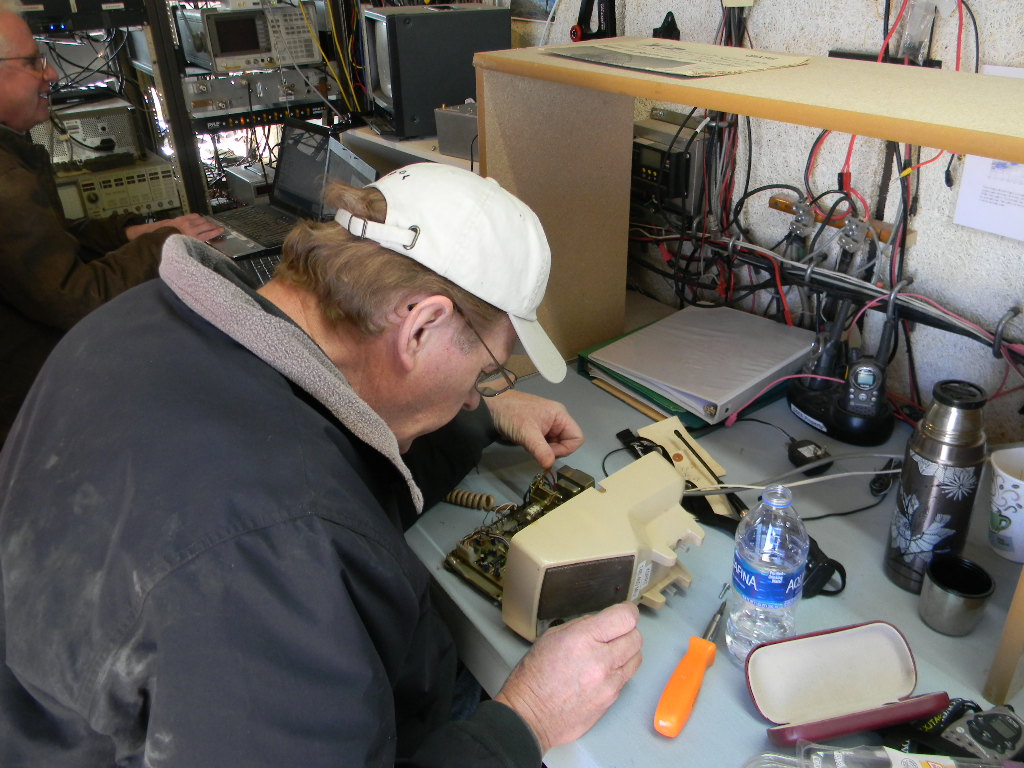
We discovered that the Communications Trailer phone used for our 2-meter talk-in radio was transmitting but not receiving. Bill started to troubleshoot it.
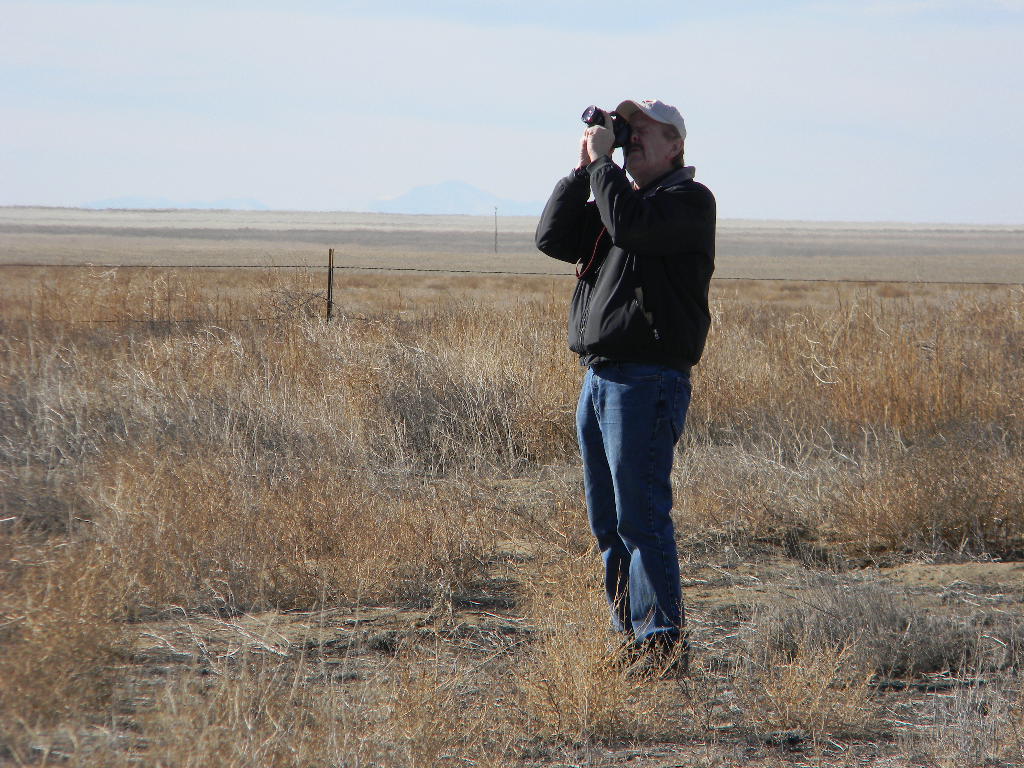
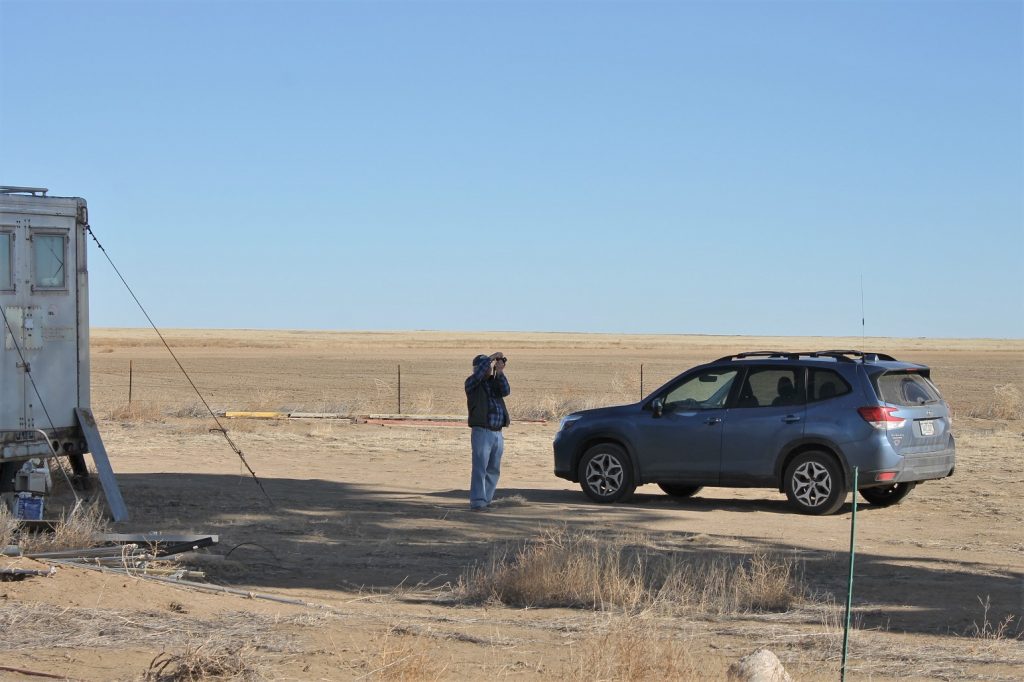
Bill photographing the dish antenna. Pikes Peak is visible in the distance, over a hundred miles away.
Gary also photographed the dish antenna.
The 60 foot antenna rotating back to its parking position after the observing runs.

Rich Russel processed the observation data, but the processing did not bring out the pulsar. Troubleshooting is a topic at the February Science Meeting. Meanwhile, the System 1 antenna pointing system worked well.

The group finished up the work well before sunset, so that traveling back with the sun setting was not a significant issue. We had good weather for this trip, for a winter day in February. Our temperature was in the 40s F, which was actually midler than the 30s in Colorado Springs. And our wind was light.

DSES February 2020 Science Meeting

Our Deep Space Exploration Society Science Meeting was held on February 22, 2020, at the home of Dr. Richard Russel.

The Science Meeting had three major topics of discussion:

  • Betelgeuse dimming experiment
  • Pulsar Observation status
  • Latest DSES papers and presentation

These are the slides from the meeting, written by Dr. Russel: DSES-Feb-2020-Science-Meeting.pdf

Some additional background and details:

We have been monitoring the news about the apparent magnitude of the star Betelgeuse dimming during the past few months. Betelgeuse is a red supergiant star in its late stages of stellar evolution. As such, it is expected to become a Type II supernova some time within the next 100,000 years. Its recent dimming has piqued interest that perhaps the star may soon become a supernova. If that were to happen, DSES is prepared to observe it immediately. We are keeping aware of notifications from the SNEWS (Supernova Early Warning System) network [https://snews.bnl.gov/], which would send an alert if indicator neutrinos were detected.

However, no current theory of supernova predicts that a star would first dim, as is being observed for Betelgeuse. And meanwhile several other physical factors are known to make Betelgeuse variable, although it has not been observed during historical times to dim as much as is being observed now.

Dr. Russel recognized that another possible physical mechanism that could cause the apparent dimming would be a dust cloud coming between the star and us along our line of sight. The cloud could be interstellar, or it could be a product of the star itself and close to the star. There is evidence for a possible cloud in existing VLA (Very Large Array) observational data, which we have available to analyze. In the imaging data, what could be an imaging artifact nonetheless shows structure, and could instead be an actual physical cloud. In the slides, Dr. Russel showed calculations of how the cloud would be expected to move if it is the culprit of the current dimming. At the meeting we developed a set of observational tests we can conduct to test our hypotheses about if there really is a cloud dimming Betelgeuse.

The second topic of discussion was about troubleshooting our attempted observing of a pulsar with our 60-foot dish antenna the previous weekend. The analysis produced no results. But there can be several possible reasons for the problem.

What we did think did work was the accurate pointing of the dish antenna with the System 1 software, to well within the beam width limits of the 408 MHz antenna feed.

The third topic was about the upcoming Society of Amateur Radio Astronomers Western Conference [http://www.radio-astronomy.org/node/323] in late March in Socorro, NM. DSES will be presenting several papers there.

The Pikes Peak Regional Science Fair was held the previous Saturday at UCCS. Bill Miller and Gary Agranat represented DSES as special judges. Tony Bigbee served as a general judge for the Fair. Bill and Gary awarded Outstanding and Honorable Mention awards in both the Junior and Senior High School categories. Bill presented the awards at the Fair’s awards ceremony, held the evening after the DSES science meeting. The Science Fair and the awards will be a topic of another post.

Three-telescope synchronized narrowband pulse observations, updated

Three-telescope synchronized narrowband pulse observations, Report of Observations, December 2019

This is a presentation about our the latest SETI observation results. The DSES 60-foot dish antenna in Haswell and the 40-foot dish antenna at the Greenbank Observatory in West Virginia have been making simultaneous observations for SETI (Search for Extraterrestrial Intelligence) since November 2017. Now a third antenna in New Hampshire has been added. Simultaneous observing by sites distant from each other helps filter out local radio frequency interference (RFI). Signals observed at each site can then more confidently be identified as non-Earth in origin. This presentation summarizes the results with the addition of the third New Hampshire antenna in December 2019. The presentation is written by Skip Crilly. It was revised February 2, 2020.

.

Please click the link to read the presentation in PDF format: Three-telescope synchronized narrowband pulse observations – Report of Observations, December 2019 by Skip Crilly, Education and Public Outreach Volunteer Science Ambassador, Green Bank Observatory, 1/22/2020, revised 2/2/2020

Skip Crilly’s earlier version is still available here.

Very Large Array (VLA) Imaging Results – 2nd Update & HI Drift Scan using 9-ft Dish at Russel Observatory September 2019

This autumn Dr. Richard Russel attended the Very Large Array (VLA) Imaging course in Socorro, New Mexico. The course taught how to take the data sets from multiple large interferometer antenna systems and produce images and science statistics.. This post presents the slides from the DSES Science Meeting on November 25, 2019. This is an update from Dr. Russel’s posts on the topic from October 19 and 31.

Dr. Russel also presents his September 2019 results of Hydrogen 21 cm (HI) drift scan measurements at his newly installed 9-foot dish antenna at his home in Colorado Springs.

Please click the link to view the illustrated pdf file:

http://dses.science/wp-content/uploads/2019/11/DSES-Science-Meeting-11-25-19-Imaging-Results.pdf

Very Large Array (VLA) Imaging Results – Updated & HI Drift Scan using 9-ft Dish at Russel Observatory September 2019

Recently Dr. Richard Russel attended the Very Large Array (VLA) Imaging course in Socorro, New Mexico. The course taught how to take the data sets from multiple large interferometer antenna systems and produce images and science statistics.. This post is an update from Dr. Russel’s post on this topic on October 19.

In this post, Dr. Russel also presents initial results of Hydrogen 21 cm (HI) drift scan measurements at his newly installed 9-foot dish antenna at his home in Colorado Springs.

Please click the link to view the illustrated post:

http://dses.science/wp-content/uploads/2019/11/VLA-Imaging-Results-Master.pdf

Very Large Array (VLA) Image Reduction Results

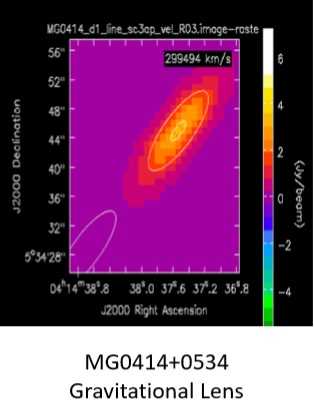
Recently Dr. Richard Russel attended the Very Large Array (VLA) Imaging course in Socorro, New Mexico. This course taught how to take the data sets from the VLA archive and produce images. The following is the first set of images reduced from the VLA archive by Dr. Russel.

Images were made of these astronomical objects:

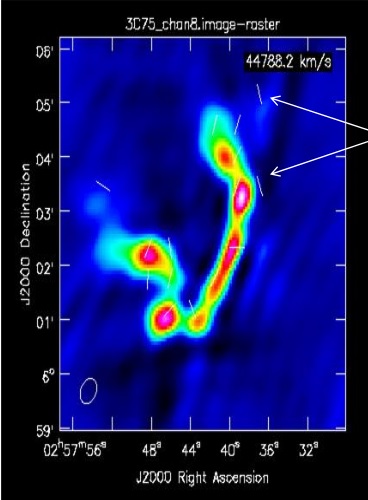
  • 3C75 Binary Black Hole System
  • 3C391 Supernova Remnant
  • Asymptotic Giant Branch (AGB) Star IRC+10216
  • MG0414+0534 Gravitational Lens HI Absorption Line

Each image takes about 1 day to produce from the raw observation.

http://dses.science/wp-content/uploads/2019/10/VLA-Imaging-Results-1.pdf

Hydrogen Drift Scan using the new 9-foot Dish

By Dr. Richard Russel

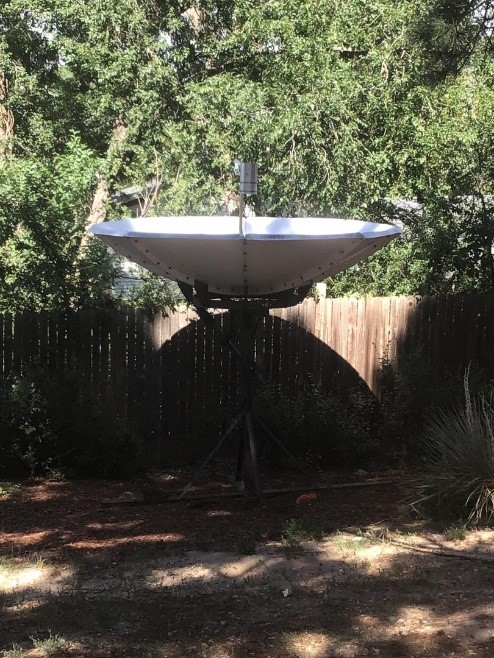
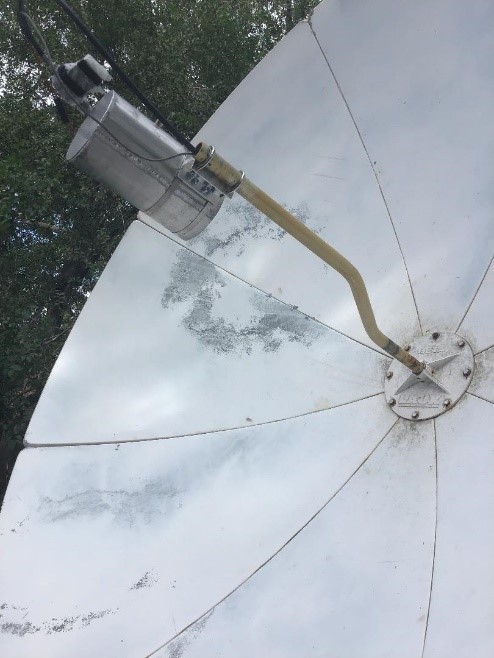
The DSES 9-foot dish is operational at Dr. Russel’s house in Colorado Springs. It is outfitted with a 1420 MHz feed with 2 low-noise amplifiers with over 40 dBi of gain and a noise figure of 0.35. The receiving system is a Spectracyber 1.

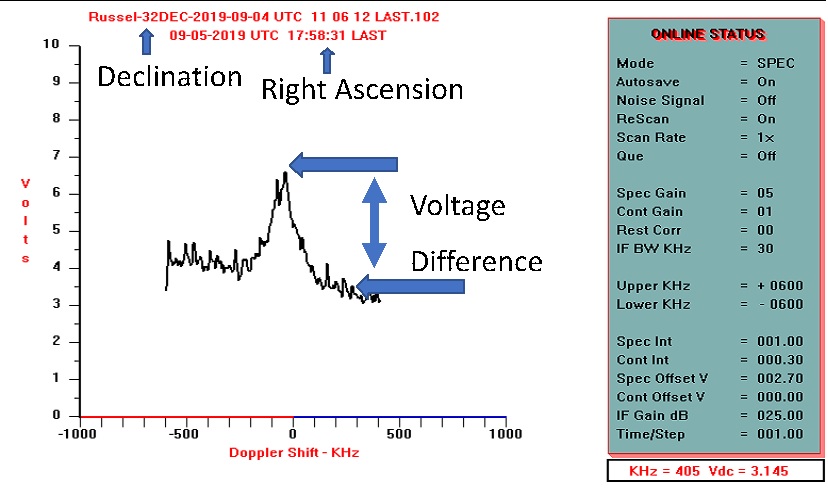
The output of the Spectracyber shows the relative peaks of hydrogen with a corresponding Doppler measurement.

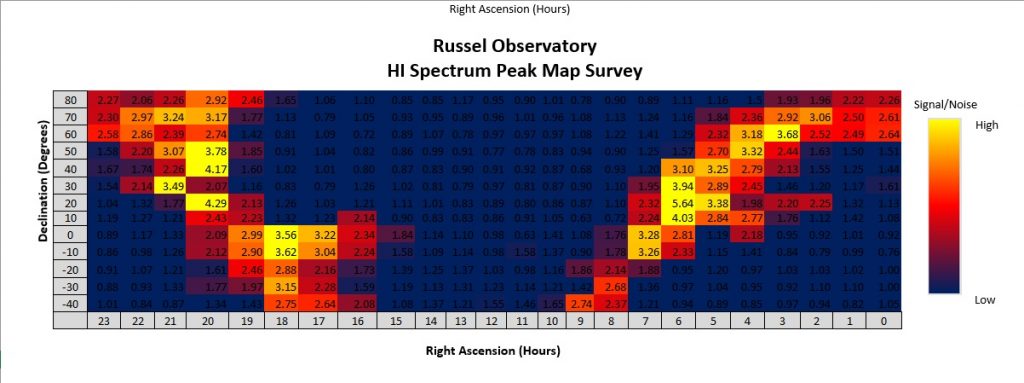
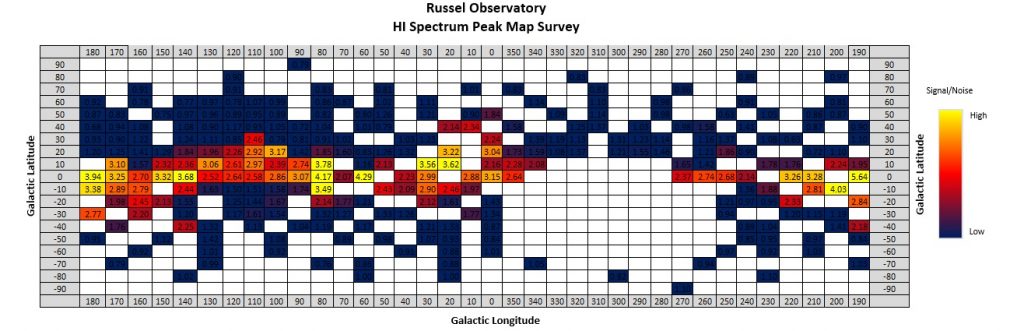
Dr. Russel performed a drift scan of the visible sky and plotted the relative peak hydrogen signals.

The hydrogen maps very well to the visible Milky Way. The plot below converts the Celestial Coordinates into Galactic Coordinates. Note that the peak hydrogen is concentrated near the 0 Galactic Latitude.

Special Thanks to Ray Uberecken and Steve Plock for helping to set up the system.

For more information:

Dr. Richard Russel: DrRichRussel(at)netscape.net

Deep Space Exploration Society: www.DSES.science