Very Large Array (VLA) Image Reduction Results

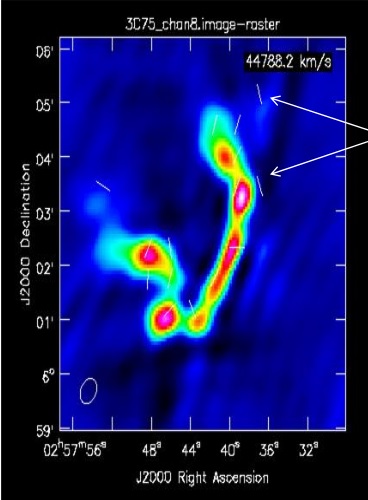
Recently Dr. Richard Russel attended the Very Large Array (VLA) Imaging course in Socorro, New Mexico. This course taught how to take the data sets from the VLA archive and produce images. The following is the first set of images reduced from the VLA archive by Dr. Russel.

Images were made of these astronomical objects:

  • 3C75 Binary Black Hole System
  • 3C391 Supernova Remnant
  • Asymptotic Giant Branch (AGB) Star IRC+10216
  • MG0414+0534 Gravitational Lens HI Absorption Line

Each image takes about 1 day to produce from the raw observation.

http://dses.science/wp-content/uploads/2019/10/VLA-Imaging-Results-1.pdf

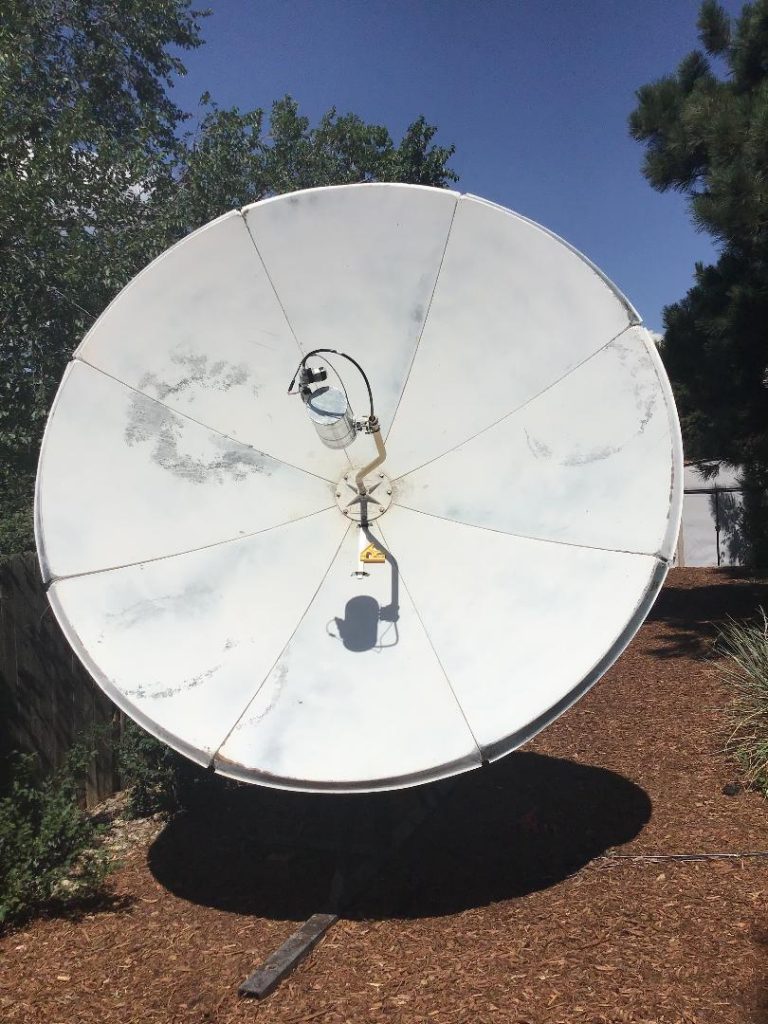
Hydrogen Drift Scan using the new 9-foot Dish

By Dr. Richard Russel

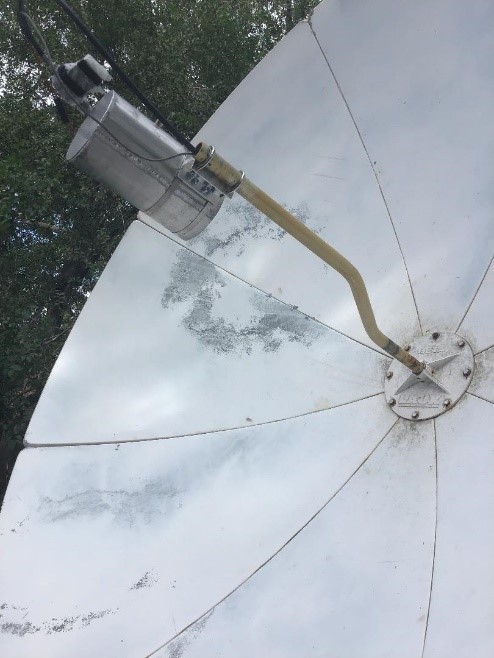
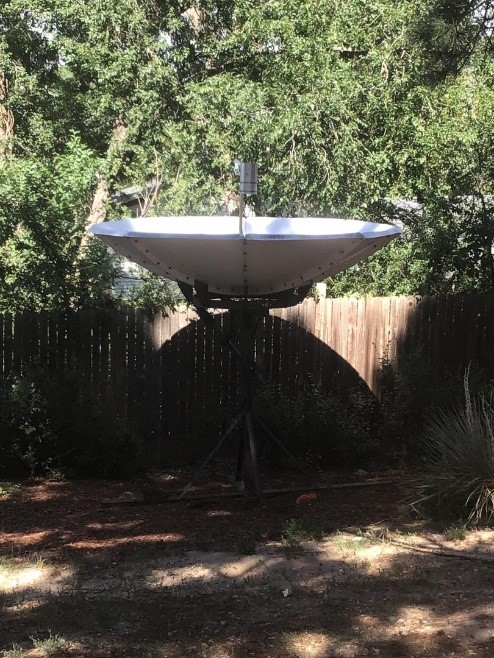
The DSES 9-foot dish is operational at Dr. Russel’s house in Colorado Springs. It is outfitted with a 1420 MHz feed with 2 low-noise amplifiers with over 40 dBi of gain and a noise figure of 0.35. The receiving system is a Spectracyber 1.

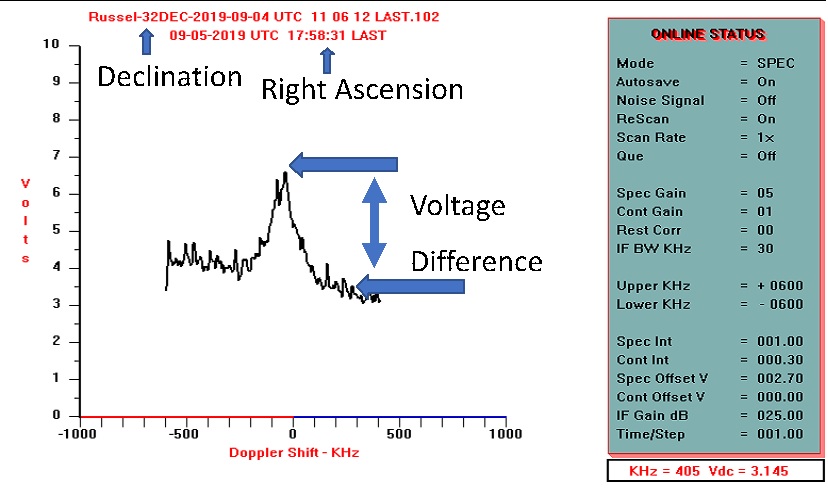
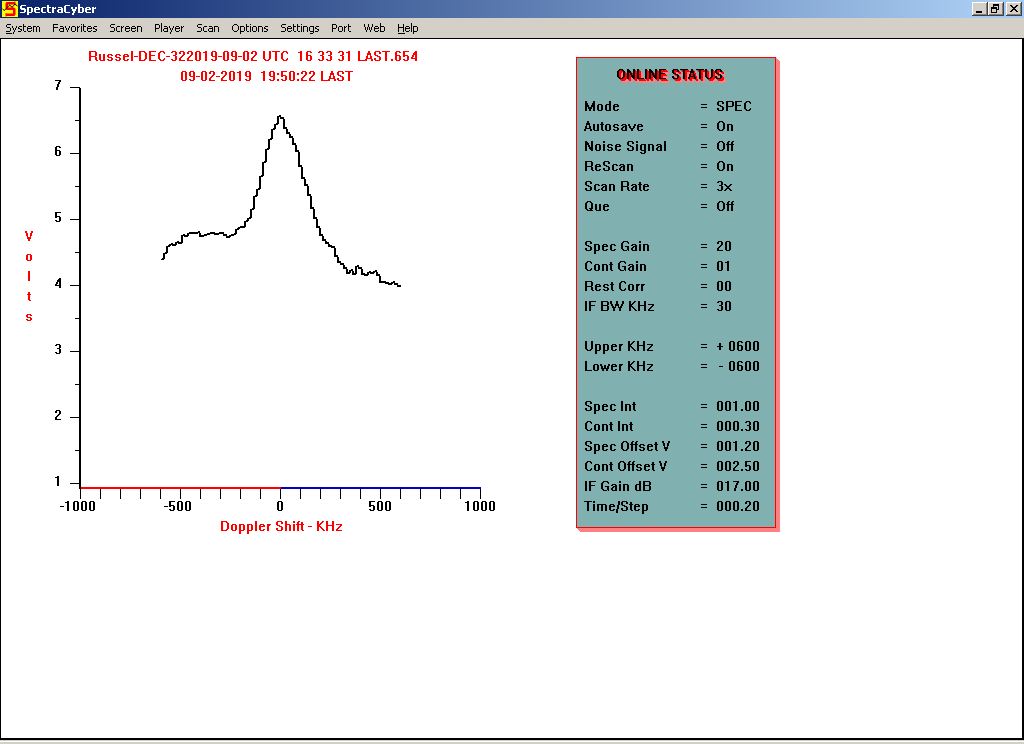
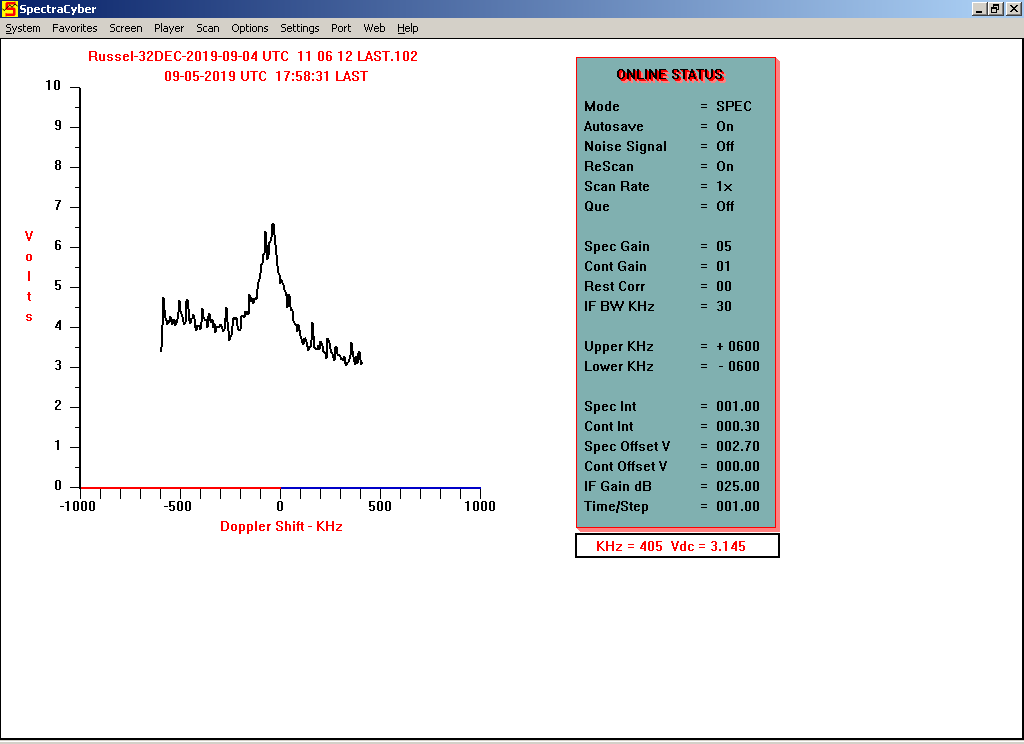
The output of the Spectracyber shows the relative peaks of hydrogen with a corresponding Doppler measurement.

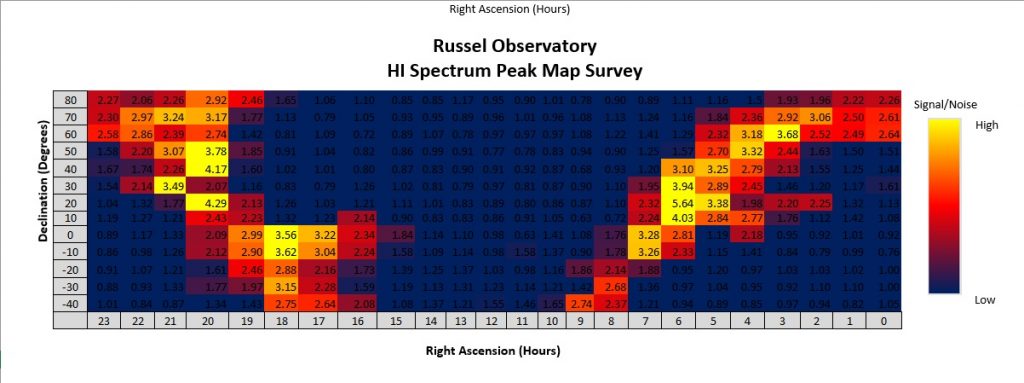
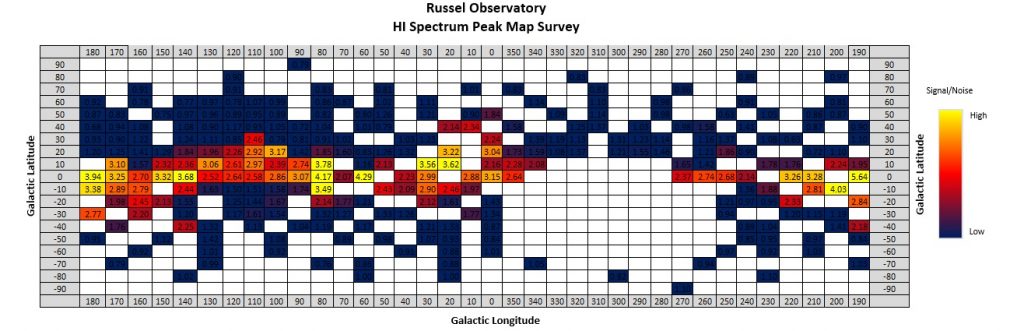
Dr. Russel performed a drift scan of the visible sky and plotted the relative peak hydrogen signals.

The hydrogen maps very well to the visible Milky Way. The plot below converts the Celestial Coordinates into Galactic Coordinates. Note that the peak hydrogen is concentrated near the 0 Galactic Latitude.

Special Thanks to Ray Uberecken and Steve Plock for helping to set up the system.

For more information:

Dr. Richard Russel: DrRichRussel(at)netscape.net

Deep Space Exploration Society: www.DSES.science

First Light of DSES 9-Foot Dish Antenna at Rich Russel’s Home

by Dr. Rich Russel, DSES Science Lead

Part 1 – September 2, 2019

Ray Uberecken came over today with another LNA, which we put in series with the first LNA. This did the trick and overcame our cable loss problem. I conducted a small drift scan across the galactic center at -32 Declination. Here is a quick result.

I will spend the next couple of days fine tuning the azimuth pointing and weatherizing the LNAs.

I will forward information to allow certain members teamviewer access if they want.

Thanks Ray and Steve Plock for their technical support!!

Part 2 – September 4, 2019

The 9 ft dish at Dr. Russel’s house is operational!
It is set up to collect neutral hydrogen frequencies at 1420.406MHz.
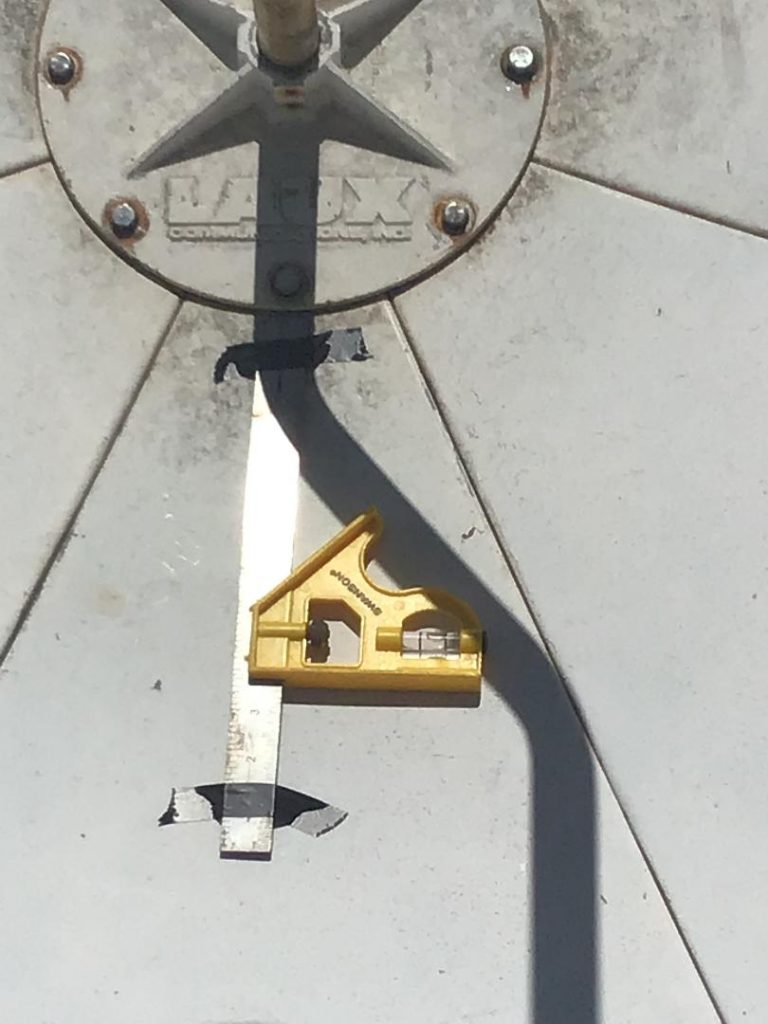
Today the dish azimuth was aligned using the Sun and a level.

The receiver is a Spectracyber 1 from Radio Astronomy Supplies. 
Below is the measurement of the hydrogen spectrum near the galactic center.
RA 17hr 58min DEC -32 degrees

Training on the use of the system will be conducted at the science meetings.

Dr. Russel

Radio Search for Extraterrestrial Intelligence SETI is fun ! – August 2019 SARA Presentation by Skip Crilly

This is Skip Crilly‘s updated paper/presentation, Radio Search for Extraterrestrial Intelligence SETI is fun ! Geographically-spaced Synchronized Signal Detection System, updated July 2019. Skip presented it at the Society of Amateur Radio Astronomers conference at Greenbank, WV on August 4, 2019. The link will open as a pdf file.

Radio Search for Extraterrestrial Intelligence SETI is fun ! Geographically-spaced Synchronized Signal Detection System

These two wave files are part of the presentation:  Figure 9 Simultaneous Tones Slow wave file and Figure 9 Simultaneous SETI Tones wave file.

May 2019 Science Meeting – Pulsars & Galactic Navigation

These are the slides from Dr. Richard Russel’s presentation at our May 2019 DSES Science Meeting.

Pulsar Galactic Navigation – DSES Science Meeting, May 2019

During the past year, Dr. Russel led us in measuring the Doppler shifts of galactic neutral hydrogen (HI). Building on his experience from navigation, he then developed his ideas on how to use HI Doppler shift measurements to navigate from star to star across galactic space.

This year we are undertaking measuring the pulse time of pulsars. Pulsars are understood to be the star remnants of supernova explosions. They become what are called neutron stars. The supernovas compress the stars tightly into enormous densities so that their matter become neutrons, and the stars are only about 7 miles in diameter. Due to the conservation of angular momentum, their spin increases very rapidly. The youngest rotate with periods of miliseconds. Their magnetic poles are often offset from their spin axes. Electrons spin rapidly along the outgoing magnetic field lines of the poles, producing synchrotron radiation, which in turn produce broad band radio signals. If a magnetic pole is oriented so that it points at Earth during the rotation, we receive a radio pulse, and maybe pulses at other wavelengths too. (That is how pulsars were first discovered during the late 1960s.)

The pulses are very regular. But the spin of the pulsars gradually lose energy and slow down over time too.

Dr. Russel took his ideas for navigation, and now he has developed a concept for doing interstellar navigation using pulsars as references. That’s what this slide set is about. He just submitted a paper on the topic to the journal of the Society of Amateur Radio Astronomers.

– ed. Gary Agranat

Three DSES members judge at 2019 Pikes Peak Regional Science Fair

Deep Space Exploration Society members Bill Miller, Gary Agranat, and Tony Bigbee participated as judges at the 2019 Pikes Peak Regional Science Fair. The Fair was held at the University of Colorado at Colorado Springs University Center building on Saturday February 23rd.  This year 115 students from 20 schools presented projects. The purpose of the fair is to encourage students to take more active interest in the study of science and mathematics, to encourage experiment and consideration of science careers, and to provide a means of reward and recognition.  Informally the fair gives students an opportunity to interact with and get helpful feedback from specialists already in the fields.

Bill and Gary were at the science fair to judge and award prizes specifically offered by DSES. The prizes were offered to encourage projects related to astronomy and radio.  However any outstanding STEM project related closely enough to the fields were considered.  Bill and Gary interviewed 17 students in 16 projects at the fair, at the middle school and high school levels, with most of the topics in physical sciences or engineering. A scoring criteria was used based on the qualities of the ideas, hypotheses, methods, data, and lessons learned.

DSES awarded one Senior Division prizes and two Junior Division prizes:

For outstanding senior division project we gave a certificate and $100 to Mark Bloomfield. Mark received 6 additional special awards from other organizations, and he placed 3rd in the Fair’s Senior Physical Sciences category.

• Mark Bloomfield [grade 11] [project SC9], Coronado High School/David Bloomfield: ‘‘Charged up: Testing lithium ion battery performance using a Raspberry Pi load cell’’

For the two Junior Division prizes we gave a certificate and $50 each to Hailey Kressen and Benjamin Homan.

• Hailey Kressin [grade8] [project 8E10], The Classical Academy JHS/Candus Muir: ‘‘A sixth sense: Omnidirectional presence detection system’’. Hailey received 6 additional special awards, and she placed 2nd in the Grade 8 Physical Sciences & Engineering category. 

• Benjamin Homan[8] [8E1], Monument Academy/Karl Brown: ‘‘Does pressure affect carbon dioxide absorption by polyethyleneimine?’’ Benjamin received 5 additional special awards, and he placed 4th in the Grade 8 Physical Sciences & Engineering category.

Tony participated as a general Award Judge for the Fair itself. He judged  middle school social and behavioral science projects.

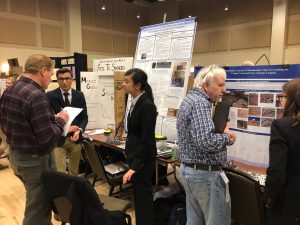
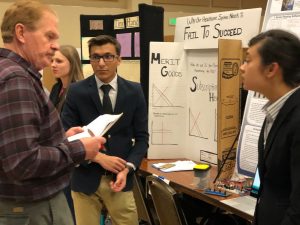
Tony took a few minutes to take some photos.  The first three photos are from when Bill and Gary interviewed Connor Takenaka about his cybersecurity project. The third includes Tony.
Bill is show interviewing Josh Nakka and Katelynn Salmon for their Senior level science project “Engineering a portable refreshable braille device for improved communication.” Gary is interviewing Jenna Salvat for her Senior level science project “A geothermal analysis of metamorphic lithologies surrounding Cripple Creek and Victor Diatreme”.
Projects Bill and Gary interviewed:

  • “Shields Up” by Samantha Cerniglia. She tested the ability of several materials to block cosmic rays. She built a cloud chamber to do the tests.
  • “LED Lights: Hero or Zero” by Michael Wu. He tested energy efficiency savings claims of a set of consumer LED lights, and found those fell short.
  • “Energy Efficiency” by Samantha Schaefer. She tested the effects of placing different colored filters on solar energy panels.
  • “This Will Blow You Away” by Levi Archambault. He tested the efficiency of windmills with different number of blades, with different wind speed conditions.
  • “Prevent Basement Floods” by Austin Cellar.  He designed and tested a low cost device to detect basement water leaks and flooding, and send an alarm.
  • “Cleaning glasses with portable ultrasonics” by Ty Rockey. He researched, designed, and tested a low cost device to clean eye glasses using water cavitation.
  • “Does Pressure Affect Carbon Dioxide Absorption by Polyethyleneimine (PEI)” by Benjamin Homan. He tested the ability of PEI to absorb carbon dioxide at sea level and 7350 foot elevation pressures.  He utilized previous research by others and theory that predicted lower pressure would result in less absorption, due to fewer number of molecules per volume.  The material would be applicable to CO2 scrubbers in submarines and spacecraft. Benjamin won one of our two Junior Division prizes.
  • “Analyzing how various hydroelectric designs can ameliorate the accessibility of tides” by Chandler Wilburn. He tried to design and test an alternate way to generate electrical power from tides, using a large pressure plate instead of flow past a turbine.
  • “Neodymium field slide” by Amir Laarja. He tested different position configurations of magnets in a generator, to test differences in efficiency.
  • “A sixth sense: Omni-directional presence detection system” by Hailey Kressin.  She designed and tested a system to detect the presence of approaching objects within 1.5 meters in 1 second, to aid people who are blind. Hailey won one of our two Junior Division prizes.
  • “Cybersecurity: Defending our Computers” by Connor Takenaka. He tested the effectiveness of different length and complexity passwords to prevent or delay hacking.
  • “Variable scintillation frequency in muon detection” by Xander Duvall.
  • “Using Solar Radiation” by Erick Lopez.  He tested the effectiveness of several designs for homes to retain heat from solar heating.
  • “Engineering a portable low-cost braille device for improved communication” by Josh Nakka and Katelynn Salmon.
  • “A geothermal analysis of metamorphic lithologies surrounding the Cripple Creek and Victor diatreme” by Jenna Salvat.
  • “Charged up: Testing lithium ion battery performance using a Raspberry Pi load cell” by Mark Bloomfield.  He developed a Raspberry Pi constant load cell to test how temperature, drain rate, and charging patterns affected energy recovered in charging.  Mark won our Senior Division Prize.

Bill presented the DSES awards at the science fair awards ceremony on the following Tuesday, February 26th.

The Pikes Peak Regional Science Fair created this nice video about the activities and the students in the science fair:
2019 Pikes Peak Regional Science Fair [https://vimeo.com/319543131].
 

Geographically-spaced Synchronized Signal Detection System by Skip Crilly, New Hampshire Astronomical Society, February 8, 2019.

Skip Crilly gave this presentation to the New Hampshire Astronomical Society, February 8, 2019.

Geographically-spaced Synchronized Signal Detection System (Please click to read pdf presentation.)


Abstract: Radio Frequency Interference (RFI) is a confounding problem in radio SETI, as false positives are introduced into receiver signals. Various methods exist to attempt to excise suspected RFI, with a possibility that true positives are rejected, and that un-excised RFI remain as false positives. Uncertain far side-lobe antenna patterns add to the uncertainty. To ameliorate the RFI problem, a system having geographically-spaced simultaneous and synchronized reception has been implemented. A radio telescope at the Green Bank Observatory in Green Bank, West Virginia has been combined with a radio telescope of the Deep Space Exploration Society, near Haswell, Colorado to implement a spatial filter having a thrice-Moon-distance transmitter rejection. Approximately 135 hours of simultaneous synchronized pulse observations have been captured from November 2017 through February 2019. This presentation describes the problem, observation system, observed results and a proposed hypothesis to be subjected to attempts at refutation through further experimentation and RFI and ETI transmitter signal model development.

Two wave audio files from the presentation, “Tones” and “Slow Tones”:

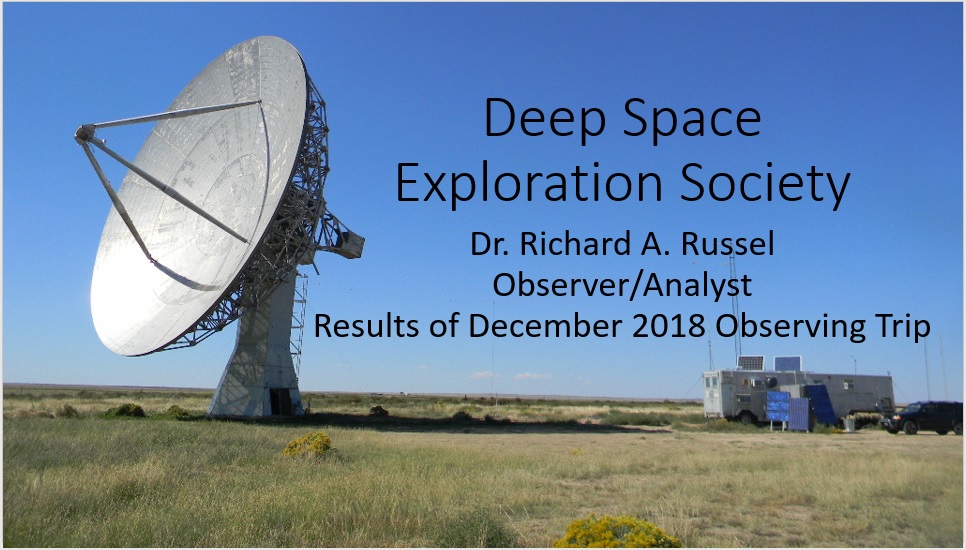
Results of December 2018 Observing Trip

Dr. Richard Russel put together this slide set about the latest results from this month’s observing.  Contents:

  • Galactic Rotation Rate Results
  • Earth’s Position in Solar System
  • Complete HI spectrum Measurements from all observing trips

Dr. Russel is now utilizing Doppler shift measurements, and hence velocity, to also estimate the Earth’s position in the Solar System.

DSES Observation Trip December 2018 [Click to open the pptx slide show file.]

DSES Science Meeting – November 26, 2018

These are the presentations from our DSES Science Meeting on November 26, 2018.

Dr. Richard Russel reported on the latest results from the Milky Way galactic rotation rate observations of November 16.  Also, he compiled all of the observations of individual radio sources done with the 60-foot antenna with the Spectracyber 1420 MHz receiver.  He includes descriptions of the objects and photos, as well frequency plot observations.

DSES Science Meeting Dr Russel 11-26-18


Dayton Jones K6DJ talked with the group about Small Antenna Calibration at JPL.

Dayton Jones Science Meeting Presentation 11-26-18 DSES_ant_cal_v2

SETI Geographically-spaced Synchronized Signal Detecction System – Simultaneous SETI Observations Oct 2017 to Nov 2018


Geographically-spaced Synchronized Signal Detecction System – Simultaneous SETI Observations Oct 2017 to Nov 2018. Please click to read the PDF presentation.

Prepared for the Deep Space Exploration Society by Skip Crilly. Revised November 8, 2018.

This is an updated revision of Skip Crilly’s slide set, originally presented last summer. Skip points out that the revision includes a summary of the pulses of November 2017 through November 2018.. Two newer NRAO 5690 plots in the presentation show the very stable performance of the telescope, and the narrower Plishner beamwidth.